

By Arnav Kala
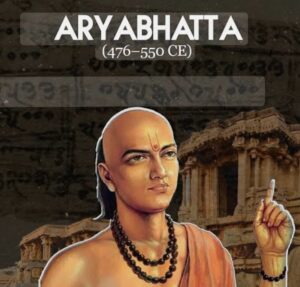
Aryabhata, born in 476 CE, stands as one of the most innovative thinkers of early Indian astronomy. His compact treatise, the Aryabhatiya, written around 499 CE, marks a significant milestone in global scientific thought, particularly for its assertion that the apparent motion of the heavens results from the Earth’s rotation on its axis. This notion, which would not be fully accepted in the Western world until the time of Copernicus a millennium later, underscores the conceptual maturity of classical Indian astronomy. Aryabhata’s argument, especially articulated in the Golapada section of the Aryabhatiya, demonstrates an empirical understanding of celestial mechanics, conveyed through concise verses and vivid analogies.
Structure of the Aryabhatiya and the Earth’s Rotation
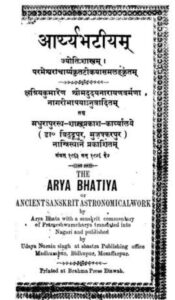
The Aryabhatiya is structured into four distinct sections with each comprising a self-contained system of astronomical knowledge. The Gitikapada addresses cosmology and units of time, the Ganitapada explores mathematics including algebra and geometry, the Kalakriyapada deals with calendrical calculations, and the Golapada, which is of primary interest in the field of astronomy, focuses on spherical astronomy and the modeling of celestial phenomena. Within the Golapada, Aryabhata explicitly states that the westward movement of stars is not a cosmic truth but an illusion created by the eastward rotation of the Earth. This is eloquently captured in a verse that compares the motion of stars to the illusion perceived by a person on a moving boat who sees stationary objects on the shore as moving backward. This analogy is striking not only for its simplicity but also for its accurate depiction of relative motion which is a concept at the heart of classical mechanics.
Numerical Accuracy in Astronomical Calculation
Aryabhata does not only offer this revolutionary idea in poetic abstraction, he backs it with rigorous numerical values that exhibit an astonishing degree of precision for his time. In the Gitikapada, he states that the number of Earth rotations in a mahayuga (4.32 million years) is 1,582,237,500. From this, one can derive a sidereal day length that aligns remarkably well with modern calculations, i.e. approximately 23 hours, 56 minutes, and 4.1 seconds, differing by less than a hundredth of a second from current estimates. Furthermore, Aryabhata calculated the length of the sidereal year to be 365 days, 6 hours, 12 minutes, and 30 seconds, with a deviation of merely three minutes from modern observations.
Understanding Sidereal and Solar Days
Understanding the distinction between a sidereal day and a solar day was crucial to Aryabhata’s astronomical model. The sidereal day is defined as the time taken for the Earth to rotate once relative to the fixed stars, while the solar day is based on the Sun’s apparent motion. Aryabhata’s planetary models and calendrical systems rely on sidereal measurements, revealing a sophisticated grasp of orbital dynamics. While Aryabhata adhered to the geocentric model prevalent in Indian and other ancient astronomical traditions, he introduced the Earth’s axial rotation to explain the daily rising and setting of celestial bodies. This was a significant conceptual advance, bridging observational astronomy and theoretical modeling.
Reception and Debates Among Indian Astronomers
Despite the brilliance of Aryabhata’s hypothesis, its reception among subsequent Indian astronomers and commentators was mixed. Bhaskara I, one of Aryabhata’s earliest followers, provided a commentary on the Aryabhatiya but often hedged on the implications of Earth’s rotation. Brahmagupta, a prominent 7th-century astronomer, openly rejected Aryabhata’s view, affirming instead the traditional belief in a stationary Earth. Varahamihira, another major figure of the same era, also dismissed the idea. The reluctance to embrace Earth’s motion reflects a broader pattern in the history of science, where innovative hypotheses often encounter resistance from entrenched paradigms.
Manuscripts, Commentaries, and Transmission
Manuscript traditions and commentary schools played a significant role in shaping the interpretation of Aryabhata’s ideas. The Brahma school, which preserved several authoritative palm-leaf manuscripts of the Aryabhatiya, consistently included the count of Earth’s revolutions as stated by Aryabhata. These manuscripts confirm that Aryabhata intended his numbers literally, not metaphorically. Yet many later commentators misread these figures, attributing them to observational illusions or rhetorical devices. The multiplicity of interpretations underscores the challenges of preserving and transmitting scientific knowledge across generations and philosophical contexts.
Influence on Islamic Astronomy and Kerala School
Aryabhata’s influence, however, was not confined to India. His works were translated into Arabic during the Islamic Golden Age, influencing scholars such as Al-Khwarizmi and Al-Biruni. Elements of his sidereal models and trigonometric techniques found their way into Islamic astronomy, where they were further developed and incorporated into observational practices. Within India, the Kerala school of astronomy, flourishing between the 14th and 17th centuries, absorbed Aryabhata’s ideas and extended them. Scholars such as Haridatta and Nilakantha not only accepted Earth’s rotation but also employed it in developing more accurate astronomical models and calendar systems.
Comparative Analysis with Western Astronomy
Comparing Aryabhata with Western traditions reveals intriguing parallels and divergences. While Greek astronomers such as Aristarchus of Samos had speculated on heliocentrism, the dominant Ptolemaic system maintained a geocentric cosmos with celestial spheres revolving around a stationary Earth. Aryabhata, working independently, introduced Earth’s rotation into a geocentric framework to explain diurnal phenomena. His explanation through analogies and computations provides a precursor to the Copernican Revolution, though without displacing the Earth from the cosmic center.
Broader Contributions and Legacy
The legacy of Aryabhata is manifold. His contributions to trigonometry, algebra, and calendrical science laid the foundations for subsequent developments in Indian mathematics and astronomy. More importantly, his assertion of Earth’s rotation stands as a testament to the power of theoretical reasoning grounded in observation. That he could conceive such an idea in the 6th century CE speaks volumes about the depth and originality of Indian scientific thought. Today, his name adorns India’s first satellite, Aryabhata, symbolizing a renewed recognition of this pioneering figure.
Conclusion
Aryabhata’s articulation of Earth’s axial rotation is not merely a historical curiosity but a profound scientific insight that prefigured later global developments. His use of analogical reasoning, backed by precise computations and embedded in a coherent cosmological framework, illustrates the sophistication of ancient Indian astronomy. While his ideas were initially contested, they endured through manuscript traditions and found resonance in later astronomical schools both within and outside India. Aryabhata’s work exemplifies the best of scientific inquiry as it was curious, bold, and deeply rooted in empirical observation. His legacy continues till this age as his work in the global and historical dimensions of science remains as relevant as ever.
References
1. K. V. Sarma (1997). “Āryabhaṭīya of Āryabhaṭa: With the Commentary of Bhāskara I and Some Later Commentators.” INSA.
2. Pingree, David. (1970). “The Sanskrit Astronomical Tables in Arabic Translation.” Journal of the American Oriental Society.
3. Subbarayappa, B.V. (2008). “Science in India: Evolution through the Ages.” National Book Trust, India.
4. Ansari, S.M. Razaullah (2002). “History of Oriental Astronomy: Proceedings of the Joint Discussion.” Springer.
5. Abhyankar, K.D. (1993). “Aryabhata and the Motion of the Earth.” Bulletin of the Astronomical Society of India.
6. Plofker, Kim (2009). “Mathematics in India: 500 BCE–1800 CE.” Princeton University Press.