

By Tehreem Asad
In May 1694, the crew of an English ship, the Charles the Second, mutinied under the leadership of Henry Every (also spelt Avery). The ship was renamed ‘Fancy’, and for the next few months, Every and his crew travelled southwards along the African coast, looting many other smaller ships, till they reached Johanna (Anjouan), Comoros Islands. Before leaving the island on 29th February 1695, Every left a letter with a trustee with the instruction to pass the letter to the next vessel belonging to the English East India Company. In the letter, he wrote:
‘Riding here at this instant in the Ship Fancy Man of War, formerly the Charles of the Spanish expedition, who departed from Croniae the 7th of May 1694 Being (and am now) in a Ship of 46 Guns, 150 men, and bound to seek our Fortunes.’
From there, Every and his crew headed towards the Red Sea. On their way, they sacked the town of Maydh, currently in Somaliland. Finally, they reached near Bab al-Mandab strait, where for five weeks they awaited the Mughal pilgrim fleet travelling bound for Surat. The ships on their return journey were sure to be full of riches and valuable possessions and were presumably the richest prize in Asia or perhaps even in the world.
A written testimony by one of the crew members, Phillip Middleton, informs us that the crew got intelligence that two rich ships bound for Surat were in Mocha. In September 1695, the crew of Fancy finally encountered a grand Mughal convoy of around 25 ships. Two ships got separated from the fleet: the Fateh Mohammed, belonging to Abd-ul Ghafur, and the other, the biggest, most heavily armed, and perhaps the most rewarding ship of the fleet, the aptly named Ganj-i-Sawai (meaning exceeding or infinite treasure). Ganj-i-Sawai was returning to Surat filled with an abundance of wealth, jewels, goods for trade and, according to the account of Khafi Khan, ‘fifty-two lacs rupees worth of cash, gold and Spanish rials’. The encounter of Ganj-i-Sawai and English pirates resulted in one of the most historic recorded acts of piracy and plunder.
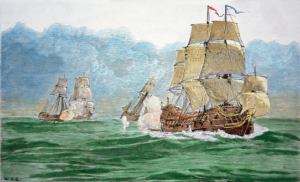
Ganj-i-Sawai being chased by Every’s fleet. The ship is mistakenly depicted as an East Indiaman.
(Courtesy: https://en.wikipedia.org/wiki/Ganj-i-Sawai#/media/File:Avery_Chasing_the_Great_Mughal’s_Ship.jpg)
BACKGROUND:
The Mughal Emperor Akbar conquered Gujarat in 1573 and, by the 17th century, Surat became the most important port in Western India. The port was essential in maintaining trans-regional commercial, religious, and political connections. Not only did it facilitate a remarkable quantity of trade, but it also functioned as the convening point for numerous travellers going on a pilgrimage to Mecca to perform Hajj. This made the sea route between the Red Sea and the port of Surat vital, especially because starting in 1576 with the ships Ilahi and Salimi, the Mughals annually sponsored Hajj fleets carrying pilgrims to the Red Sea. However, Mughal vessels travelling through this route often had to confront the Portuguese. The Portuguese introduced the cartazes licensing system in the 16th century, which imposed their trading monopoly over the Indian Ocean and forbade any vessel from sailing in the Indian Ocean without a Cartaz (the trade license/pass). Abu’l-Fazl writes in Ain-i Akbari that the Portuguese were a ‘stumbling-block in the way of the pilgrims to the Hijaz’.
The reigns of Emperors Jahangir, Shah Jahan, and Aurangzeb saw a period where the Mughals had to compete with several maritime competitors, including the Portuguese, the British, and the Marathas. Beyond threats from these groups, the 17th century saw an upsurge in European pirates seeking fortune in the Western Indian Ocean, leading to a period labelled by many as the ‘golden age of piracy’. In addition to raiding merchant ships of the European East Indian trading companies, pirates also attacked the Mughal-sponsored Hajj fleets that sailed between Surat and Mocha (Yemen). These Hajj fleets would primarily serve the function of carrying the pilgrims, but they would also typically carry merchant cargo. Several merchants, as well as pilgrims, sold goods during Hajj, which meant that on the return journey to India, they would carry a significant amount of wealth, including gold and silver, which made capturing these ships extremely profitable.
THE SHIPS OF MARIAM-UZ-ZAMANI
Empress Mariam-uz-Zamani, known popularly by her misnomer Jodha Bai, was the chief consort of Emperor Akbar and the mother of Emperor Jahangir. Her powerful position in the imperial Mughal court meant that she had considerable authority and possessed a substantial personal treasury. The empress also engaged in commercial activities with local as well as European traders, trading in silk and spices. Her first ship, called Rahimi, carried, along with pilgrims, goods for trade. It was considered to be the largest vessel trading in the Red Sea at the time. In September 1613, Rahimi was heading back to India from Mecca with pilgrims as well as a large quantity of gold and silver. It was raided by the Portuguese, even though the Mughal had already paid a ‘protection fee’. The ship was attacked, people were robbed, women were sexually assaulted, and some of the passengers were killed.
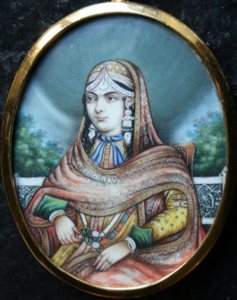
A 19th-century sketch of Mariam-uz-Zamani
(Courtesy: https://en.wikipedia.org/wiki/Mariam-uz-Zamani#/media/File:Posthumous_portrait_of_Mariam_uz-Zamani.jpg)
Portugal and England produced several pirates in this period that operated both with and without the backing of their governments. The Portuguese had even established a form of organised and state-sanctioned piracy. It is argued that each isolated act of piracy would provide impetus to what would later culminate in the colonisation of the Indian subcontinent. Purportedly, the Portuguese seem to have been engaging in high-seas piracy aimed particularly at the Mughal Empire because their maritime control was being challenged by other European nations. Other reasons, like frustration over a possible entente between the Mughals and the English and religious persecution, have also been suggested for this act of Portuguese piracy.
Naturally, this incident infuriated the then-emperor Jahangir and resulted in a severe and harsh response, involving measures like a complete halt to trade with Portugal, shutting down of churches, imprisonment of traders, etc. Following this incident, Mariam-uz-Zamani ordered the construction of an even larger ship with 62 guns and an arrangement for more than 400 musket men, making it one of the most intimidating ships of its time. This ship was Ganj-i-Sawai.
RECONSTRUCTING THE PLUNDER OF GANJ-I-SAWAI
Following the attack, the captain of the Ganj-i-Sawai, Muhammad Ibrahim, wrote a letter to Emperor Aurangzeb detailing the devastation of the ship. The letter explains that Ganj-i-Sawai set sail from the port of Mocha, where the news came that the English pirates had been spotted near this area. The captain made the decision to fall back to Jeddah in order to avoid an attack from the pirates. He then recounts in the letter that the English ship proceeded to attack the nearby areas, which is possibly a reference to the sacking of Maydh.
Unbeknownst to the travellers of the imperial ship, Every and his crew had anchored at Perim Island, waiting for a pilgrim convoy. He was joined by five other vessels here, and they decided to work as partners and cooperate in the attack with Every as the captain. They, however, were spotted by a merchant vessel, which warned the Mughal fleet. The twenty-five ships of the Mughal convoy were able to escape the marauders at night. However, in the morning, the pirates came to know of this and began to chase the fleet. Within a few days, they were able to catch up to Fateh Muhammad, which they successfully looted. Their next target was Gunsway (Ganj-i-Sawai), which was immense in size, heavily armed, and carried soldiers and musketeers who greatly outnumbered Every’s crew.
Muhammad Ibrahim mentions that Ganj-i-Sawai and Fateh Muhammad got separated from the convoy once they passed the Bab al-Mandab Strait. The two ships split the soldiers among themselves and agreed to provide mutual protection to one another until they reached Surat. They spotted four ships without flags, which the captain presumed to be of fellow travellers. However, these were the ships of Every and his crew, who drew close to Ganj-i-Sawai, and by the time the English flags were raised, it was too late to avoid the assault. Ganj-i-Sawai fired on the pirate ships, which caused one of the cannons on the ship to blow up. This caused confusion on the deck. In response, Every’s ship fired and struck the Mughal ship’s main mast, which left it unmaneuverable. Ganj-i-Sawai was able to withstand the attack for a few hours, killing a few of their attackers. Ultimately, the pirates pulled up next to the vessel and swarmed the ship. The letter by Muhammad Ibrahim lamented that it was a hopeless battle.
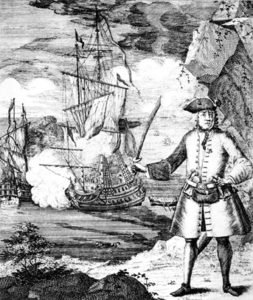
An 18th-century depiction of Henry Every, with the Fancy shown capturing the Grand Mughal Fleet
(Courtesy:https://en.wikipedia.org/wiki/Henry_Every#/media/File:Henry_Every.gif)
A member of the crew of Every left a testimony, written in August 1696, which recounted how the ship was pillaged. He stated that the pirates kept the ship at sea for two days and looted it during this time. According to him, it took a while for them to clear out all the loot because travellers had hidden their treasure and they would not tell the crew about its whereabouts, even after they were tortured. Nonetheless, the pirates secured one of the largest hauls in history and were able to take away a huge quantity of treasure, jewels, and wealth. The plunder of Ganj-i-Sawai is also mentioned in the chronicle written by Khafi Khan in c.1732 called Muntakhab ul-Lubab. About the events of the attack on Ganj-i-Sawai, he writes:
‘When they· had laden their ship, they brought the royal ship to shore near one of their settlements, and busied themselves for a week searching for plunder, stripping the men, and dishonouring the women, both old and young. They then left the ship, carrying off the men. Several honourable women, when they found an opportunity, threw themselves into the sea to preserve their chastity, and some others killed themselves with knives and daggers’.
The description of robbing, torturing, and killing the passengers and the sexual assault faced by the women on board has been constant in almost all of the sources detailing the event. Unlike the testimony of Phillip Middleton, Khafi Khan claims that Ganj-i-Sawai was plundered for almost a week. According to him, it was the cowardice of Captain Ibrahim Khan and the lack of resolute leadership that led to the destruction of the ship, since it was way larger and better equipped than the vessels of the pirates. He was also very convinced of the involvement of the East India Company in the plunder, despite the English chief denying this claim, since his friends who were on the ship at the time of its capture told him that the pirates wore English attire.
AFTERMATH:
The damaged vessels, Ganj-i-Sawai and the Fateh Mohammed, stripped of their wealth, returned to Surat in late 1695. Soon, the news of their ransacking reached the Emperor as well as the local community. The attack on the imperial ship carrying pilgrims from Mecca was seen as a brutal act of violence and was met with public resentment. The event not only enraged the people on account of violence but also hurt their religious sentiments since the passengers of the ship were mainly pilgrims. To avoid violence, the governor of Surat sent out soldiers to stop the murder of Englishmen. He placed the president of the factory of the East India Company, Samuel Annesley, along with several other employees under house arrest. Eventually, they were transferred to prisons where they were bound in iron chains to prevent escape. Agents of the English East India Company in Surat were also imprisoned, and many imprisoned Englishmen reportedly died due to the terrible conditions they were kept in. The news infuriated Emperor Aurangzeb, who condemned the English as criminals. He ordered a complete halt to the trade with the English, seizing their trading posts and goods, and preparing an army to attack the British stronghold at Bombay. The situation risked a total eviction of the British from India by the Mughals, threatening their lucrative trade. The English sought to persuade the Emperor to withdraw his severe orders through the intervention of Wazir Asad Khan on the condition that they would compensate for the massive loss endured and search and punish the pirates.
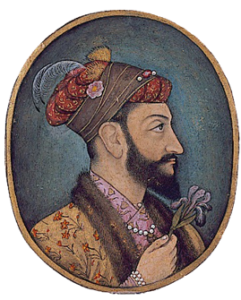
Aurangzeb, c. 1650
(Courtesy:https://en.wikipedia.org/wiki/Aurangzeb#/media/File:Face_detail_(2),_Aurangzeb_Bahadur_holding_an_iris_(6124502565)_(cropped).png)
The news also reached the East India Company in England, where it was met with horror. They desperately inundated the government in London to take action. The Privy Council issued a proclamation in July 1696, which denounced Henry Every and his crew as pirates. The government launched what is seen by many as the first global manhunt and offered a £500 reward for each member of Every’s crew captured. The East India Company, similarly, offered an additional £1,000 per head bounty.
Ultimately, the harshest orders were eventually reversed by the emperor. However, trade with European nations did not start for a while, and after the incident, continued pressure remained on European interests. The English, the French, and the Dutch were instructed to send ships to catch the pirates or risk having to refund the losses of the Ganj-i-Sawai themselves. They were also required to protect Indian ships. On January 6, 1696, Samuel Annesley agreed to a bond promising to provide a convoy to safeguard upcoming pilgrim fleets in the Red Sea. However, despite this commitment, the East India Company prisoners in Surat were not freed until June 27, 1696, enduring almost a year in detention.
As for Every and his crew, they disbanded in the Caribbean in April 1696. Fourteen of his crew members were arrested, of whom six were hanged following a series of highly publicized trials. These members were found innocent of the charge of the plunder of the Ganj-i-Sawai , since it did not constitute a crime under English law. However, they were convicted of mutiny. Henry Every himself was never found. This led him to become the subject of many legends, stories, and fictional accounts, such as the 1713 play ‘The Successful Pyrate’ and Daniel Defoe’s ‘The King of the Pirates’. Several rumours circulated about his life and death. While Henry Every vanished into legend, the event shook the Anglo-Mughal relations. It brought the Mughal Empire and the English East India Company to the brink of rupture, triggered one of the earliest global manhunts, and compelled European powers to assume greater responsibility for maritime security.
BIBLIOGRAPHY:
1. Kynn, Tyler Joseph. “Pirates and Pilgrims: The Plunder of the Ganj-i Sawai, the Hajj, and a Mughal Captain’s Perspective.” Journal of the Economic and Social History of the Orient, vol. 64, no. 1/2, 2021, pp. 93–122.
2. Naz, Darakshshan. “DISRUPTING MUGHAL MARITIME CONNECTIVITY: PIRACY AND PLUNDER AGAINST THE MUGHAL SHIPS RAHIMI AND GANJ-I SAWAI.” Proceedings of the Indian History Congress, vol. 82, 2023, pp. 502–12.
3. Rogozinski, Jan. Honor Among Thieves: Captain Kidd, Henry Every, and the Pirate Democracy in the Indian Ocean. Stackpole Books, 2000.
4. Govil, Aditi. “MUGHAL PERCEPTION OF ENGLISH PIRACY – KHAFI KHAN’S ACCOUNT OF THE PLUNDER OF ‘GANJ-I SAWAI’ AND THE NEGOTIATIONS AT BOMBAY, 1694.” Proceedings of the Indian History Congress, vol. 61, 2000, pp. 407–12.
5. Safdar, Aiysha, and Muhammad Azam Khan. “History of Indian Ocean-A South Asian Perspective.” Journal of Indian Studies, vol. 7, no. 1, 2021, pp. 183–200.
6. https://www.historic-uk.com/HistoryUK/HistoryofEngland/Henry-Avery-Every-King-Of-Pirates/
7. https://www.worldhistory.org/Henry_Every/




















,_Aurangzeb_Bahadur_holding_an_iris_(6124502565)_(cropped).png)