
By Anusha Khan
The eighteenth century is often remembered as a period of decline, with Delhi imagined in ruins, decadent, and stripped of its former splendor. Politically, this was true: the Mughal center weakened, invasions and internal disturbances created turmoil and decay. Shahr Ashob poetry reflects this, lamenting cultural collapse and satirizing corrupt elites. Strikingly, beyond these elite narratives, another picture emerges of a Delhi still teeming with life, where ordinary people, as well as the nobility, contributed to a shifting, vibrant cultural scene.
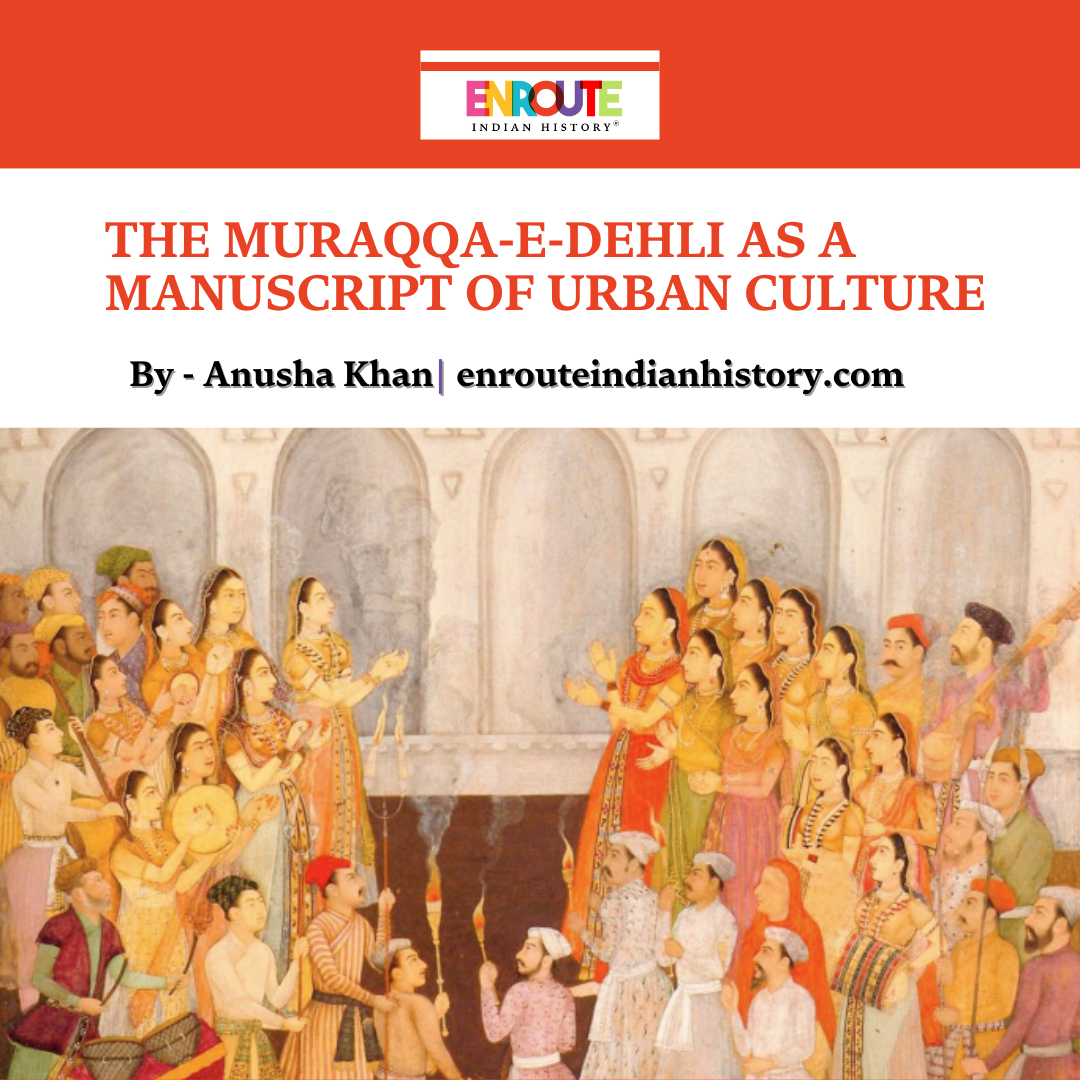
With this broader perspective we turn to Dargah Quli Khan’s Muraqqa-e-Dehli (1738-41) which takes us through the lanes of the city where we encounter an urban world that appears paradoxical; grieving under calamity, yet bursting with poetry, music, and festivity. As Rohma Rashid observes, this tension between grief and festivity defined ordinary existence in the capital. Reading the Muraqqa as a manuscript of urban culture allows us to recover this resilience, to hear the voices absent from imperial chronicles, and to see Delhi itself as an album of diverse, overlapping cultural fragments.
Folio I: The Chronicler and His Album
Dargah Quli Khan was born in 1710 in Aurangabad, into a Persian family that had migrated to India in the seventeenth century. At fourteen, he entered the service of Nizam-ul-Mulk Asaf Jah I, the powerful Mughal governor of the Deccan. When Asaf Jah travelled to Delhi between June 1738 and July 1741, Khan accompanied him as part of his retinue and was a witness to the capital both on the eve of Nadir Shah’s devastating invasion of 1739 and in its aftermath.
During this stay, Khan kept a detailed record of his observations. His account, originally titled the Risalah-i Salar Jung, was later published in 1926 as the Muraqqa-e-Dehli. The title muraqqa—meaning patchwork or album—is apt, for the work assembles fragments of Delhi’s life in the manner of the albums of paintings and calligraphy prized in Mughal culture. His descriptions move seamlessly from Sufi shrines and urs ceremonies to bustling markets, festivals, and processions, and from musicians, dancers, and courtesans to poets and scholars at the heart of Delhi’s literary world.
What makes the Muraqqa distinctive is precisely the way Khan moved between worlds. Linked to the court through his service to the Nizam, yet curious enough to wander shrines, bazaars, and salons, he recorded both elite and everyday life. The result is a manuscript where the brilliance of Mughal culture stands out all the more sharply against the turbulence of political decline.
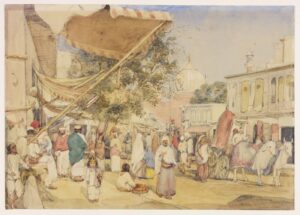
Carpenter, William. View of the Bazaar at the Back of the Jami Masjid, Delhi. 1856, Delhi. Painting.
Folio II: The Bazaar—Spectacles of Trade and Wit
The bazaars of Shahjahanabad come alive in the Muraqqa, densely crowded with figures, colors, and commotion. For Dargah Quli Khan, these markets were not only centers of trade but also stages of spectacle, where the city’s social and cultural life unfolded in full view. Two great markets—Chandni Chowk and Chowk Sa’adullah Khan—sat between the Jama Masjid and the Red Fort, serving as the city’s most important predominantly male social spaces.
Chandni Chowk, originally laid out by Jahanara Begum, retained its splendour in Khan’s account. Shops overflowed with goods from across India, the Middle East, and Europe: precious gems, perfumes, porcelain, weapons, and fine textiles, enough for a lakh of rupees to be spent in a single day. The squares teemed with storytellers, astrologers, pavement doctors, and hawkers of every sort. Alongside merchants, qahwa-khanas (coffee houses) buzzed with poetry recitations, while aristocrats passing to mosque or palace mingled freely with artisans, hawkers, and entertainers. As Khan observed, “young good-looking men danced everywhere and created great excitement…whenever one lifts one’s eyes, the gaze glides over the beauty of a moon-faced one.”
Chowk Sa’adullah Khan offered a far more raucous scene. Notorious for spurious goods, endless sellers of medicines for hidden ailments, and stalls of exotic birds, its lanes overflowed with astrologers, storytellers, and pavement doctors, filling the air with noise and clamor. Khan depicts it as chaotic, unruly, and irresistibly amusing; even those of gentle birth could not resist its attractions, though they often pretended to pass by on some other pretext. Together, the two markets reveal Delhi as a city of contrasts: elegance and disorder, trade and spectacle, elite and popular life coexisting in a single, crowded theatre.
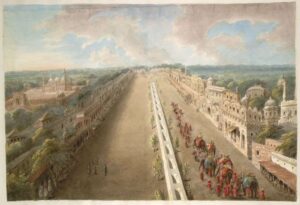
Watercolor representation of an idealised view of the Chandni Chowk from the top of the Lahore Gate of the Fort, with the Nahr-i Bahisht depicted running down the middle. Executed by Sita Ram. Circa 1814-15.
Folio III: Shrines—The Carnivalesque Devotion of Delhi
If the bazaars of Shahjahanabad were crowded folios of trade, wit, and performance, the shrines inscribed a different but equally dense page of the city’s life. Around saints’ graves and sacred relics, devotion mingled with festivity, as the belief in a saint’s barakka (grace) drew devotees seeking blessing while turning the dargah into a bustling theatre where the sacred and the profane coexisted.
The most important ritual was the urs, literally the saint’s “marriage,” celebrated on the anniversary of his death when he was believed to unite with the divine beloved. At Khuld Manzil, Khan describes an atmosphere charged with indulgence: lovers embracing in every corner, public drinking without fear of censure, young men dazzling onlookers with their beauty and ardor. “Wherever the gaze falls you see love-stricken faces,” he writes, “and when a person comes back to his senses, a youth winks at him, and by the time his eyes light up, some wretch sends her message”. Nobles and commoners crowded together in this carnival of pleasure, accompanied by singers, dancers, and beggars in numbers “greater than flies and mosquitoes.”
Other festivals revealed the same blending of piety and revelry. The Prophet’s birthday was celebrated with great pomp at the Arab ki Sarai, where eulogies and Qur’an recitations filled the night, but where, as Khan wryly noted, many came as much to gaze upon the “Arab lads” as to worship. The spring festival of Basant brought a week of exuberance, beginning with homage to a footprint of the Prophet and culminating in music, dance, and intoxication. Khan depicts musicians and dancers entering “accompanied by beautiful people who sprinkled perfumes on the waiting spectators,” while rows of young singers offered songs to the relic. On the final day, dancers bathed the grave of a beloved with liquor and performed ceaselessly through the night, transforming the ritual into a riot of color and sound.
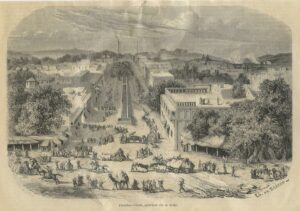
Old view of Chandni Chowk. Courtesy of the heritage lab.
Folio IV: Desire—Theatres of Performance and Pleasure
In Khan’s Muraqqa, another set of folios opens onto scenes of desire, performance, and pleasure, each portrait sketched with the intimacy of someone moving through Delhi’s social worlds. From noble mansions to crowded streets and courtesans’ salons, the city itself becomes a theatre where beauty, performance, and spectacle intertwine.
Among the nobles, Azam Khan, son of Fidwi Khan, turned his residence into a house of spectacle, surrounding himself with boys of extraordinary beauty, “like coins tested in the furnace of desire.” Mirza Munun, famed for his seductive skill, could in Khan’s words “organize gatherings of ghilman [the beautiful boys of paradise],” weaving evenings of charm and dalliance. The emperor’s favorite, Taqi, presided over a “house of wonders” where dancers swayed like petals and downy-cheeked youths cast glances as sharp as arrows. Grief too was transformed into performance: marsiya reciters such as Mir Abdullah and Jani Hajjam staged mourning for Imam Husain as aesthetic display, turning lament into performance.
From the interiors of mansions, desire spilled into the city’s open spaces. Outside the Red Fort, Miyan Hinga, dressed in white “like moonbeams scattered at dusk,” held passersby captive with his movements until they abandoned their errands. Sultana, barely twelve, bewitched audiences with song and dance, “a candle-flame claiming equality with the sun.” On the banks of the Yamuna at Reti Mahabat Khan, wrestling matches drew crowds as much for the beauty of the athletes as for their skill, their glistening bodies becoming another spectacle of the city.
Women, too, commanded this theatre of performance. Courtesans such as Rehman Bai, Asa Pura, and Kamal Bai dazzled with music, dance, and wit, their adab making them companions as prized as they were enchanting. Some blurred boundaries between elite and popular culture: Kamal Bai, once exclusive to the emperor, opened her doors to the bazaar. By mid-century, mehfils had begun to eclipse mushairas, their evenings thronged with qawwals, dancers, and storytellers where nobles mingled freely with townspeople in nights of repartee and song. Taken together, these portraits reveal a panorama of Delhi’s evenings, where nobles and courtesans, dancers and wrestlers, grief and pleasure continually overlapped, binding the city in theatres of beauty and desire.
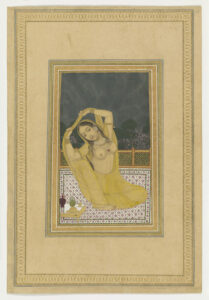
A night-time scene of a courtesan seated upon a terrace with a garden behind, late 18th century. Courtesy of Royal Collection Trust.
Khan’s Muraqqa reveals a Delhi that defies the idea of a fading capital. Even as imperial fortunes waned, its bazaars buzzed with trade and wit, its shrines combined devotion with carnival, and its gatherings turned grief into art and desire into spectacle. By placing nobles and courtesans alongside hawkers, wrestlers, and street performers, Khan captures a city alive with everyday energy, where ordinary lives shimmered amid political turbulence. What emerges is not merely a record of spectacle, but a portrait of resilience: a Delhi where the city itself became theatre, and its people—in all their eccentricity and endurance—were the ornaments that kept it vibrant.
References
Khan, Dargah Quli. Muraqqaʻ-e-Delhi: The Mughal Capital in Muhammad Shah’s Time. Translated with an introduction and notes by Chander Shekhar and Shama Mitra Chenoy, Deputy Publications, 1989.
Kidwai, Saleem. “Dargah Quli Khan: Portrait of a City (Persian).” Same-Sex Love in India, edited by Ruth Vanita and Saleem Kidwai, Palgrave Macmillan, 2000.
Rashid, Rohma Javed. “Tumultuous Times: Crisis, Culture and the City of Shahjahanabad in the Eighteenth Century.” Social Scientist, vol. 45, no. 7–8, July–Aug. 2017.