

The Mystery of the Narmada Man: Hathnora, the Only Hominid Fossil Evidence from India
- March 23, 2026
By Saiee Katkar
In 1982, on the banks of the Narmada River in Madhya Pradesh, a fossil skull was discovered at Hathnora village. This skull is known today as the Narmada Man. It is important because it is the only hominid fossil ever discovered in India. Africa, China, and Indonesia are famous for their many early human fossils, but India has produced just this one. This makes the Narmada Man both rare and mysterious.
The story of this fossil is not just about bones buried in the ground. It is about questions of identity, science, and history. What kind of human was the Narmada Man? Why have we found only one fossil in a country as vast as India? And what does his story mean for how we see our place in human evolution? These questions turn a single skull into a mystery that continues to fascinate scientists and students alike.
Discovery at Hathnora
The fossil was discovered by Arun Sonakia, a geologist working with the Geological Survey of India. While studying the gravels of the Narmada River, he noticed a fossilized skullcap. It was later identified as belonging to a hominid, and soon became one of the most important paleoanthropological discoveries in South Asia (Sonakia and de Lumley 354).
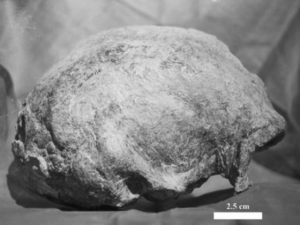
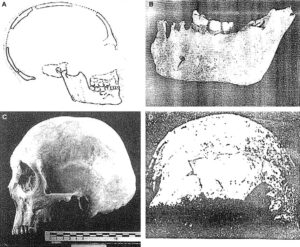
The fossil was not complete. It was only part of the cranium, but even this fragment carried enough information to spark major debates. Over the years, a few other fragments like a clavicle and some limb bones have also been reported from the Narmada valley (Sankhyan 236). Still, no other hominid skull has been found in India, making the Hathnora skull unique.(Figure 1)
Features and Dating
The Narmada Man is dated to the Middle Pleistocene period, which means he lived around 200,000 to 300,000 years ago (Patnaik et al 115). This places him in the same broad time frame as other famous fossils such as Peking Man in China and Java Man in Indonesia.
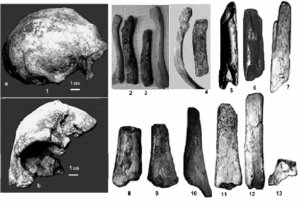
When scientists studied the fossil, they noticed that it had a mix of features. The cranial bones are very thick, and the brow ridges are large and heavy. These are traits often seen in Homo erectus. But at the same time, the brain size of the Narmada Man was estimated between 1200 and 1400 cubic centimetres, which is close to modern humans (Homo sapiens) (Athreya 138). This unusual mix made classification very difficult.(Figure 2).
Some scientists, including Sonakia himself, described it as Homo erectus narmadensis (Sonakia and de Lumley 356). Others, like Shanti Pappu and S. Athreya, suggested that it might be closer to Homo heidelbergensis, a species thought to be a bridge between erectus and sapiens (Athreya 144). This debate continues today. What makes the fossil mysterious is that it seems to be standing at a crossroads of evolution, showing both primitive and advanced traits.
The Global Puzzle
If we compare the Narmada Man with fossils from other parts of the world, the puzzle grows even larger. Africa is often called the “cradle of humankind” because many early fossils have been found there, like those in Ethiopia and Kenya. China has its Peking Man, found at Zhoukoudian, while Indonesia has Java Man. These sites have given dozens of fossils, forming clear evolutionary sequences.
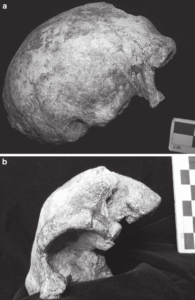
India, however, has only this one. Geographically, India lies between Africa and East Asia. It is natural to expect that ancient human passed through this land. The features of the Narmada Man, partly erectus-like, partly sapiens-like make him look like a missing link between these regions (Figure 3).
Some scholars, like Sonakia and de Lumley, even suggested that he could be a possible ancestor of modern Indians (Sonakia and de Lumley 357).
This possibility makes the fossil very important. It shows that India was not just a passage for migrating humans but might also have been a home where evolution continued.
Why Only One Fossil?
The biggest mystery is not the fossil itself, but the silence around it. Why has India yielded only one hominid skull when other regions have given so many?
There are a few reasons. First, fossils need special conditions to survive. They are usually preserved in caves or lake deposits. Much of central India is covered in hard soils and river gravels, which do not always allow fossils to survive (Mishra 2). This makes discoveries very rare.
Second, research in India has often been limited. After the discovery of the Hathnora skull, some surveys were done, but they were ‘sporadic’ and not always systematic (Sonakia and de Lumley 354). In contrast, Africa and China have seen decades of dedicated excavation projects that uncovered many fossils.
Third, many fossils may still be hidden. The Narmada basin is rich in stone tools from the Acheulian culture handaxes, cleavers, and flakes. It has also given animal fossils from the Pleistocene period. These show that humans lived and hunted in this region. If tools and animals survived, then perhaps more human fossils are buried there, waiting to be found (Mishra 3).(Figure 4)
Why Does It Matter Today ?
The Narmada Man is more than a scientific curiosity. For India, he is a symbol of prehistoric identity. In most textbooks, we read about Africa as the birthplace of humans and China or Indonesia as places where early humans thrived. India is often left out of this story. The Narmada Man challenges this gap. He shows that India too was part of the evolutionary stage.
This matters today because it reminds us that Indian prehistory is important to the world. It also calls for pride and responsibility. If we only have one fossil, it must be studied and preserved with great care. And we must invest more in research so that the story of India’s ancient humans can be uncovered further.
For students like me, the Narmada Man is a reminder that history is not only about kings and empires. It is also about deep time, about people who lived hundreds of thousands of years ago. This fossil is part of who we are, even if we do not yet fully understand him.
Conclusion
Today, the skull of the Narmada Man is kept at the Anthropological Survey of India in Kolkata. It may look like a fragment of bone, but it carries with it enormous meaning. It tells us that humans once lived in India long before recorded history. It tells us that India was not empty in the prehistoric past, but a land where important stages of evolution happened.
The mystery of the Narmada Man is not only about his species. It is also about his loneliness. Why is he the only fossil? Was India home to a separate branch of humans now extinct? Was it a corridor between Africa and East Asia? Or is the real story still hidden beneath the soils of the Narmada valley?
Whatever the answers, the Narmada Man matters. He is India’s only direct witness to human evolution. He is both a scientific puzzle and a cultural symbol. Most of all, he is an invitation to search deeper, to research harder, and to give India’s prehistory the attention it deserves.
References
● Athreya, S. “Was Homo heidelbergensis in South Asia? A Test Using the Narmada Fossil from Central India.” American Journal of Physical Anthropology, vol. 147, no. 2, 2012, pp. 137–150.
● Mishra, Sheila. The Narmada River in Indian Prehistory. Deccan College, 2016. ResearchGate.
● Patnaik, Rajeev, et al. “New Geochronological, Paleoclimatological, and Archaeological Data from the Narmada Valley Hominin Locality, Central India.” Journal of Human Evolution, vol. 56, no. 2, 2009, pp. 114–133.
● Sankhyan, A.R. “Evolutionary Perspective on Narmada Hominin Fossils.” Advances in Anthropology, vol. 10, no. 3, 2020, pp. 235–258.
● Sonakia, Arun, and Henry de Lumley. “Narmada Homo Erectus – A Possible Ancestor of the Modern Indian.” Comptes Rendus Palevol, vol. 5, no. 1–2, 2006, pp. 353–357.
● Figure 1. Lateral view of the Narmada skullcap (Hathnora fossil). Photograph by A. Sonakia. Source: Athreya, 2012 (American Journal of Physical Anthropology).
● Figure 2. Collection of Narmada hominin fossil fragments (calvaria, clavicle, ribs, femora, humeri). Source: Sankhyan, 2020 (Advances in Anthropology).
● Figure 3. Frontal and lateral views of the skull fossil showing brow ridges and vault thickness. Source: Athreya, 2012.
● Figure 4. Fossil-bearing deposits and associated Acheulian tools from Narmada Valley. Source: Mishra, 2016 (The Narmada River in Indian Prehistory).