
By Anusha Khan
On 15 August 1947, there were two Delhis: one draped in the glow of freedom, the other scarred by the panic and violence of forced migration. In the shadow of waving flags and Red Fort speeches, trains poured into the city carrying families who had left behind homes, neighbors, and entire worlds. Their new journey was marked by loss, uncertainty, and a desperate search for shelter in an unfamiliar city already bursting at its edges, rather than by celebrations of independence.
“Independence is… an abstract thing,” recalled one migrant from Lahore decades later. “It didn’t give you anything tangible. Partition was a very tangible reality…Whenever we met, as a family- for us, it was Partition, not Independence [that counted] …”-Interview, Delhi, March 18, 1995.[1] For thousands like them, the story of 1947 was not one of political birth, but of personal rupture.
Delhi—dilwalo ki Dilli—has always been a city shaped by refugees and migrants. From Central Asia, Persia, Afghanistan, and beyond, waves of people arrived over centuries, each leaving their mark by building the city’s neighborhoods, markets, and skylines. But 1947 was different in scale and nature. Partition turned Delhi into both a place of refuge and a site of bloodshed, its streets echoing with both celebration and screams. The partition intertwined the memories and traumas of refugees with the very walls and monuments of the city.
Refugees and Monuments: A City Transformed
When the refugee trains began arriving in Delhi in August 1947, the city was unprepared for the sheer scale of displacement. Some 4.75 million refugees migrated to India during Partition, of which nearly half a million arrived in Delhi alone. Before 1947, Delhi’s population was around 950,000. Between 1947 and 1951, as the city expanded rapidly, its population nearly doubled to 1.74 million, with Partition refugees making up over 28 percent of that total. As historian Gyan Pandey observes, politically, culturally, and demographically, the Delhi of the 1950s and beyond was a “Partition city.”[2]
In the scramble for shelter, the Ministry of Relief and Rehabilitation turned to Delhi’s most iconic monuments. The sixteenth-century Purana Qila—once a detention site for Japanese internees during WWII—became one of the largest refugee camps. Its courtyards and Mughal barracks were filled with makeshift tarpaulin shelters, charpoys, and cooking fires.[3] Other imperial sites such as Humayun’s Tomb, Safdarjung’s Tomb, Firoz Shah Kotla, and the Arab Sarai, along with smaller mosques and shrines, became homes for thousands who had lost theirs.
This created a striking and often jarring juxtaposition: the grandeur of Delhi’s architectural heritage set against the precarious existence of its new inhabitants. Monumental gateways framed lines of refugees queuing for water from a single tap; intricately carved walls were blackened by soot from cooking fires; and sacred spaces doubled as sleeping quarters and makeshift latrines. Contemporary accounts describe “disorganized tents and heaps of tin roofs” stretching endlessly amid “naked children, unkempt women, and men overcome with anger” wandering in uncertainty.[4]
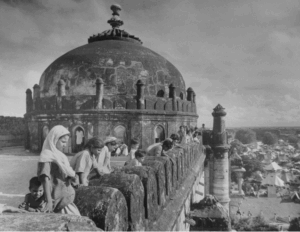
Margaret Bourke-White, Refugees on top of Sher Shah Sur’s sixteenth century Qala-i Kuhna mosque, Purana Qila (November 1947), which was transformed into a school for refugee children, courtesy of The LIFE Picture Collection/Shutterstock
Unequal Lives Within the Camps
Life inside these camps was far from equal. Social hierarchies and communal suspicion accompanied refugees into these shared spaces. Dalit refugees were often pushed to the physical and social margins, crowded into the most unsanitary quarters with poor access to water, medical care, and rations. While some families occupied the more sheltered Mughal barracks, many Dalit families were left to endure the heat and rains in open courtyards or flimsy shacks along outer walls.
Muslim refugees faced a different kind of marginalization. Though many had fled violence from Punjab and western Uttar Pradesh, in Delhi they were frequently viewed with suspicion and “othered” even among displaced populations. They faced stricter policing, reduced resources, and slower rehabilitation. Proposals to segregate camps by religion were considered but never fully implemented. Still, these tensions added to an already precarious existence.[5]
Inside monuments like Humayun’s Tomb and Purana Qila, caste and religion influenced where people slept, the amount of privacy they could claim, and how safely they could move about after dark. The same archways that shelter hundreds could also conceal exclusion and harassment. The Archaeological Survey of India (ASI) condemned what it called the “defilement”[6] of these historic sites, demanding the removal of refugees, yet these protests rarely acknowledged the human cost of eviction. “Restoration” often meant displacing the most vulnerable first.
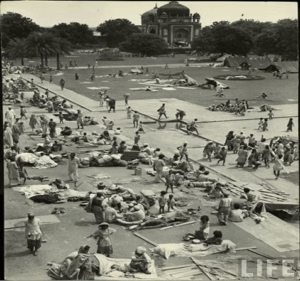
Refugees at Humayun’s Tomb, Delhi in August to Oct 1947. Singh, Ramanjit, photographer. Refugees at Humayun’s Tomb, Delhi. 1947. The Punjab Partition Forum, www.punjabpartition.com/forum/photographs/refugees-at-humayun-s-tomb-delhi.
Overcrowding, poor sanitation, and disease were constant threats, and violence sometimes spilled into the camps with looting, assaults, and communal clashes adding to the fear. Though most refugees were moved out of Purana Qila by the early 1950s, some refused to leave for years. By 1959, nearly 5,000 people still lived inside the fort, preferring the community and relative safety they had built to the poorly serviced resettlement colonies on Delhi’s outskirts.[7]
Today, the Purana Qila museum traces habitation back to 1000 BCE but omits its years as a refugee camp. The stone walls are scrubbed clean, but beneath lies an unacknowledged archive: the memory of a time when Delhi’s monuments sheltered not tourists, but the displaced bodies of a nation being remade.[8]
From Camps to Colonies: Rehabilitation, Inequality, and Delhi’s New Economy
By the early 1950s, Delhi’s refugee crisis had shifted from emergency shelter to long-term resettlement. The Ministry of Relief and Rehabilitation set out to remake the city by evicting temporary settlements from monuments, distributing land and housing, and building colonies, markets, cooperatives, and industrial zones to absorb over half a million refugees into the capital’s fabric. Neighborhoods such as Patel Nagar, Rajendra Nagar, Moti Nagar, and Lajpat Nagar appeared within a few years, their names honoring nationalist leaders[9] and their streets lined with schools, temples, and gurudwaras as a physical imprint of the refugee presence on the city’s map.
Rehabilitation did not erase the hierarchies refugees brought with them; it reproduced and entrenched them in new spaces. Registration offices effectively sorted arrivals by perceived worth. Registration offices effectively sifted refugees into categories of worth. Those with resources, political connections, or upper-caste status secured permanent housing in military barracks or prime city plots: centrally located, well-serviced, and offering a path to upward mobility. The “resource-poor,” by contrast, were left in World War II tents or hastily erected mud huts in camps that lacked clean water, proper drainage, or electricity.
Dalit refugees bore the brunt of this inequity. Many were allotted segregated sections within colonies, echoing the social exclusion of their villages. In Regharpura, for example, the so-called “Harijan section”[10] was a cluster of cramped, under-serviced huts that quickly deteriorated, drawing parallels with colonial-era labor settlements. Sanitation was poor, and caste-based discrimination continued in access to communal facilities like water taps and ration lines.
Muslim refugees too faced harsh marginalization. While many had fled from violence in Punjab and western Uttar Pradesh, they were viewed by sections of the state and public as suspect citizens. Some official relief efforts explicitly prioritized Hindu and Sikh refugees; Anis Qidwai recalls instances where the Delhi Relief Committee was instructed to cater only to these groups.[11] Muslim refugees were often sent to Muslim-majority areas in Old Delhi, reinforcing segregation rather than fostering integration.
For many Punjabi Hindu and Sikh refugees, however, rehabilitation became a springboard to prosperity. Skilled in trade, craftsmanship, and administration, they used state policy and personal networks to secure prime plots in colonies like Lajpat Nagar and Patel Nagar[12], or to claim abandoned Muslim properties in key markets. Industrial zones in Malviya Nagar, Okhla, and Kalkaji offered cheap rents, loans, and cooperative structures, helping them dominate industries from textiles to transport by the mid-1950s.
In no time, the new residents of Delhi had stamped their cultural and political dominance on the city. Refugee-run markets popularized tandoori food, Punjabi cinema, and new consumer habits, reshaping Delhi’s tastes and rhythms. As Ranjana Sengupta writes, they became “the last conquerors of Delhi”, not as conquerors through war, but through their decisive role in shaping the modern capital’s identity. Yet this history of rehabilitation is also one of erasure, of those left behind in the shadows of monuments and on the city’s margins.[13]
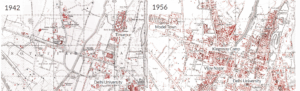
Transformation of North Delhi. Alluri, Aparna, and Gurman Bhatia. “The Decade That Changed Delhi.” Hindustan Times, https://www.hindustantimes.com/static/partition/delhi/.
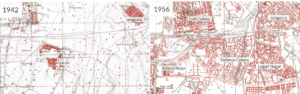
Transformation of South Delhi. https://www.hindustantimes.com/static/partition/delhi/
Erasure, Memory, and the Afterlife of Refugee Delhi
Delhi’s monuments, once shelters for the displaced, now stand as pristine heritage sites, their refugee years erased from official memory. Yet the city still carries the afterlife of displacement in family stories, fading photographs, and the quiet recollections of neighbors who remember when these places were homes, not museums. As Dhooleka Sarhadi Raj observes, this re-narration thrived on selective forgetting; refugees recast themselves as migrants, the state muted the violence of Partition, and later generations inherited a past stripped of its rupture. Gyanendra Pandey’s paradox of Partition as “remembered and forgotten at the same time” is etched into Delhi’s fabric: refugee neighborhoods flourish, even as their origins slip quietly from view. A story born of loss, improvised survival, and the fragile life of camps has been recast as one of self-made success, the forgetting that erases hardship also securing a claim to national belonging. Delhi’s post-Partition transformation was not merely an urban success story but an act of narrative reconstruction, folding the traces of refuge—material and human—into the nation-state’s self-image and the city’s cultivated amnesia.
[1]Interview, Delhi, March 18, 1995 (name withheld at interviewee’s request); and PrakashTandon,PunjabiCentury, 1857-1947, University of California Press, Berkeley and Los Angeles, 1968, p 249, quoted in Pandey, Gyanendra. “Partition and Independence in Delhi: 1947-48.” Economic and Political Weekly, vol. 32, no. 36, 1997, pp. 2261–72. JSTOR, http://www.jstor.org/stable/4405816. 2261
[2] Bhardwaj, Anjali. “Partition of India and Women’s Experiences: A Study of Women as Sustainers of Their Families in Post-Partition Delhi.” Social Scientist, vol. 32, no. 5/6, 2004, pp. 69–88. JSTOR, https://doi.org/10.2307/3517994. 72.
[3] Rajagopalan, Mrinalini. Building Histories: The Archival and Affective Lives of Five Monuments in Modern Delhi. University of Chicago Press, 2016. 141.
[4] Azadi ki Chhaon Mein, quoted in Pandey, “Partition and Independence,” 2263.
[5] Pandey 2265.
[6] Sutton, Deborah R. “Masjids, Monuments and Refugees in the Partition City of Delhi, 1947–1959.” Urban History, vol. 50, no. 3, 2023, pp. 468–485. Cambridge University Press, https://doi.org/10.1017/S0963926821001036.
[7] Sutton 473.
[8] Chandra, Aditi. “Monuments as Body Archives.” Third Text, 19 May 2023, www.thirdtext.org/livingarchives-chandra. 10
[9] Chatterjee, Prerana. “Managing Urban Transformations of Refugee Settlements in West Delhi from Camps to Nagars: The Story of Moti Nagar and Kirti Nagar.” Creative Space, vol. 2, no. 2, Jan. 2015, pp. 183–208. doi:10.15415/cs.2015.22005.
[10] Saxena, Tanisha. “Down Refugee Lane: How Delhi Made Space for the Displaced.” The Patriot, 17 Sept. 2022, https://thepatriot.in/reports/down-refugee-lane-how-delhi-made-space-for-the-displaced-27933.
[11] Pandey 2269.
[12] Singh, Ramanjit. “The Changing Face of Delhi – 1947 to 1957.” Punjab Partition, 12 Sept. 2021, www.punjabpartition.com/single-post/the-changing-face-of-delhi-1947-to-1957.
[13] Singh, “The Changing Face of Delhi”.
References
Bhardwaj, Anjali. “Partition of India and Women’s Experiences: A Study of Women as Sustainers of Their Families in Post-Partition Delhi.” Social Scientist, vol. 32, no. 5/6, 2004, pp. 69–88. JSTOR, https://doi.org/10.2307/3517994.
Chandra, Aditi. “Monuments as Body Archives.” Third Text, 19 May 2023, www.thirdtext.org/livingarchives-chandra.
Chatterjee, Prerana. “Managing Urban Transformations of Refugee Settlements in West Delhi from Camps to Nagars: The Story of Moti Nagar and Kirti Nagar.” Creative Space, vol. 2, no. 2, Jan. 2015, pp. 183–208. doi:10.15415/cs.2015.22005.
Pandey, Gyanendra. “Partition and Independence in Delhi: 1947-48.” Economic and Political Weekly, vol. 32, no. 36, 1997, pp. 2261–72. JSTOR, http://www.jstor.org/stable/4405816.
Raj, Dhooleka Sarhadi. “Ignorance, Forgetting, and Family Nostalgia: Partition, the Nation State, and Refugees in Delhi.” Social Analysis: The International Journal of Social and Cultural Practice, vol. 44, no. 2, Nov. 2000, pp. 30–55. Berghahn Books, http://www.jstor.org/stable/23166533.
Rajagopalan, Mrinalini. Building Histories: The Archival and Affective Lives of Five Monuments in Modern Delhi. University of Chicago Press, 2016.
Saxena, Tanisha. “Down Refugee Lane: How Delhi Made Space for the Displaced.” The Patriot, 17 Sept. 2022, https://thepatriot.in/reports/down-refugee-lane-how-delhi-made-space-for-the-displaced-27933.
Singh, Ramanjit. “The Changing Face of Delhi – 1947 to 1957.” Punjab Partition, 12 Sept. 2021, www.punjabpartition.com/single-post/the-changing-face-of-delhi-1947-to-1957.
Sutton, Deborah R. “Masjids, Monuments and Refugees in the Partition City of Delhi, 1947–1959.” Urban History, vol. 50, no. 3, 2023, pp. 468–485. Cambridge University Press, https://doi.org/10.1017/S0963926821001036.