
The Science Hidden in Hindu Temples: Decoding the Sri Yantra
- October 10, 2025
By Ananya Vishnu
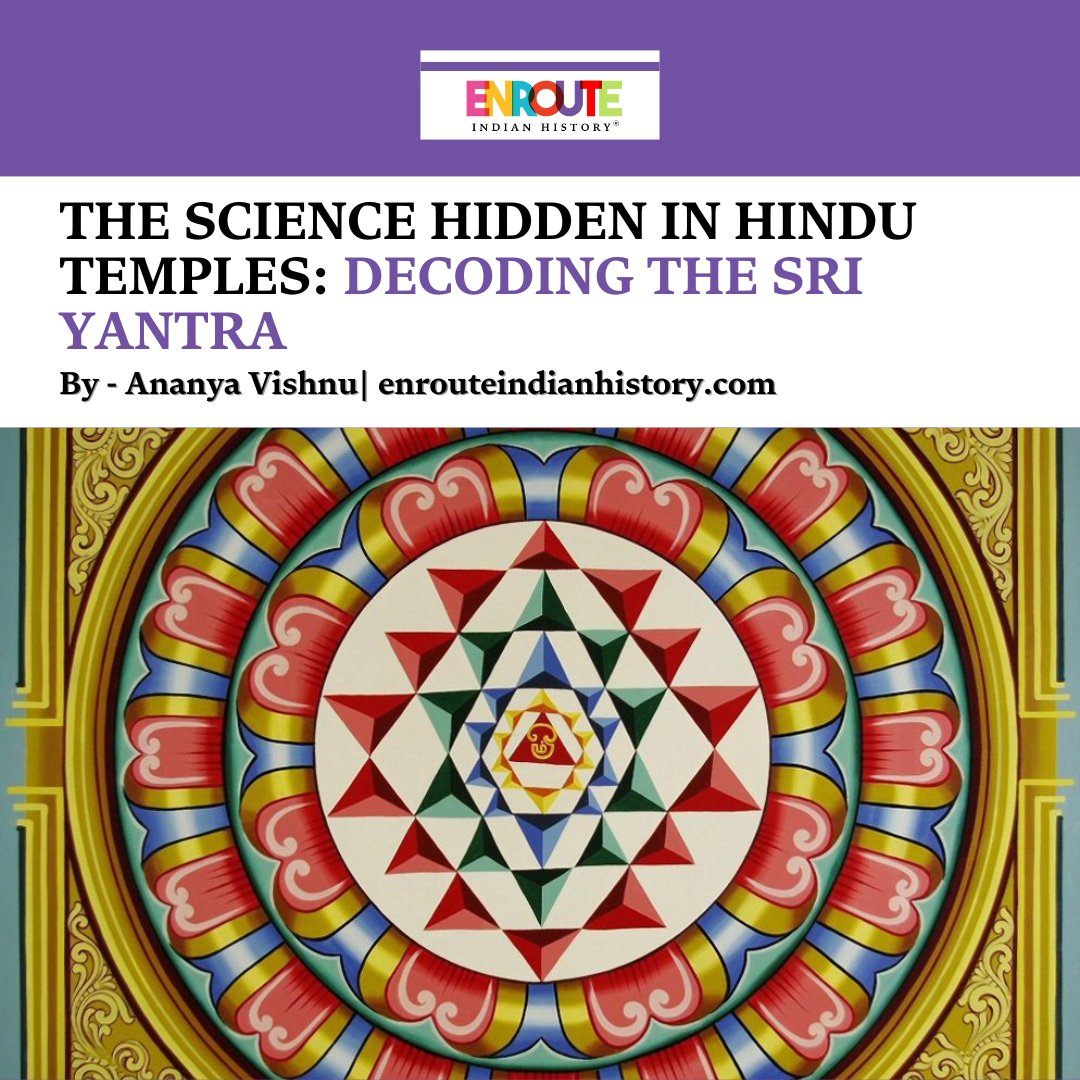
Step into the rich world of Hindu cosmology, and one inevitably encounters the Sri Yantra, a geometric marvel that is far more than just a pretty pattern. Hailed as the “king of chakras” , this ancient symbol, whose name combines “Sri” meaning most auspicious with “Chakra” or the wheel of cosmic consciousness, is a profound representation of concentrated energies, weaving together the very fabric of existence. Rooted in the ancient Shri Vidya tradition, this diagram of nine interlocking triangles is both a spiritual instrument and a cosmic blueprint, serving as a window into Indian notions of creation, consciousness, and reality. (Rangarajan, 2009)
Since time immemorial, scholars have seen a deep connection between geometry and the structure of the universe.
Philosopher and Yogi Sri Aurobindo who used the Sri Yantra for his journal Dharma, described the Sri Yantra as a symbol where heaven and earth meet.
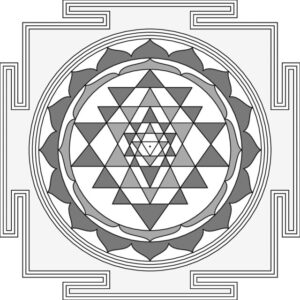
The Classic Shree Yantra
At the Heart of Creation: The Bindu
The Sri Yantra begins where the universe itself is believed to originate, that is, in the bindu, the central point of the diagram. This seemingly simple dot represents the unmanifest origin of all creation, a concentrated reservoir of infinite potential. From this epicenter, the entire structure of the cosmos unfolds, symbolizing the dynamic emergence of form from formlessness. The bindu also embodies the primordial union of Shiva and Shakti, consciousness and energy, stillness and motion. It is simultaneously the beginning and the end, the source and the return, anchoring the Sri Yantra in the timeless rhythm of cosmic existence. (Gurvendra, 2023)
In many ways, the bindu parallels the modern scientific notion of a singularity which according to Big Bang cosmology, is the state of infinite density and zero volume from which the universe emerged. Just as the singularity marks the boundary where conventional understandings of time and space break down, the bindu signifies the threshold between the unmanifest and the manifest. Both concepts, point toward a shared awe for the liminal moment where existence begins.
From this potent bindu, the universe bursts forth, initiating a process of division and polarization. This cosmic “big bang”, manifests as three primal bindus forming the primary triangle.
This primary triangle, a mere set of three points, is surprisingly packed with meaning, reflecting fundamental triads of existence: the cosmic functions of Srishti (Creation), Sthithi (Preservation), and Samhara (Destruction). Even the Goddess herself is trifold (tripura), appearing as Bala (the young), Tripurasundari (the beautiful), and Tripurabhairavi (the terrifying). Her radiance mirrors the threefold aspects of the sun, moon, and fire, as Lalita transforms into Kameshwari (love, moon), Vajreshwari (fire, space), and Bhagamalini(sun).
This ancient understanding was not about exalting one state over another, but embracing the multidimensionality of life and consciousness, deeply embedded in the natural processes of prakriti. (Rangarajan, 2009)
Weaving the Cosmos: Interlocking Triangles and the Body of the Sri Chakra
If the bindu is the seed, and the primary triangle is the sprout, then the Sri Yantra’s true complexity blossoms with its interweaving triangles, called “konas”. This geometric masterpiece is formed by five Shakti konas that point downwards and precisely superimpose on four Shiva konas pointing upwards. This intricate embrace creates a staggering forty-three smaller triangles, each a miniature universe of its own, with the bindu adding one more “point-triangle” for a total of forty-four. This complex interplay forms the very body of the Sri Chakra, illustrating the harmonious, continuous dance of Shiva and Shakti at every level of being. (Sathisha, 2023)
A testament to how profoundly ancient seers thought about universal principles can be described here. The Shakti konas are linked to the five primal elements that are Space, Earth, Fire, Water, Air. Conversely, the Shiva konas represent cosmic principles like Maya or Shiva’s illusive power and Suddha Vidya or wisdom guiding creation. This stunning visual represents the twenty-five fundamental elements also called Tattvas that constitute reality according to Shri Vidya cosmology.
The Sri Chakra’s design extends outward with layers of lotuses and a protective “earth square” with four entrances (Mahesh, 2023). Within these triangles, specific Sanskrit letters are placed, representing deities as conscious forces governing the various powers of nature.
From Ancient Symbols to Modern Living
The profound cosmology embedded in the Sri Yantra did not remain confined to philosophy and tantric practices; it vibrantly manifested in the physical and cultural landscape of India. The diagram’s principles of recursion, balancing polarities, and hierarchical order are evident in Hindu temple architecture, where the temple itself is often conceived as a three-dimensional Sri Yantra, or as Mount Meru. Just as the Sri Yantra has its central bindu, temples possess a sanctum sanctorum, a sacred core from which all other elements radiate outwards, mirroring the cosmic unfoldment. (Kak, 2006)

The Shree Yantra Temple in Amarkantak, Madhya Pradesh serves as a 3D rendition of the Shree Yantra.
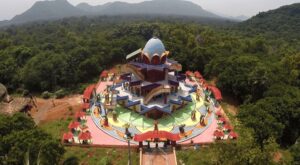
Sri Meru Nilayam Temple, Devipurum, Andhra Pradesh is considered as the only place in the world where one can physically enter the Shri Yantra.
Beyond monumental temples, the Sri Yantra gracefully finds its place in almost every Hindu household, often as a metal plate, a drawing, or an orgonite pyramid. For many, it is a daily reminder of inner cosmic power and mental strength, and a visual aid for meditation. Its contemporary use has expanded far beyond ritual settings, gaining widespread popularity as a focal point for meditation. Whether in traditional households, yoga studios, or modern wellness spaces, the Sri Yantra is commonly used by individuals as they meditate, chant, or practice breathwork. It is also frequently printed in books on spirituality or featured in guided meditation apps, making it one of the most widely recognized and used geometric diagrams for spiritual practice today. Its role in meditation continues to grow, as people turn to ancient symbols for grounding and stillness amid the noise of modern life. In a rapidly modernizing India, where ancient traditions meet contemporary aspirations, the Sri Yantra acts as a tangible link to a timeless heritage.
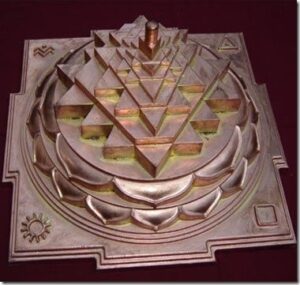
Sri Yantra, made by the Devipuram temple, Andhra Pradesh, India
The Californian Institute of Integral Studies adopted the Sri Yantra as the University’s sacred symbol
Concluding Thoughts: A Timeless Vision
Perhaps one of the most exciting, and certainly amusing, intersections for the Sri Yantra in recent times is its curious relationship with quantum theory. While modern physics grapples with unifying quantum mechanics or the small scale world of atoms and relativity or the large scale universe, some researchers are drawing intriguing parallels between these complex scientific concepts and the ancient diagram. For instance, Tushharkumar J. Bhatt’s work attempts to bridge this gap, suggesting that the Sri Yantra is not merely spiritual but a symbolic representation of universal scientific principles.
The Sri Yantra stands as a remarkable testament to the forward-thinking cosmological concepts held by ancient Indians, especially considering their limited technological development. Far from being simplistic, their understanding of the universe, as embodied in this complex diagram, was deeply sophisticated.
The Sri Yantra stands as a testament to the innate curiosity and intellectual depth of ancient Indian civilization. It reflects a culture where the thirst to understand the cosmos was inseparably linked with the urge to explore the self. This ancient diagram is more than a spiritual emblem, it embodies a mindset that valued both experiential wisdom and rational inquiry. The Sri Yantra, in this light, is not just a relic of the past but a vibrant reminder that the pursuit of cosmic knowledge and self-realization has always been part of India’s intellectual bloodstream.
References
1. Rangarajan, S.,2009. The Mandalic Consciousness: Sri Chakra as Psychocosmogram. The Trumpeter, 25(1). ISSN: 0832-6193.
2. Sathisha, M. ,2023. Cosmic Elements as Represented in the Sri Chakra. International Journal of Advanced Multidisciplinary Research and Studies, 3(6), pp. 465–468.
3. Mahesh, K. ,2023. Understanding the Geometry of Sri Chakra. Preprint in International Journal of Sanskrit Research. doi:10.22271/23947519.2023.v9.i6d.2277.
4. Bhatt, T.J. ,2020. The Comparative Study of Quantum Theory and Shree Yantra. International Journal of Information Technology. Atmiya University. Available at: https://www.researchgate.net/publication/340245005 [Accessed 15 July 2025].
5. Gurvendra, A.L. ,2023. Yantra and Yagya. Interdisciplinary Journal of Yagya Research, 6(2). Dev Sanskriti Vishwavidyalaya, Haridwar. doi:10.36018/ijyr.v6i2.114.
6. Kak, S. ,2006. Art and Cosmology in India. Patanjali Lecture, Center for Indic Studies, University of Massachusetts, Dartmouth, 5 May.
Images
1. ResearchGate 2015, Sri Yantra – Figures, ResearchGate. Available at: https://www.researchgate.net/publication/277295011_Sri_Yantra/figures?lo=1 [Accessed 17 July 2025].
2. District Administration Anuppur 2024, Shree Yantra Temple Gallery, Anuppur District Website. Available at: https://anuppur.nic.in/en/gallery/shree-yantra-temple/ [Accessed 17 July 2025].
3. Madhya Pradesh Tourism Board 2024, Shri Yantra Mandir – Amarkantak, MP Tourism. Available at: https://www.mptourism.com/shri-yantra-mandir-amarkantak-madhya-pradesh-india.html [Accessed 17 July 2025].
4. Wikimedia Commons 2013, Sri Yantra Maha Meru, photograph. available at: https://commons.wikimedia.org/wiki/File:Meru1.jpg [Accessed 18 July 2025]
5. Devipuram. 2025. Sri Yantra Meru Nilayam. Devipuram. Available at: https://devipuram.org/about-us/temples/sri-yantra-meru-nilayam/ [Accessed 18 July 2025]
6. California Institute of Integral Studies. Our Story, California Institute of Integral Studies. Available at: https://www.ciis.edu/discover-ciis/our-story [Accessed 18 July 2025]