
The Sin of Sugar: Coca-Cola, Sugar Economy and the Bittersweet Tale of Taste in India
- December 11, 2025
By Ramyani Banerjee
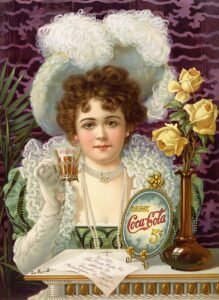
Coca-Cola 5 Cents Advertisement, c. 1900
Image Source:- Wikimedia Commons (1900) Coca-Cola 5 cents advertisement [image]. Available at: https://upload.wikimedia.org/wikipedia/commons/thumb/8/8c/Cocacola-5cents-1900_edit1.jpg/800px-Cocacola-5cents-1900_edit1.jpg (Accessed: 29 October 2025).
How a Medicinal Syrup turned into a Beverage Brand?
We are now aware of the recent headlines—Hyderabad-based paediatrician Dr. Sivaranjani Santosh’s relentless eight years’ campaign has finally pushed the FSSAI to crack down on misleading “ORS” labels used by sugary beverage brands. But this controversy over what we drink—and what we are made to believe we’re drinking—has a much longer history, one that fizzes with marketing myths, medical claims. Long before fruit-based “rehydration” drinks flooded the market, Coca-Cola arrived in India in 1956 with its cheerful promise to “Refresh Yourself.” What seemed like a harmless beverage for the Indians soon became an emblem of modernity, aspiration, and the sweet seduction of global capitalism. But what if you knew that in the beginning, Coca-Cola also was a popular medicinal tonic?
This story begins in Atlanta, Georgia, 1886, where pharmacist Dr. John Stith Pemberton mixed up a peculiar concoction: a flavored syrup of coca leaves and kola nuts, blended with carbonated water and sold for five cents a glass! Marketed as a tonic to cure fatigue, headaches, and even morphine addiction, it promised nothing less than rejuvenation in every sip. By the time Pemberton died in 1888, he had sold most of his rights to the formula. However, an ambitious Atlanta businessman, Asa Griggs Candler, saw what others didn’t — the future of refreshment was in the bottle, not the prescription. By 1892, he had incorporated The Coca-Cola Company, transforming Pemberton’s medicinal tonic into a national obsession.When Joseph Biedenharn first bottled Coca-Cola in Mississippi in 1894, he didn’t just preserve a drink — he sparked a revolution in global mass marketing. By the early 20th century, Coca-Cola had conquered the whole of America. The world, as it turned out, was next.
The Era of Global Capitalism: How Coca-Cola Redefined India’s Soft Drink Market?
Sugar in India isn’t just a taste—it’s a tradition, a quiet addiction woven into every celebration, every cup of chai, every festive sweet. The country’s dependence on sugar goes beyond personal consumption—it sustains a vast industry of cane farmers, mill workers, and traders. But when Coca-Cola first arrived in India in 1956, it was not just a drink ; it was the taste of a new global order. With bottling plants sprouting across cities and billboards promising refreshment, the brand quickly seeped into the rhythms of Indian modern life.
But the love affair soured two decades later. In 1973, the Indian government introduced the Foreign Exchange Regulation Act (FERA), demanding that foreign companies dilute their control — selling 60% of their equity to Indian investors and, crucially, disclosing proprietary know-how. Naturally, for Coca-Cola, whose billion-dollar empire depended on the secrecy of its formula, such compliance was unthinkable. When the Janata Party came to power in 1977, it enforced the law with new zeal, and Coca-Cola was shown the door. The party’s prominent leader, George Fernandes who was also the Minister of Industries, accused the company of drawing off profits abroad while investing little at home — a sentiment that was aligned with post-colonial India’s era of economic nationalism. Beneath this political expulsion, however, lay another layer of concern — the growing unease over Coca-Cola’s high sugar content and its symbolic link to Western consumerism, which many saw as incompatible with India’s developmental ethos of austerity and self-reliance.
This is evident from the fact that, following Coca-Cola’s exit, the Indian government launched Double Seven, while Coca-Cola’s former bottler, Pure Drinks, introduced their Campa Cola in 1977— both positioned as patriotic, homegrown alternatives that were intended to inspire national pride and self-reliance in consumption. Yet, neither brand could capture lasting consumer loyalty. Double Seven soon vanished from the market, while Campa Cola had a dramatic revival decades later in 2023, reintroduced by Reliance Industries with sleek new packaging and nostalgic branding
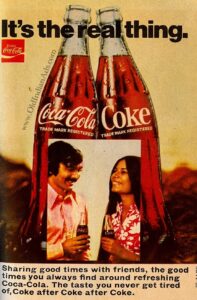
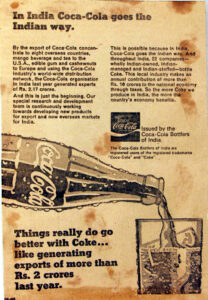
Left:- A Coca cola Advertisement of 1990’s [Image Source:- How Coca-Cola has been integral to the making of Indian politics post-independence, ED Times [online]. Available at: https://edtimes.in/how-coca-cola-has-been-integral-to-the-making-of-indian-politics-post-independence/ (Accessed: 29 October 2025).]
Right:- Old Coca Cola Advertisement of 1970’s [Image Source:- Times of India. (1972) ‘Coca-Cola goes the Indian way’, Times of India, 17 April, p. 4. Available at: https://scalar.usc.edu/works/counter-cola/media/coca-cola-goes-the-indian-way-times-of-india-april-17-1972-4 (Accessed: 29 October, 2025]
But, when Coca-Cola was expelled from India under foreign exchange regulations, it was Parle who seized the vacuum, introducing another popular drink, Thums Up— a bold, spiced cola that soon became a national favorite and a symbol of Indian enterprise. Ironically, Parle’s beverages , along with the earlier cola soft drinks — were also deeply entrenched in the same sugar economy they had seemingly replaced. Only the brand name had changed; the sweetness remained. The sugar concentration in these drinks far exceeded recommended daily intake limits, giving them their unmistakably rich, syrupy taste. Soon joined by Limca and Gold Spot (the most popular non-cola drink of its time), Parle’s homegrown beverages became emblems of Indian ingenuity — drinks that belonged to India, tasted like India, and thrived rapidly in the absence of the American giant.
However, when India’s economy liberalized in 1991, the door that once shut out the world was thrown wide open. Two years later, in 1993, Coca-Cola made its grand return — ending a 16-year exile imposed by the Foreign Exchange Regulation Act (FERA). But this time, it wasn’t merely reviving a beverage business; it was resurrecting an entire sugar economy. From new bottling plants in Pune to distributors across small-towns in India, Coca-Cola’s comeback coincided with the dawn of economic liberalization, embedding the company deeply into India’s agro-industrial landscape.
By 1994, almost all of Parle’s soft drinks had been quietly retired or were absorbed — Gold Spot, for instance, was rebranded into Fanta, to make way for Coca-Cola. Less than a decade later, by 2002, India’s soft drink wars were at their fiercest. Coca-Cola and Pepsi were locked in a high-stakes battle for market dominance, flooding television screens with celebrity endorsements and jingles. Millennials, in particular, will remember many of these iconic ads that became part of popular memory — from Pepsi’s rebellious “Yeh Dil Maange More!” to Coca-Cola’s patriotic “Thanda Matlab Coca-Cola.” The competition extended far beyond advertising; it was a cultural contest over taste, identity, and aspiration. Both brands poured millions into cricket sponsorships, Bollywood stars tie-ins, and rural outreach, saturating everyday life with their promise of cool refreshment. However, beneath the glitter of these campaigns, capitalism was at full swing. What emerged however was not just corporate consolidation or the triumph of global capitalism— but the end of an era when India’s soft drink story was, quite literally, its own.
The Bitter Aftertaste: Coca-Cola and India’s Sugar Economy:
Over the decades, Coca-Cola’s Indian operations have grown into one of its most significant global markets, employing thousands and working with millions of retailers. But beneath this huge success lies a complicated story about sugar — its sourcing, its social costs, and its shifting role in India’s food economy. Unlike the United States, where high-fructose corn syrup (HFCS) dominates, Coca-Cola in India is made with cane sugar — a decision shaped by both local availability and taste preferences. And India is one of the world’s largest producers of sugarcane, and the crop pulses through its rural economy like lifeblood. Coca-Cola’s vast bottling operations rely heavily on this resource, sourcing primarily from Maharashtra, Uttar Pradesh, and Karnataka — key sugar-producing states. This choice ties Coca-Cola not just to sugar manufacturers and mills but to the broader agricultural and labour dynamics of the cane economy. The company’s production costs, sustainability commitments, and even its public image are all intertwined with how India grows, processes, and governs its sugar.
But this interdependence runs deep — and so do its contradictions. Coca-Cola’s steady demand helps keep many sugar mills alive, sustaining rural incomes and feeding local economies. But that same demand also fuels a cycle of precarity: Migrant and marginalized workers, often recruited through opaque subcontracting networks and operating in environments with little legal oversight, toil in conditions that can be best described as exploitative and harmful. Many live in temporary settlements near the mills, bound by debt, their lives organized around a system that keeps costs low and legal accountability lower. The company’s sugar, in other words, carries more than calories — it carries history, hierarchy, and hardship. Human rights advocates rightly argue that these conditions raise uncomfortable questions about the true cost of the sugar that goes into India’s favorite soft drinks.
In recent years, as global and domestic health concerns around sugar consumption have intensified, Coca-Cola India pledged to reduce sugar content in its beverages to align with WHO and FSSAI recommendations.But these efforts, while commendable, are often reactive rather than transformative, addressing symptoms but not the structural inequalities in India’s sugar economy.
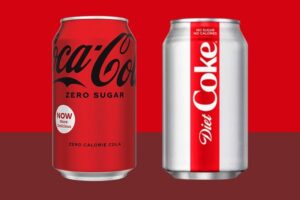
The Coca-Cola “Zero Sugar” and “Diet Coke” Cans
[Image Source:- Taste of Home. (n.d.) Coke Zero vs Diet Coke [Image]. Available at: https://www.tasteofhome.com/article/coke-zero-vs-diet-coke/ (Accessed: 29 October 2025)].
Coca-Cola’s “Zero-Sugar” Paradox:
Now the sugar wars resurfaced with the rise of “diet” and “zero” variants. Once synonymous with indulgence and excess, soft drinks entered an age of guilt-free pleasure, and no one has ridden this shift more deftly than Coca-Cola. When Coca-Cola Zero Sugar launched in India in 2014, the red label promised something almost too good to be true — the same classic taste, minus the sugar. It wasn’t just another product launch; it was a cultural recalibration — because for over a century, sugar had been not merely Coca-Cola’s backbone, but its very soul.
Globally introduced as Coca-Cola Zero in 2005 and reformulated in 2016 to echo the taste of the “real thing,” the drink’s Indian debut was carefully orchestrated — rolled out first across metros like Delhi, Mumbai, and Bengaluru, designed with glossy ad campaigns and aspirational imagery. The message was simple: you can have your cola and drink it too — without the calories, without the guilt.
The move came at a time when India’s waistlines were expanding, and so were its anxieties. Diabetes, obesity, and lifestyle diseases had become urban epidemics. Suddenly, the same ingredient that had made cola iconic — that crystalline grain of pleasure — became its most dangerous flaw. And yet, the irony lingers. While Coca-Cola’s shiny new “Zero Sugar” bottles gleam with the aesthetics of modern health, they remain tethered — economically and morally — to the same sugarcane economy that sweetened their predecessors. Artificial sweeteners like aspartame and sucralose may have replaced sucrose in the drink, but they haven’t yet freed Coca-Cola from the web of sugar politics. In truth, the story of zero-sugar cola is less about subtraction and more about substitution — a balancing act between image and inheritance. They promise health, yet they are born from an ecosystem that still depends on sugarcane’s labor and profit.
Conclusion:
Coca-Cola’s marketing in India has been incredibly powerful — tying sugar water to happiness, family, youth, and of course, nationalism. While other sodas are equally sugary, Coca-Cola is seen as the face of the soft drink industry. But India’s cola consumers are changing fast — they count calories, read labels, and demand accountability. The rise of zero-sugar and sugar-free variants from Coca-Cola, Thums Up, and Pepsi reflects a broader awakening, shaped by growing health awareness, government sugar-reduction policies, and a shifting desire for balance over indulgence. But beneath the veneer of “health”, it continues to carry the same sugary core that once defined India’s soft drink landscape— only rebranding sugar indulgence as choice now.
What distinguishes Coca-Cola, therefore, is not merely that it commercialized the problem of sugar, but that it globalized its overindulgence. The criticism it faces stems from what it represents. Over the decades, it has come to symbolize American cultural dominance and the spread of Western consumer capitalism. However, by embracing ethical sourcing and confronting labour inequities within its sugar supply chain, the company could redefine what “refreshment” means in the 21st century. The fizz of the future, it seems, won’t just depend on how many bubbles rise to the top — but on how deep a company is willing to go to clean up its roots.
So the next time you crack open a can of Coca Cola, or Coke Zero Sugar, listen closely. Beneath that hiss lies the echo of a larger question: can a drink so tied to sweetness ever truly be guilt-free?
BIBLIOGRAPHY:
1. Britannica, T. Editors of Encyclopaedia (2025, October 29) The Coca-Cola Company. Encyclopaedia Britannica. Available at: https://www.britannica.com/money/The-Coca-Cola-Company (Accessed: 28 October 2025).
2. Bhushan, R., 2015. Consumers shun ‘artificial sweeteners’, go for regular Pepsi and Coca Cola instead of diet variants. The Economic Times, 29 April. Available at: https://economictimes.indiatimes.com/industry/cons-products/food/consumers-shun-artificial-sweeteners-go-for-regular-pepsi-and-coca-cola-instead-of-diet-variants/articleshow/47090141.cms (Accessed: [date you accessed it]).
3. Buch, H. (2020) ‘Coca-Cola India plans to bring down sugar content in beverages below 6 gms in 2 years’, Moneycontrol, 2 March. Available at: https://www.moneycontrol.com/news/business/companies/coca-cola-india-plans-to-bring-down-sugar-content-in-beverages-below-6-gms-in-2-years-4993531.html (Accessed: 29 October 2025).
4. Coca-Cola (n.d.) Coca-Cola India’s Project Unnati. [online] Coca-Cola. Available at: https://www.coca-cola.com/in/en/media-center/coca-cola-indias-project-unnati (Accessed: 29 October 2025).
5. Campaign India, 2025. A history of the Coke vs Pepsi war in 3½ minutes. Campaign India. [online] 27 March. Available at: https://www.campaignindia.in/article/a-history-of-the-coke-vs-pepsi-war-in-3-1-2-minutes/421624 [Accessed 28 October 2025].
6. Dey, S. (n.d.). Move Over Coke: We’re in Love With The Raspberry Melba By This Homegrown Brand At Camp. LBB Pune. Retrieved October 30, 2025, from https://lbb.in/pune/take-a-sip-of-raspberry-ardeshirs-beverage-brand-since-1884/
7. Elliott, S. (2007) ‘Can’t Tell Your Cokes Apart? Sue Someone’, The New York Times, 5 March. Available at: https://www.nytimes.com/2007/03/05/business/media/05adcol.html (Accessed: 7 September 2025).
8. Economic Times (2015) Consumers shun artificial sweeteners, go for regular Pepsi and Coca-Cola instead of diet variants [online]. Available at: https://economictimes.indiatimes.com/industry/cons-products/food/consumers-shun-artificial-sweeteners-go-for-regular-pepsi-and-coca-cola-instead-of-diet-variants/articleshow/47090141.cms (Accessed: 29 October 2025).
9. Hyderabad paediatrician’s eight-year-long battle leads to FSSAI prohibiting usage of ORS on food products, The Hindu, 18 June 2023. Available at: https://www.thehindu.com/news/cities/Hyderabad/hyderabad-paediatricians-eight-year-long-battle-leads-to-fssai-prohibiting-usage-of-ors-on-food-products/article70170085.ece (Accessed: 29 October 2025).
10. Pragyabodh (2007) ‘History of Coca-Cola in India’. Available at: https://pragyabodh.com/2007/07/history-of-coca-cola-in-india/ (Accessed: 28 October 2025).
11. Rizul Gupta, “Coca-Cola Company and Brand: A Case Study and Analysis of a Market Leader in Soft Drink Segment to Track Its Evolution, Growth Trajectory, and Future Prospects,” International Journal of Transformations in Business Management (IJTBM), vol. 8, no. 3, Jul–Sep 2018, pp. 68–78. Available at: https://ijtbm.com/admin/upload/03%20Rizul%20Gupta.pdf [Accessed 29 Oct. 2025].
12. Team THC (2023) India’s cola history through logos [online]. The Hard Copy. Available at: https://thehardcopy.co/indias-cola-history-through-logos/ (Accessed 28 Oct. 2025).
13. The Fuller Project (2024) The Brutality of Sugar-Debt, Child Marriage, and Hysterectomies [online]. The Fuller Project. Available at: https://fullerproject.org/story/the-brutality-of-sugar-debt-child-marriage-and-hysterectomies/ (Accessed: 29 October 2025).
14. The Hindu Business Line (2023) ‘Coca-Cola launches Coke Zero Sugar in India’, 25 May. Available at: https://www.thehindubusinessline.com/companies/coca-cola-launches-coke-zero-sugar-in-india/article64997135.ece (Accessed: 29 October 2025).
15. Shroff, K. (2016) ‘Coca-Cola’s inimical business practices in India’s heartlands’, The Caravan, 13 August. Available at: https://caravanmagazine.in/vantage/coca-colas-inimical-business-practices-indias-heartlands (Accessed: 29 October 2025).