
RAVNEET KAUR
“Those who have a hunger for stories….of kings and queens, of Badshahs and Begums…(they) maybe seated on the floor or a torn mat; they may pay their bakshish with smiles and tears (I don’t want gold medals and certificates), them who will gaze with dreamy stares and sighs, as I narrate- it is they who I write for. I present them my aadaab, my salutations and urge them to listen to my stories carefully.”
~ Abanindranath Tagore
“[Abanindranath Tagore is like the artist] who is more talked about than seen. In this he is like a classic that is little read but is a part of our cultural consciousness”
~ R. Siva Kumar, Paintings of Abanindranath Tagore (2008)
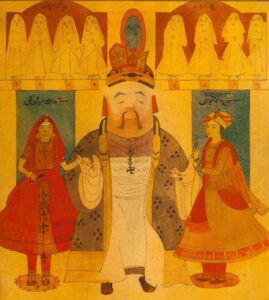
Figure 1. Finding of The Ninth Doll by Abanindranath Tagore. The Arabian Nights Series (1928-30). Watercolour. Google Arts and Culture. (Finding of the ninth doll https://artsandculture.google.com/asset/finding-of-the-ninth-doll/AAFsKpRApc_X5w)
THE PAINTER-WRITER
Abanindranath Tagore, a name foremost in any discourse of 20th-century Indian art, is known to many of us as the founder of the Bengal School of Art and a ‘nationalist’ painter who played a vital role in forging a nationalist consciousness through his art during the Indian struggle for freedom. The label of a ‘Hindu’ revivalist is also often smeared upon his forehead. But amidst this tyranny of labels, the storyteller Aban Thakur, the painter-writer, the narrator and the illustrator of children’s fantasy fiction gets buried. As mentioned above, Abanindranath is more talked about than seen. To really see him and his work, both paintings and writings, the labels need to be peeled and the layers examined.
Though Abanindranath’s works can certainly be read through a nationalist lens and had no doubt a pivotal patriotic leaning as they were painted during the Swadeshi Movement, to rest the case here would be a disservice and a loophole, as recent scholarship in the field of art history has shown. Debashish Banerji (2009) perfectly captures the dilemma and writes – that the “central concern in the art of Abanindranath Tagore is not the normalisation of nationalist or orientalist principles but a critical engagement with post-Enlightenment modernity as the underlying paradigm behind colonialism and nationalism….seeking on one hand transcendence or individual autonomy and on the other, a creative communitarian intersubjectivity”. This attempt to engage with modernity and emerging cosmopolitanism was what defined Abanindranath’s trajectory.
“If words are pictures spoken…. Then painting is a story in form (rup-katha) told by colour and line,” says Abanindranath, wherein rup-katha can be translated as fable or allegory. That he was a fiction writer, a children’s book illustrator and above all a storyteller is perhaps the most overlooked part about Abanindranath. Thus, to understand his work in its entirety would mean gaining a sense of the interplay and dialogue between his paintings and writings, both his own and others like folktales, fables, mythological and historical.
EARLIER WORKS
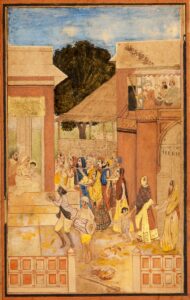
Figure 2. The Birth of Krishna by Abanindranath Tagore. 1896-67. Simplykalaa. (https://simplykalaa.com/abanindranath-tagore/)
Abanindranath kick-started his career with illustrations for Dwijendranath Tagore’s poem Svapnaprayana, Rabindranath Tagore’s poem Bimbavati and his verse drama Chitragada, which made use of chiaroscuro and cross-hatchings. Abanindranath Tagore’s first fictional creation was the Khirer Putul (trans. The Make Believe Prince), written in 1896. Around the same time, he painted the Krishna Lila Series (1896-97), inspired by Indo-Persian miniatures and Bengali Vaishnava literature. Another children’s fiction, Rajkahini, was written in 1905. The next feather in his cap was the Omar Khayyam Series (1906), accompanying the Persian polymath Omar Khayyam’s poetry book, Rubaiyat.
Abanindranath’s next literary endeavours were – Buro Angla, Nalak (1916), Bhutpatrir Dese (Land of Goblins and Ghosts) in 1915, and Khajanchir Khata (Accountants Journal), written and illustrated in 1916. In 1919, he started the art journal Rupam with his elder brother Gagendranath Tagore, a painter in his own right. Further ahead, he wrote Banglar Brata (Folk Ritual Rhymes of Bengal), a scholarly work with monographs on folk rites of Bengal and women’s art – a monumental step as it brought folk art into conversations of Indian art.
Thus, Abanindranath wrote several works of fiction which became popular and were widely read too. Several generations of Bengalis grew up reading these fantasy fictions (Roy, 2022). These works were often accompanied by his own illustrations, moreover these works prove that it would not be wrong to say that Abanindranath painted words and wrote art.
Seen throughout his career, from 1895 onwards, as seen in the Krishna Lila Series, he started distancing himself from European academic realism and moved to watercolours in miniature format. He also makes use of a pseudo-Persianate script, which is actually Bengali but looks like Persian, an imitation of the Mughal script.
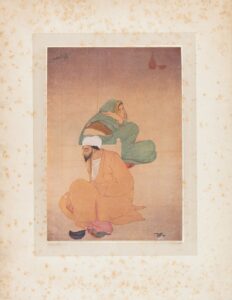
Figure 3. . The Rubaiyat of Omar Khayyam by Abanindranath Tagore. 1910. DAG. (https://dagworld.com/the-three-indian-illustrators-of-the-rubaiyat.html)
Around the same time, he studied – Morotai – Japanese brushwork under Yokoyama Taikan and Shunsho Hishida. This use of watercolour and Japanese wash technique would go on to become a characteristic feature of his work and later on that of the Bengal School of Art. The use of watercolours and ink in the wash technique would lend Abanindranath’s work a ‘mystic’ quality, and the emphasis shifts to the mood and ambience. European realism would come to a dissolving end as the wash technique blurs the details and only the mood – ‘an imagined zone of ambivalence’ – is left behind. The use of colour also becomes an expressive symbol, but it is “colour almost divested of itself” as art historian Tapati Guha-Thakurta says.
This change can be witnessed through Abanindranath’s illustrations. The Chitragada illustrations, his earliest works, do not have much resemblance to the text and betray a “Victorian-esque” character (Kumar, 2026). Meanwhile, the Omar Khayyam Series is especially crucial because they add to the text and serves to enrich it. These have an “evocative denseness” of feeling and thought. Further ahead, the painted would not only accompany but even supersede the written in Abanindranath’s works.
THE ARABIAN NIGHTS
“Everything he had tried and achieved piecemeal in his earlier works came together in [the Arabian Nights] …. In itself a palimpsest of memories culled from many cultures and churned from into a labyrinth of stories …. A narrative conjoining of different times and spaces”
~ R. Siva Kumar, The Arabian Nights and the Web of Stories (2012)
As we have noticed, from the start, Abanindranath’s paintings had a literary base, and his writings are full of visual imagery, this dialogue between the two reaches its highest point and culminates in the Arabian Nights (1928-30). The storyteller, Sheherazade, is at the heart of the story and Abanindranath’s narrative, whose stories are used by him to gain his own narrative voice (Kumar, 2012).
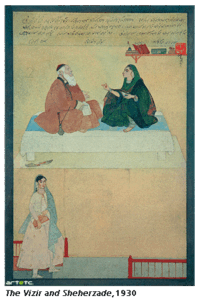
Figure 4. The Vizier and Sheherazade by Abanindranath Tagore. 1930. Aakriti Art Gallery. (https://www.aakritiartgallery.com/artnewsnviews/the-arabian-nights-and-the-web-of-storie.html)
The Decapitation of the Wife is an illustration depicting the cruel and haughty Shahriyar overseeing the decapitation of one of his wives. The painting is devoid of any colour, as the magic of stories has not yet entered the Sultan’s palace. The Vizier and His Daughter depict the old Vizier, Sheherazade and Dunyazad, her younger sister. The colour and contour contrast between the three is striking – Dunyazad is on the threshold of youth, Sheherazade is in the “fullness of bloom” while the Vizier is the old and wise head of the household. The three figures also portray three aspects of storytelling – enchantment, truth and wisdom. All three holding a book and a shelf of books in the background, serve to tell us that they’re all well read, a literary family so to say and moreover gesture towards the larger themes of literary power and the world of stories.
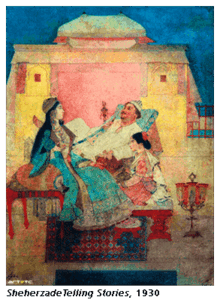
Figure 5. Sheherazade Telling Stories by Abanindranath Tagore. 1930. Aakriti Art Gallery. (https://www.aakritiartgallery.com/the-arabian-nights-and-the-web-of-storie.html)
The painting Sheherazade Telling Stories shows how the cruel and callous Shahriyar has turned into a relaxed man through Sheherazade and her stories. Smoking a hookah, and at leisure with one hand placed upon a pile of books, he is a changed man. The painting is once again a testimony to the transformative power of storytelling; while the stories tell us of a changed man who falls in love with Sheherazade, Abanindranath shows us this changed man and the ‘curative potency’ of stories.
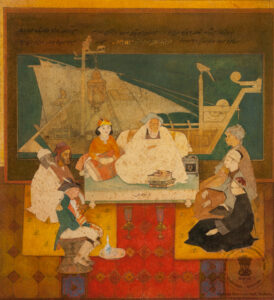
Figure 6. Sindbad The Sailor by Abanindranath Tagore. 1930. Watercolour. Wikimedia Commons. (https://commons.wikimedia.org/wiki/File:Abanindranath_Tagore_-_Sindabad,_the_Seller,_1930.jpg#/search)
In Sindbad the Sailor, unlike the young and macho adventurer, Abanindranath paints Sindbad as an old man. Interestingly, this Sindbad the Sailor does not travel in physical place but in the realms of imagination where he weaves his tales and thus becomes Sindbad the Storyteller. He stays at the same place, and instead of going to faraway places, the people from these places come and visit him to listen to his stories. Sindbad places one hand on a pile of books and the other on his heart – indicating the two sources of his stories. Herein, the disproportionate ship in the background becomes a symbol of the storyteller’s imagination. Moreover, Abanindranath can be seen as self-identifying with the storyteller, a combination of the young boy and the wise old man.
Significantly, the paintings do not serve a secondary purpose to the text and “often supersede the narrative by reinterpreting it” as they move from the story to allegory and further on to a personalised interpretation. The intertextuality lies not in the resemblance between the written and the painted but the distance between the two, through rereading, reinterpretation and reinvention, is the “source of the intertextuality” (Kumar, 2026). These paintings become personal readings as both the storytellers, Sheherazade and Sindbad, become manifestations of Abanindranath, and through their voice, he tries to regain his own.
JORASANKO
“As I stayed by myself, my eyes gradually learnt to see, my ears to listen… .a friendship blossomed between that enormous Jorasanko house and me, as it revealed itself in new ways through its nooks and crannies …. Even the bricks and wooden frames spoke to me, we knew each other so well. That is where it all began for me.”
~ Abanindranath Tagore, Jorasanko Dhare (Around Jorasanko)
The Jorasanko House and its inhabitants, the Tagore family, were vibrant forces in them whose influence can be seen in all the maestros it produced, be it Rabindranath Tagore, Sunayani Devi or Girindrenath Tagore. Abanindranath was no exception, and thus Jorasanko and its ‘immediate colonial cosmopolitan neighbourhood’ found entry in distant landscapes and times through his paintings.
In one painting, titled Aladdin and his Lamp, Abanindranath transforms the tale of a struggling Aladdin finding the lamp in the barren desert to an Aladdin thrifting his way through a lamp shop. Abanindranath’s Aladdin is inside a lamp shop, where he finds the Genie lamp instead of the desert as in the original story. The lamp shop is significant, as back then several lamp shops were present around Jorasanko.
The Hunchback and the Fishbone is a major work where emerging modernity and cosmopolitanism find their way in through Abanindranath’s brush. Though originally the tale is set in China, in the painting, the Jorasanko House can be seen in the background. The Hunchback, who accidentally swallowed a fishbone while he was dining at a Tailor’s, is at the forefront with the tailor and his wife trying to get the bone out; notice a fishbone in a plate below and a sewing machine on top.
In the background, a smoking Abanindranath, being served by a servant, himself can be seen while he dines with a British couple at the Jorasanko House. The parallel with the story is unmistakable. On the side hangs the board – ‘Kerr Tagore and Co.’ referring to Dwarkanath Tagore’s (Abanindranath’s Great-grandfather) managing company, while the Union Jack flies atop the House. Behind the dining scene is Dwarkanath Tagore’s painting, where his face is hidden behind a shutter curtain. Interestingly, European newspapers often compared Dwarkanath’s parties to the Arabian Nights, alluding to the ‘exoticness’ of the Orientals.
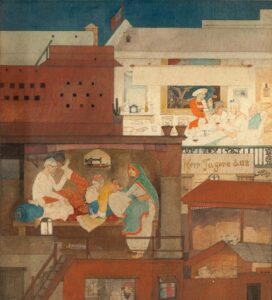
Figure 7. The Hunchback and the Fishbone by Abanindranath Tagore. The Telegraph India. (https://www.telegraphindia.com/opinion/windows-to-arabia/cid/1602868)
Abanindranath makes a personal reading of the story and transforms it into the Jorasanko House while at the same time weaving the history of his family and colonialism into it. This illustrates how he makes “a visual representation of his own interpretation of the tales, transported to his immediate cultural milieu of Jorasanko”, where various strands of “fragmented modernity” – the Jorasanko family community, Bengal regionalism, colonialism, age-old tales, people and even art techniques from other parts of the world – come together.
R. Siva Kumar summarises it perfectly that – “paradoxical as this may sound, Abanindranath moved towards an individual style and voice through an assimilation of elements from various cultural pasts and the re-articulation of internalised memories”. Through these paintings, a distinct style or character, both in subject and technique, can be seen as Abanindranath combines various elements while time and again coming back to the same theme.
THE STORYTELLER
R. Siva Kumar aptly outlines that to understand Abanindranath and his work, he first needs to be situated in his colonial background and starts the discourse with contemporary Company paintings and their cultural taxonomy. He writes that in the Company paintings done by Indian painters “everything stood separate even when they were placed together, like cut flowers in a vase” and amidst this, Abanindranath’s work can be read as a “slow endeavour to revivify the links between things, men and the world, to regain the native voice and to restore the flow of stories”.
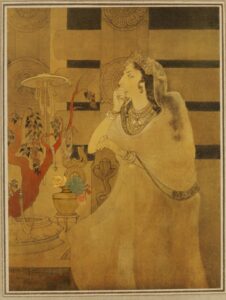
Figure 8. Asoka’s Queen by Abanindranath Tagore. 1910. Simplykalaa. (https://simplykalaa.com/abanindranath-tagore/)
In this manner, the earlier Krishna Lila Series, derived from the Padavalis and Palakirtans, were an “attempt to salvage the fragmented remnants” of the ancient stories of the subcontinent. The Omar Khayyam Series, with its atmospheric sensibility and later on the Bengal Actors Series, with their abundance of detail, wit and humour, are advancements in the same direction.
Apart from the paintings accompanying the texts, Abanindranath also paints several watercolour landscapes, paintings with historical themes – Passing away of Shahjahan, Jahangir in his Garden, Buddha and Sujata, etc., and his later works include the notable Krishna Mangal Series and Anand Mangal Series (1938). Some things worth noting are that even when painting historical themes and historical figures, Abanindranath does not treat them as hard truths but rather as fables and as a part of larger everyday stories that are around us, and in doing so, blurs the line between history and literature.
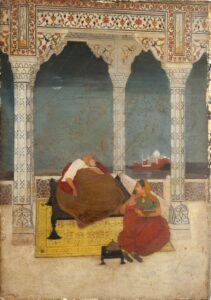
Figure 9. The Passing of Shahjahan by Abanindranath Tagore. 1900. Simplykalaa. (https://simplykalaa.com/abanindranath-tagore/)
The question of nationalism is another. As said earlier, though his works have a nationalist leaning, categorising Abanindranath as a flagbearer of Indian nationalism, especially in a binary sense where he is also an anti-West proponent, is completely misleading. Western figures and the use of watercolours, as he learned from his masters, were as much a part of his work as Vaishnava, Mughal and Japanese elements were. The West, as much a reality as the East, finds its place as Abanindranath painted the hybrid cosmopolitan present. Moreover, his ‘most nationalist’ painting, Bharat Mata, itself was not what it is today. Abanindranath originally painted it as the Banga Mata in 1905 during the partition of Bengal, and it was figuratively inspired by his daughter, who had recently died and by Sister Nivedita, a social activist who was actually an Irish woman. Once again, what is magnanimously national for us today was deeply personal for Abanindranath.
To conclude, the written and painted come together, overlap, are reinterpreted, transported and transformed in innumerable ways in Abanindranath’s works, his books and his paintings. The books are full of visual imagery, and the paintings have a literary base. Several traditions, cultures, peoples and themes are amalgamated – Vaishnava Padavalis, Mughals, Buddha, pseudo-Persianate Bengali script, Japanese wash technique, watercolours, miniatures, folktales, classics and so on. And all of this comes together as a cohesive whole to tell us a story. As K. S. Subramanyan tells us – “[Abanindranath] revelled in telling stories to children and to adults who had the child in them still alive”. “Thus, from the outset it was not a revival of stories but a revival of storytelling that he was after” (Kumar, 2012). Storytelling and narration built on a collage of voices and imaginations is thus at the core of Abanindranath’s art and maybe even at his own.
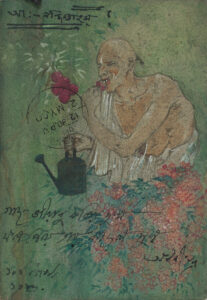
Figure 10. Acharya Nandi Sapthoham by Abanindranath Tagore. 1909. Watercolour. DAG. (https://dagworld.com/term-of-the-month-the-wash-technique.html)
BIBLIOGRAPHY & REFERENCES
1. Kumar, R. Sivakumar. “From Historicism to Intertextuality: Abanindranath’s Quest for an Indigenous Narrative Voice”. DAG, New Delhi, 7 January 2026. Lecture.
2. Banerji, Debashish. 2009. The Alternate Nation of Abanindranath Tagore. Thousand Oaks: SAGE. New Delhi.
3. Kumar, R. Siva. 2012. The Arabian Nights and the Web of Stories. Issue No. 29. Aakriti Art Gallery. (The Arabian Nights and the Web of Stories)
4. Majumdar, Soumik Nandy. 2011. Abanindranath Tagore: A Reappraisal. Vol. 3. Issue No. 18. Aakriti Art Gallery. (Abanindranath Tagore: a reappraisal)
5. Vij, Neena Gupta. 2021. Tales Across Time: Understanding Hybridity in Children’s Fantasy Fictions from the Bengal Renaissance. Dzieciństwo. Literatura I Kultura 3(2). Pg no. 166-181.
6. Roy, Soumyadeep. 2022. Marriage of Nuruddin: The Magical and the Mundane in the World of Abanindranath Tagore. Indigeniousweb. (Marriage of Nuruddin: The Magical and the Mundane in the World of Abanindranath Tagore – Indigenous)
7. Bose, Arkaprava. “Creative Dialogues: Correspondence of Abanindranath Tagore and Rabindranath Tagore with Nandalal Bose”. The Master’s Hand: The Artistic Vision of Nandlal Bose. 2019. Pundole’s.
8. Abanindranath Tagore. DAG. (Abanindranath Tagore)
9. 150 Years of Abanindranath Tagore. DAG. Collection Stories. (150 years of Abanindranath Tagore)
PHOTO CREDITS
1.Figure 1. Finding of The Ninth Doll by Abanindranath Tagore. The Arabian Nights Series (1928-30). Watercolour. Google Arts and Culture. (Finding of the ninth doll https://artsandculture.google.com/asset/finding-of-the-ninth-doll/AAFsKpRApc_X5)
2. Figure 2. The Birth of Krishna by Abanindranath Tagore. 1896-67. Simplykalaa. (https://simplykalaa.com/abanindranath-tagore/)
3. Figure 3. The Rubaiyat of Omar Khayyam by Abanindranath Tagore. 1910. DAG. (https://dagworld.com/the-three-indian-illustrators-of-the-rubaiyat.html)
4. Figure 4. The Vizier and Sheherazade by Abanindranath Tagore. 1930. Aakriti Art Gallery. (https://www.aakritiartgallery.com/artnewsnviews/the-arabian-nights-and-the-web-of-storie.html)
5. Figure 5. Sheherazade Telling Stories by Abanindranath Tagore. 1930. Aakriti Art Gallery. (https://www.aakritiartgallery.com/the-arabian-nights-and-the-web-of-storie.html)
6. Figure 6. Sindbad The Sailor by Abanindranath Tagore. 1930. Watercolour. Wikimedia Commons. (https://commons.wikimedia.org/wiki/File:Abanindranath_Tagore_-_Sindabad,_the_Seller,_1930.jpg#/search)
7. Figure 7. The Hunchback and the Fishbone by Abanindranath Tagore. The Telegraph India. (https://www.telegraphindia.com/opinion/windows-to-arabia/cid/1602868)
8. Figure 8. Asoka’s Queen by Abanindranath Tagore. 1910. Simplykalaa. (https://simplykalaa.com/abanindranath-tagore/)
9. Figure 9. The Passing of Shahjahan by Abanindranath Tagore. 1900. Simplykalaa. (https://simplykalaa.com/abanindranath-tagore/)
10. Figure 10. Acharya Nandi Sapthoham by Abanindranath Tagore. 1909. Watercolour. DAG. (https://dagworld.com/term-of-the-month-the-wash-technique.html)