
By Arnav Kala
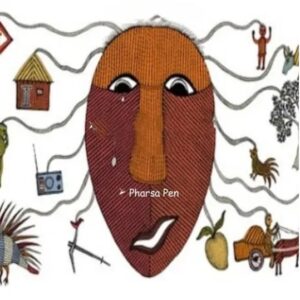
Among the Gond people, Persa Pen stands as a supreme but formless clan deity, representing not only spiritual authority but also the bedrock of Gond identity. There is no idol of Persa Pen, no temple, and no image to hold onto, there only lies a sacred wooden pillar (kamk), marked with the sun and moon, that indicates the deity’s presence. Unlike major world religions that anchor their deities in grand temples or precise scriptures, Persa Pen is known and felt through oral traditions, ritual dances, trance, music, and community performance. This god without a symbol serves as a cultural glue for Gonds across central India, maintaining cohesion without the aid of iconography or institutional priesthood. The uniqueness of this worship not only highlights the sacred autonomy of tribal religion but also reveals deep philosophical insight into how divinity is understood beyond visual form.
Mythical Origins and the Clan-Deity Relationship
Gond mythology begins with the tale of Pahandi Kupar Lingal, a heroic figure who is believed to have liberated the Gond ancestors trapped in a cave. Lingal organised these early humans into phratries(clan divisions), with each phratry inheriting its own aspect of Persa Pen. Despite this division, all versions of the deity are ultimately connected, with each being a facet of a singular divine presence. This concept of distributed divinity, where no single centralized version of Persa Pen exists, gives Gond religion both resilience and flexibility. Each clan maintains its own shrine, rituals, and priest, yet all Gonds remain bonded by shared myths, genealogies, and ritual structures. Clan identity becomes both social and religious, dictating whom one can marry, how rituals are performed, and even where people sit during religious feasts. This decentralized system, rooted in sacred myth, has preserved the Gond community’s spiritual cohesion even in the face of external cultural pressures.
The Shrine and the Emblem: A Sacred Space Without Icons
The shrine of Persa Pen, typically located near the center of a village or a sacred grove, is often marked by a kamk, a tall wooden pillar bearing sun and moon motifs carved at the top. These symbols stand as the only authorized visual markers of the god’s presence. Instead of anthropomorphic statues or elaborate temple structures, the site remains a simple but spiritually potent space, deeply tied to the land and the clan that maintains it. The kamk is not merely a placeholder, it also serves as a ritual anchor, a point where the spiritual and the earthly intersect. The priest or katora, who belongs to the same clan as the deity, does not serve as an intercessor between man and god in the conventional sense but rather as a guardian of ritual knowledge and tools. The sacred spear and animal-tail whisk used in ceremonies further embody the god’s power, but even these are symbols, not idols. Worship, in this context, becomes an act of remembering and invoking rather than visually representing, which is a rare and profound take on spirituality that upholds the sacred without the need for physical form.
Trance, Devotion, and the Annual Jatara
The most dramatic expressions of devotion to Persa Pen take place during the annual Jatara or Patar Puja, usually conducted in the intense heat of May or June. These community-wide ceremonies are filled with emotional and physical intensity: men go into trances, shout invocations, and may even subject themselves to whipping to prove their devotion. As the Pardhan bard plays his fiddle, believed to channel spiritual energy, participants begin dancing in fervor, awaiting the moment when Persa Pen descends and possesses a devotee. Once possessed, the individual acts as a temporary embodiment of the deity, offering blessings, answers to community questions, and healing. This moment, both feared and revered, becomes the high point of the ritual year, and no visual symbol could match its visceral power. The musical and performative aspects, especially the role of the Pardhan, further highlight that the divine here is experienced through sound, sensation, and collective memory rather than vision. This immersive spirituality is both theatrical and sacred, rooted in the land but transcending the material.
Ritual Roles and Social Order
Gond religion does not depend on a hierarchical priesthood but operates through clearly defined ritual roles assigned by birth within the clan structure. The baiga, or village priest, is often called to oversee agricultural or healing rituals, while the katora, as mentioned earlier, manages Persa Pen’s specific ceremonies. The Pardhan, a hereditary bard, performs mythic songs and is vital in reactivating ancestral memory during rituals. These roles are not merely ceremonial, they constitute the organisational structure of Gond society. During rituals and feasts, participants from different phratries follow strict seating arrangements, ritual speeches, and offerings that reflect their genealogical and spiritual status.
Cosmic Linkages and Environmental Sacredness
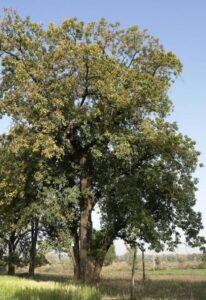
Gond cosmology intricately ties their deities to nature and the sky. The sun and moon carved on the kamk are not random decorations but part of a larger astronomical framework. Gonds have unique names for constellations, lunar phases, and planetary cycles, all of which are embedded in oral stories and seasonal rituals. This cosmology determines agricultural decisions, wedding timings, and religious festivals. The sacredness of trees, especially the Mahua and Saja, is central to Persa Pen worship. The Saja tree, in some cases, is treated as a living embodiment of the deity or as a symbol of maternal protection. Mahua, on the other hand, is not only ritually significant but also economically crucial for food and liquor production, making its seasonal blooming both a spiritual and material blessing. Thus, Gond spirituality is deeply environmental, not in a modern activist sense, but in a lived, integrated way where ecology and divinity cannot be separated.
Cultural Resistance and the Question of Identity
As mainstream religious and cultural forces continue to encroach upon tribal areas, Persa Pen worship has become a form of cultural resistance. While some Gonds have begun incorporating images or aligning their deities with Hindu gods like Shiva or Baradeo, many elders and tradition-bearers resist this process. They argue that idol worship contradicts the core principles of their faith, which celebrates an unseen, uncontained divinity. This resistance is not merely religious but also political, an assertion of Gond autonomy in the face of marginalization and assimilation. Scholars like Motiravan Kangali have argued that Gond philosophy, called Punem, reflects ancient materialist and nature-bound traditions, with roots potentially older than Vedic Hinduism. Today, as younger generations face urbanization and shifting identities, the preservation of Persa Pen worship becomes even more critical, not just for religion but for maintaining a link to indigenous worldviews that reject centralization, hierarchy, and idolization. Despite challenges, many Gond villages continue to conduct the Jatara, teach myths orally, and preserve sacred groves, keeping alive a tradition that believes power lies not in what is seen, but in what is remembered and performed together.
Conclusion
Persa Pen stands as a striking counterpoint to the global norm of image-based worship. The god’s invisibility is not a lack but a feature, a deliberate form of spiritual presence that transcends material representation. Through oral tradition, ritual, dance, trance, and natural symbolism, the Gonds maintain a deeply meaningful religious system that is both socially binding and spiritually profound. It offers a compelling case of how community memory and ecological awareness can shape a theology that is fluid yet deeply structured. In a time when homogenization threatens indigenous lifeways, the persistence of Persa Pen worship testifies to the resilience of a religion rooted not in temples or scriptures but in the sacred autonomy of its people.
References
1.Michael Yorke. Raj Gond People — Belief, Religion, Festivals.
2. Michael Yorke. A Note about Persa Pen.
3. Gaatha: Research on Gond Painting in Patangarh.
4. Evolving Perceptions. Madia Gond Community.
5. Vahia, Mayank N., and Yadav, Ganesh. “Gond Astronomy: Beliefs and Observations.” arXiv:1306.2416 arxiv.org
6. Encyclopedia.com Entry on Gond People. encyclopedia.com