
By Anusha Khan
Dressing the Empire: Mughal Clothing and Power
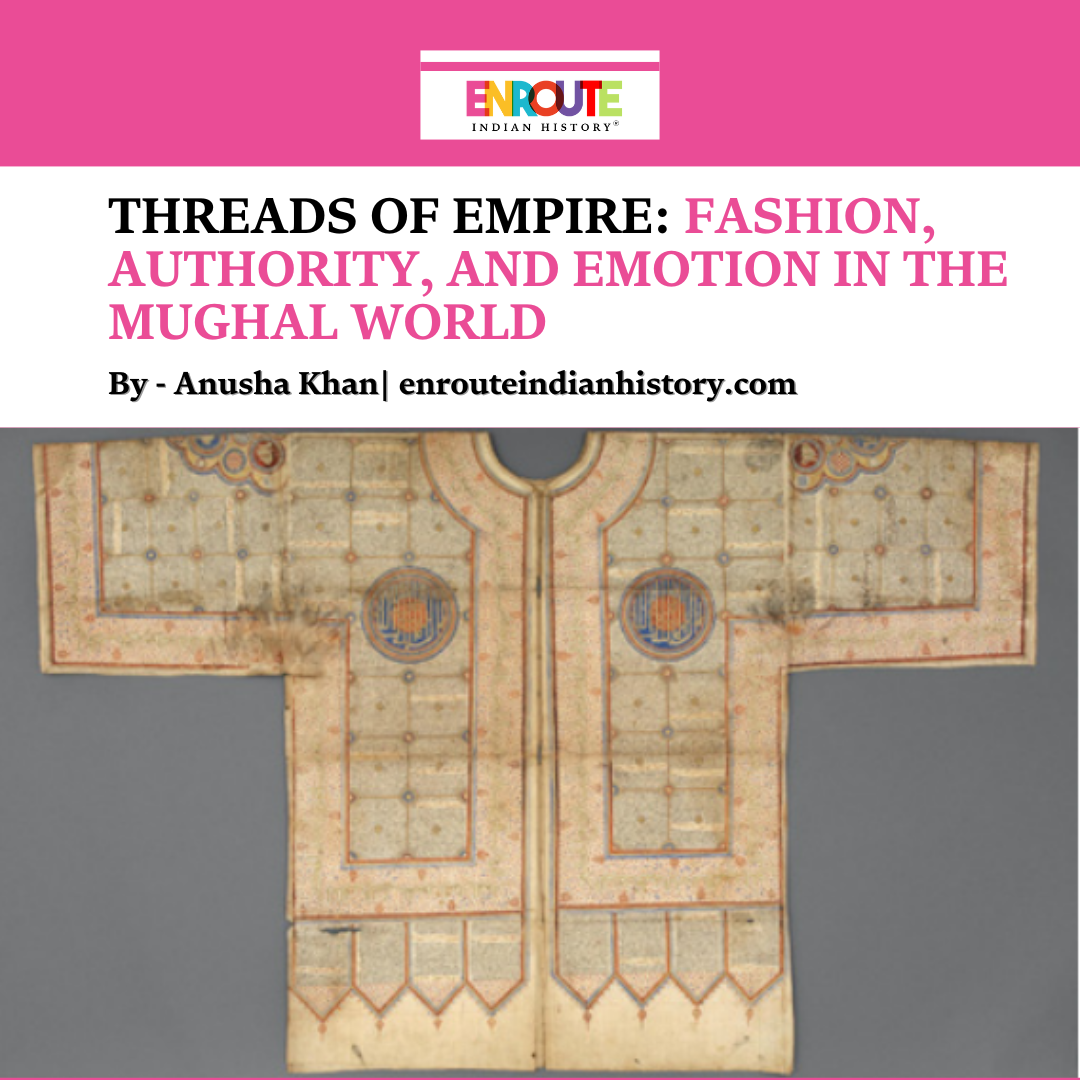
What does it mean to dress like a Mughal prince? How could a piece of cloth mark not only status, but power, piety, and belonging? In the seventeenth century, the Mughal court was a stage where empire, fashion, and hierarchy intertwined. The Mirzanama, a Persian guide to princely conduct, devotes careful attention to attire: “a mirza should never wear brocade or cloth of gold—these are beneath his dignity—and should instead layer pearl buttons, silver-threaded caps, and shawls imprinted with gold and silver leaves.” Every fold, sash, and chosen colour reflected a claim to royal refinement, moral authority and imperial order.
These instructions reveal a world in which clothing was a medium of power. The emperor and his nobles did not simply dress but also performed their place in the empire. Karkhanas across Delhi, Lahore, Agra, and Fatehpur, produced fabrics so fine they could vanish against the skin. Abul Fazl marvelled at these karkhanas, where artisans embroidered silks, painted muslins, and threaded gold into cloth, shaping the visual language of Mughal sovereignty.
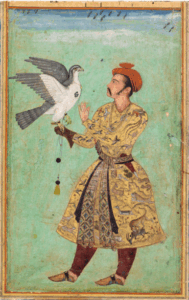
Prince with a falcon, courtesy of museum associates
Delhi itself was a city woven out of fabric. In Shahjahanabad, bazaars glittered with zari, workshops hummed with the clatter of looms and needles, vats of indigo and saffron dyes perfumed the air. To walk its streets was to step into a living textile: brocades shimmering in shopfronts, muslins fine as mist unrolled by merchants, tailors cutting velvet robes for noble patrons.
To study Mughal clothing, then, is to ask larger questions: how did empire shape aesthetics? How did dress mediate rank, gender, and religious ideals? And how did the careful choreography of the court—the layering of tunics, the gleam of pearls, the shimmer of gold-threaded muslin—reflect an early modern understanding of self-fashioning, performance, and belonging? Through texts and miniatures, through memories stitched in silk and muslin, we glimpse a world where cloth was inseparable from the exercise of power, where garments carried meanings that far outlasted their wearers.
Karkhanas: The Workshops of Empire
In Delhi, the karkhanas were not just workshops but theatres of empire, where fabric, colour, and thread carried the weight of power. Abul Fazl, in the Ain-i Akbari, marveled at their scale and precision: thirty varieties of cotton, thirty-nine of silk, twenty-six of wool, each named, priced, and recorded. Nothing escaped notice—every yard of cloth was measured, every spinner and embroiderer supervised—as if the karkhana itself were a mirror of Akbar’s order. The emperor’s wardrobe set the rhythm of this world: Abul Fazl notes he commissioned a thousand new suits each year, his garments marking the seasons like courtly calendars.
Visitors were struck by the spectacle. Francois Bernier, used to Parisian extravagance, confessed that the finery of the Mughal court was “beyond imagination.” He described long halls where one chamber held embroiderers bent over stretched muslin, another echoed with the hammer of goldsmiths, another with tailors cutting and stitching robes and turbans. To step into a karkhana, he wrote, was to step into a miniature city, a place alive with labour, discipline, and splendour. Hindus and Muslims worked side by side, their identity less in religion than in the lineage of their craft, sustaining the empire’s cosmopolitan order.
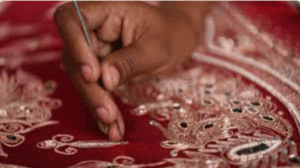
zardosi, courtesy of google arts and culture
The fabrics themselves carried stories. Cotton was the cloth of compromise: plain, pure, endlessly adaptable. Blends like mashru—cotton on the outside, silk hidden in the weft—allowed Muslim elites to enjoy sheen without violating prohibitions. Muslin jamas clung sheer to the body, balancing Indic ideals of bare-chested royalty with the modesty of Islam. Tansukh, literally “comfort for the body,” was a cotton so fine it rivalled silk in desirability. White cotton signalled purity, red spoke of vitality and sovereignty, yellow marked fecundity, green carried the sanctity of Islam. Clothes became a language of colour, read instantly by those who knew how to look.
Embroidery added further radiance to these fabrics. Zardozi—from zar (gold) and dozi (embroidery)—came from Persia but under the Mughals reached heights of extravagance. On karchob frames, artisans leaned close with hooked aari needles, threading flattened wire (badla), sequins (sitara), coiled threads (dabka), spirals of gold (salma), into curling vines and whorls that caught and fractured the light. Lighter kamdani shimmered on muslin; while Nur Jahan’s taste redefined courtly wardrobes with chikankari: delicate white-on-white embroidery that rippled softly against translucent muslin gowns.
Textiles of Power: What the Mughals Wore
The symbolism of clothing at the Mughal court ran deep. Humayun, guided by astrologers and Sufi metaphysics, chose the colors of his robes based on cosmic harmony: red on Tuesdays to invoke Mars’s strength, yellow on Thursdays for Jupiter’s wisdom. Even a sash could speak: the kamarband, tied at the waist, meant more than ornament. To be “waist bound up,” as Rosalind O’Hanlon writes, was to be girded for service, ready for loyalty and battle, the very fabric of masculinity.
Texture revealed hierarchy. Banarasidas, a seventeenth-century merchant, noted that the wealthy did not merely signal status through expensive fibers but through fabrics that pleased the touch, emphasizing texture and refinement. Even simple cloths could hold meaning: rough or harsh fibers marked lower status, while smooth, delicate weaves suggested sophistication and discernment
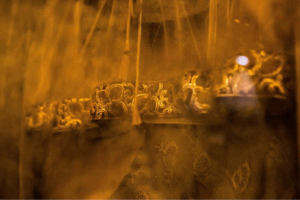
courtesy of google arts and culture
This hierarchy of fabrics underpinned the ritual and political economy of the Mughal court. The khilat—robes of honor—embodied both devotion and authority. Bestowed by the emperor, they conveyed spiritual and temporal favor, transforming material into message. Bestowed by the emperor, they conveyed spiritual and temporal favor. A robe, sometimes with a turban, sash, or jeweled dagger, was both gift and instrument: it reinforced loyalty, displayed wealth, and affirmed the emperor’s centrality. As Jagjeet Lally notes, even selecting textiles for the khilat—whether a Bengali cotton, Rajasthani tie-dye, or Kashmiri pashmina—was a careful negotiation of taste and politics. Yet robes could also whisper danger. Chronicles tell of poisoned garments sent to rivals, cloth turned into weaponry, intimacy into peril.
Sylvia Houghteling argues that fabrics that held scent, warmth, and touch more intimately than marble or stone and calls them “sentimental silks”. Akbar stuffed robes with flowers so they released fragrance when worn. Jahangir sent a shawl “often used by us” to a Rajput ally, extending the warmth of his own body across distance.
At the Mughal court then, clothing was a sophisticated language, communicating rank, allegiance, and cultural identity. Central to male attire was the jama, a long tunic-like garment that came in numerous variations. The chakdar jama, perhaps the most iconic, had a four-pointed hem and closely fitted sleeves, often worn over a thin undershirt or nothing beneath, allowing the luminosity of the skin and even the contours of the body to remain visible. This translucency balanced Indic ideals of bodily display—where the body reflected inner virtue—with Islamicate conventions emphasizing modesty. Complementing the jama were nadiri coats, sleeveless garments richly embroidered with gold thread, beads, or pearls, and charqabs, Timurid-inspired robes edged with pearlwork. These garments were markers of ceremonial importance and political favor, often gifted by the emperor to princes or vassals to signify approval or convey authority.
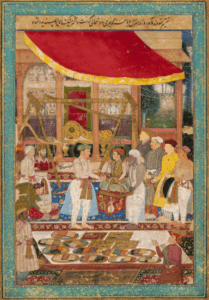
Emperor Jahangir weighing his son Khurram in gold. Attributed to Manohar.
Women’s wardrobes glowed no less brightly. The flowing peshwaz, open at the front and often embroidered in gold, was paired with swirling ghagra skirts and translucent odhnis. Dupattas shimmered with zari, veils softened with chikankari’s white-on-white embroidery. Nur Jahan, the era’s fashion innovator, introduced lightweight dodami dresses, elegant panch tola scarves, brocades, lace (kinari), and chikankari, elevating women’s attire into a courtly art. The peshwaz, an open-front garment fastened with buttons, fell gracefully to the knees or ankles, sometimes worn with a mirzai jacket over it. Loose trousers, short-sleeved cholis, or draped saris completed ensembles, reflecting a sophisticated negotiation of modesty, elegance, and social signaling. The layering, textures, and adornments of women’s clothing, from jewelry to headgear, made their appearance an extension of courtly cosmology and social hierarchy.
The Artist’s Trick: Interior Lives on Fabric
In Mughal painting, textiles convey identity, morality, and history with unflinching precision. Jahangir’s Preferring a Sufi Sheikh to Kings (c. 1615–18) intertwines textiles with spiritual and political hierarchies. The emperor sits atop an hourglass throne, his striped trousers and sheer tunic rendered so delicately the artist’s brush mirrors the weaver’s craft. The Sufi sheikh beside him wears plain wool robes in muted colors, emphasizing spiritual renunciation, while kings such as James I and the defeated Ottoman Sultan occupy the margins, their textiles marking status yet subordinated to moral hierarchy. Even minor figures, such as an Indian raja or the artist himself, appear in jamas fastened to the left—Hindu custom—turning a garment into a statement of belonging. Every fold, stripe, and jeweled detail marks rank, taste, and cosmological significance, but the fabrics themselves seem alive, responding to the hierarchies, allegiances, and spiritual choices of the figures who wear them.
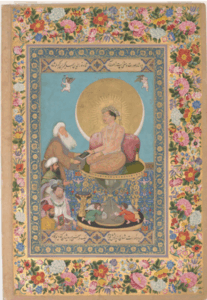
Emperor Jahangir preferring a Sufi Sheikh to kings from the St. Petersburg Album. Bichitr.
Some textiles reveal histories far darker than their colors suggest. In Bichitr’s depiction of Shah Jahan receiving his sons and Asaf Khan, Reza Bahadur stands at the center in a robe of gold-figure silk, the only figure wearing such a garment. The pattern on his robe recalls the five relatives he executed to secure Shah Jahan’s throne. The robe becomes a silent ledger of violence, the flattened figures on the silk like a necklace of bodies, reminding the viewer of atrocities committed behind the splendor of courtly ceremony.
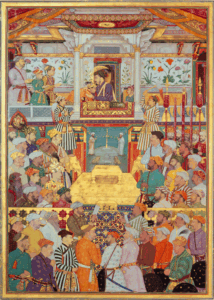
Shah Jahan receives his three eldest sons and Asaf Khan during his accession ceremonies
Similarly, a sixteenth-century Persianate painting shows a young prince holding a wine cup, while his cloak tells another story entirely: prisoners are being led to execution, the rope of one captive running across the prince’s arm. The juxtaposition of serene youth and violent narrative unsettles the viewer: the fabric enacts history, and the wearer becomes entwined with the story woven into his clothes.
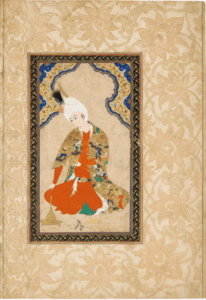
Young prince. Signed “Muhammad Haravi.”
The Living Thread of Mughal Textiles in Delhi
In Mughal India, textiles carried meaning, memory, and power. The artistry of zardozi, kinari, salma-sitare, and karchobi embroidery was not mere decoration. Flowers, parrots, elephants, and geometric motifs turned robes into wearable echoes of palaces and gardens. These garments were portable monuments, where identity and sentiment were stitched in gold and silver.
This legacy pulses through Delhi today. Chandni Chowk, Suiwalan, Ballimaran, and Kinari Bazaar were—and remain—hubs where artisans bent over gold and silver threads, weaving history into every stitch. Even after karkhanas disappeared and factories reshaped markets, women in Chitli Qabar and boutiques across South Extension and Lajpat Nagar continue to preserve Mughal shimmer. Zardozi borders, embroidered saris, and bridal lehengas carry centuries of memory, blending Persian finesse with Indian artistry.
From the empire’s courts to the bustle of Kinari Bazaar, Mughal textiles remain more than ornament. In every shimmering thread, the city’s soul, artistry, and history continue to breathe.
References
Houghteling, Sylvia. “Sentiment in Silks: Safavid Figural Textiles in Mughal Courtly Culture.” Affect, Emotion, and Subjectivity in Early Modern Muslim Empires: New Studies in Ottoman, Safavid, and Mughal Art and Culture, edited by Kishwar Rizvi, Brill, 2015, p. 124.
Houghteling, Sylvia. “The Emperor’s Humbler Clothes: Textures of Courtly Dress in Seventeenth-Century South Asia.” Ars Orientalis, vol. 47, 2017, pp. 91–116. http://dx.doi.org/10.3998/ars.13441566.0047.005
Lally, Jagjeet. “Imperialism and Fashion: South Asia, c. 1500–1800.” The Cambridge Global History of Fashion, vol. 1, Cambridge University Press, 2022.
Sharma, K.D., and Swati Sharma. “Royal Karkhanas under the Mughals.” Historic Indian Textiles of Gold and Silver, Author Press, 2020.
Raheja, Radhana, and Simmi Bhagat. The Great Women behind the Mughal Harem and Their Contribution in Costume and Jewelry Designing. Routledge India, 2019.
Singh, Arundhati. “Threads of Gold and Silver: The Lost Craft of Salma-Sitare.” New Indian Express, 16 Aug. 2025, https://www.newindianexpress.com/cities/delhi/2025/Aug/16/threads-of-gold-and-silver-the-lost-craft-of-salma-sitare.