
Threads of Faith and Folklore: Gazir Pat and the Art of Devotional Storytelling
- December 11, 2025
By Ramyani Banerjee
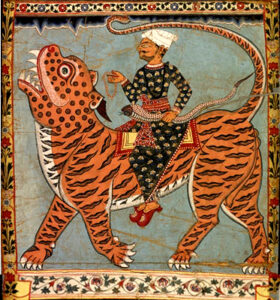
Gazi Pir/Gazir Pir on a tiger. Old Indian Arts, 2011, https://www.oldindianarts.in/2011/04/scenes-from-legend-of-gazi-scroll.html?m=1.
In the tangled mangrove forests of the Sundarbans, faith often takes the form of protectors who stand between humans and the dangers of the wild. Two such figures loom large in the cultural memory of Bengal — Dakshin Ray and Gazir Pir. At first glance, they belong to different traditions, yet their shared presence in Bengal’s cultural imagination reveals something far greater — a history where devotion blurred boundaries, and art transformed belief into a common language.
Among the many artistic expressions of this syncretism, few are as captivating as Gazir Pat. (Eng: Gazi’s scroll) This Gazir Pat is a specialized strand of the broader pata or patachitra tradition — that is, scroll or cloth paintings. (The word pata or patta essentially means “cloth” or “canvas,” and chitra means “picture.”) As the scroll stretches downward, panel by panel, a centuries-old tale unfolds: Gazi Pir, mounted on a tiger, battles demons and rescues villagers.
Although Gazir Pat is thematically centered on a Muslim figure and its popularity eventually migrated to, and is now largely concentrated in Bangladesh after Partition, its foundations remain deeply Indian. The form of the art, the narrative style through which it is performed, and the community of artisans who created it are all rooted in an ancient Indian artistic lineage. As such, Gazir Pat exemplifies India’s cultural hybridity — a devotional practice that drew upon Islamic memory yet carried the indelible imprint of Indian storytelling traditions. Over many centuries, wandering painters, storytellers, pilgrims, fairs, and rural communities carried scrolls that recounted religious tales, mythological epics, and moral allegories. It is not merely a static artifact; it is performance, faith, and visual poetry rolled into cotton and colour. At once local and vast, humble and expressive, it carries centuries of myth, belief, and social memory across generations.
The Pata Tradition and its Expressions:
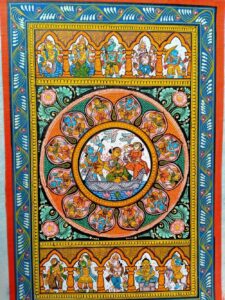
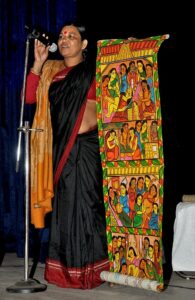
(Left) Orissa Patachitra of Vishnu’s Dashavatara Wikimedia Commons,
https://commons.wikimedia.org/w/index.php?search=patachitra&title=Special%3AMediaSearch&type=image
(Right) Photographed by Ganguly, Biswarup. Swarna Chitrakar from Naya village of West Midnapur performing at the
international conference on "Strategic Transformations: Museums in 21st Century" at Ashutosh Birth Centenary Hall, Indian
Museum, Kolkata on 14 February, 2014. 14 Feb. 2014, 11:59:59, Wikimedia Commons,
https://commons.wikimedia.org/wiki/File:Swarna_Chitrakar_-_Kolkata_2014-02-14_3080.JPG
One of South Asia’s most mesmerizing narrative traditions is the folk scroll painting, an art form that continues to live through the Chitrakar community of West Bengal, Orissa and parts of Bangladesh. Yet, its origins and even the beginnings of the Chitrakars themselves are wrapped in speculation. Ancient Indian texts, however, hint at the art’s sacred roots. The Brihaddharma Purana text tells the story of Lord Vishvakarma, the divine architect, who fathered nine sons with a woman of lower caste. These nine—collectively called the Nabasayakas—were destined for different forms of physical labour within the rigid caste hierarchy. The youngest, the Purana notes, was fated to become a pata painter. In this myth, the scroll painters of Bengal are not merely artisans; they are the heirs of a sacred and socially
codified vocation.
Yet, the trajectory of the chitrakars was far from linear. While other Nabasayakas climbed the social ladder through their professions, the patachitra painters remained tethered to their craft and bore the stigma of marginality. Charanachitras, Mankhas, and Yamapatas were among the earliest textile scroll paintings, weaving together stories with a moral and didactic edge. 3 These narrative traditions, deeply rooted in visual storytelling, are referenced across Hindu, Jain, and Buddhist texts. Over time, many sought dignity and opportunity through conversion to Islam during the medieval period. Even then, their craft—producing images, often deemed idolatrous—kept them at the peripheries of orthodox Muslim society. The Chitrakars thus inhabited a liminal space, navigating two worlds: in their own households, they went by Muslim names, while their largely Hindu clientele continued to know them by Hindu ones. Despite these shifting religious markers, one thing remained unchanged — their shared surname,
Chitrakar, (literally meaning “painter”) which reflected the continuity of their ancient profession. This is something that still exists today for the scroll painters of West Bengal.
This layered identity unfolded against the backdrop of pre-colonial Bengal, a land of porous borders, pilgrimage networks, Sufi saints, shrine cults, folk beliefs, and cultural syncretism. So, figures like Shah Ismail Ghazi were not merely spiritual guides; they were woven into political, social, and material life. Their stories, sung in local praise songs (better known as Patua Sangit, a folk scroll-singing tradition that is still popular in the areas of Medinipur, Birbhum, Burdwan and Murshidabad), celebrated at shrines, and sometimes captured visually, circulated across villages, fairs, and festivals. It was in this vibrant, interwoven reality—where caste, faith, and occupation intersected—that Gazir Pat, one of the most enduring forms of scroll painting, emerged.
From the 12th or 13th century until the late 19th century, Patuas and Chitrakars were active across Bengal, with hubs in Bankura, Murshidabad, Birbhum, Nadia, Midnapur, and Hughli, and in what is now Bangladesh—Dhaka, Noakhali, Mymensingh, Comilla, Faridpur, and Rajshahi. Deeply rooted in rural life, these scrolls carried devotional and moral narratives, and their performance was a communal experience. Entire households or neighbourhoods would gather to watch the scroll unfurl, listen to accompanying songs, and reflect on the messages woven into the images. Yet, each region lent the art its own voice: styles, motifs, color palettes, song texts, and even scroll dimensions varied subtly, while the overarching narrative framework remained recognizable.
Today, these scrolls survive in Kolkata’s Asutosh Museum of Indian Art and Gurusaday Dutt Museum, along with Sonargaon’s Folk Art & Crafts Museum in Bangladesh, who safeguard the legacy of a tradition that is simultaneously ancient, living, and profoundly emblematic of Bengal’s cultural hybridity.
How is Gazir Pat made?
Contrary to purely paper scrolls, a classic Gazir Pat is typically done on thick cotton fabric. Typically, the scroll is divided into about 25 panels, the central one the largest, with multiple rows of smaller panels above and below. This layout is meticulously planned from the outset: the central panel invariably depicts Gazi Pir riding a tiger, flanked by companion figures such as Manik Pir or Kalu. Above are four rows of smaller panels; below are three, often illustrating Yamadut—messengers of Yama, the river goddess Ganga, or punishments awaiting transgressors. Elsewhere, episodes of miracles, confrontations, mythic animals, and moral lessons unfold in chronological narrative, each carefully mapped before the pigments touch the cloth. These scrolls also illustrate broader sacred imagery: the battlefield of Karbala, the holy Ka‘aba, or depictions of Hindu worshipping shrines.
The colour and form in Gazir Pat are symbolic rather than realistic. Panels are filled with flat tones—red, yellow, green, blue, black, and occasionally white—but red and blue dominate, giving the scrolls their signature vibrancy. Figures and motifs are deliberately simplified and contrasted. This style is not about realism but bold symbolic forms and shapes that remain legible even from a distance. Because the scroll is part of a performance, clarity and visual “readability” matter: each figure and motif must stand out under dim light.
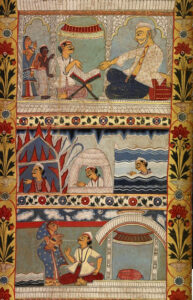
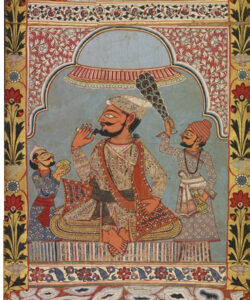
Gazir Pat with its chronological sequence, painted by Shambhu Acharya in 2018.
Source:- “The Art Road: Linking Dhaka and Berlin through South Asian Art.” Larry’s List,https://www.larryslist.com/artmarket/the-talks/the-art-road-linking-dhaka-and-berlin-through-south-asian-art/. Accessed 2 Oct. 2025.
During the earlier times (around 12th–13th centuries) pigments for Patachitra were derived from locally available minerals, vegetable dyes, and other natural materials, while the traditional glue was prepared from tamarind seeds. In recent decades, artists may adopt synthetic pigments or modern paints to reduce costs and improve longevity. These artists preserve not just technique, but the oral tradition, the poetic texts, the rhythm of performance, and the cultural memory of Gazi Pir.
Among the notable artists whose works have kept this lineage alive are of late Shudir Acharya, his son Shambhu Acharya (their family had taken this profession for centuries), and Kanai Miah who was very famous for his Gazir Gaan.
Who is Gazir Pir? Identity, Heritage & Social Position
Its central figure, Gazi Pir, is revered in many rural communities by both Hindus and Muslims, particularly by those whose lives are tied to the forests and waters of the Sundarbans—woodcutters, honey collectors, fishermen, and boatmen. His legends carry echoes of Khijir Pir or Khawaj Khijir, the Muslim saint believed to safeguard rivers and seas. In local lore, Gazi is imagined astride a tiger, facing demonic foes and guarding all who venture into the wilderness. Interestingly, in West Bengal’s Sundarbans, a parallel figure exists: Satya Pir, mounted on a leopard. Both figures hold symbolic emblems in their hands, a reflection of shared cultural reverence that transcends religious boundaries. This becomes evident when one considers the Pir Panchali Kavya—devotional verses dedicated to Satya
Pir—which are still recited in Bengali households during the Satya Narayana Puja (as a part of Hindu God Narayana).
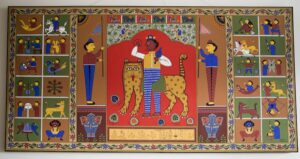
“Scenes from the Legend of Gazi. Murshidabad, India 1800’s” Old Indian Arts, 2011,
https://www.oldindianarts.in/2011/04/scenes-from-legend-of-gazi-scroll.html
Yet the historical Gazi was very different from his mythic incarnation. Shah Ismail Ghazi, who died in 1474, was a 15th-century Sufi preacher who arrived in Bengal during the reign of Sultan Rukunuddin Barbak Shah. Beyond spiritual pursuits, he led military campaigns on the Sultanate’s frontiers—against the Gajapati dynasty in Orissa and other regional powers. His victories earned him both political influence and popular acclaim. Folk memory, however, often blurs the lines between history and myth. In Bengali tradition, saints, heroes, and local legends interweave freely. The name “Gazi Pir” came to signify a saintly protector, a master over tigers and demons, safeguarding communities in peril.
The historical feats of Shah Ismail Ghazi—preaching, battle prowess, and spiritual leadership—provided fertile ground for the mythic figure that would emerge in folk consciousness. Over time, Gazir Pir in scrolls and songs merged history and devotion, reality and imagination.
The scrolls themselves are more than artistic artifacts—they are living repositories of belief, morality, and memory. They illustrate Gazi’s miracles, his confrontation with demonic forces, and his protective power, weaving together a vernacular theology accessible to local communities. In regions where formal religious instruction felt remote, Gazir Pat offered a visual and performative vocabulary of faith. Performances were immersive communal events: musicians and singers would sit cross-legged on a square mat, facing north. The lead performer placed a symbolic representation, Gazir Asha—the “Hope of Gazi”—to the north, invoking sanctity. Then, hymn-like songs would unfold, telling Gazi’s tales, with fellow performers joining at intervals. The instruments—flutes, harmoniums, mandira (tiny cymbals), and long-bodied dhols—created a rhythmic, melodic backdrop.
The songs embedded in the scrolls, the Gazir Gaan, are layered with meaning. Beyond recounting miracles, they offer moral guidance, critique social vices, and caution against cosmic justice administered by Yama. These performances were part sermon, part entertainment, part cultural education, at a time when mass literacy and formal schooling were rare.
At the heart of this tradition are the patuas, the hereditary artisans who paint, narrate, and perform across generations. Many come from the Bedey (Bede/Bedy) community, often Muslim converts by faith, whose folk identity intersects with religion, caste, and mobility. These nomadic and semi-nomadic artists are custodians of both craft and culture, preserving technique, poetic texts, rhythms, and communal memory. Yet the pressures of urbanization, shrinking audiences, and the commodification of scrolls as decorative art threaten this heritage. Many patuas have abandoned the craft or shifted professions; some have married into other communities, diluting the continuity of transmission. Yet where the tradition survives, Gazir Pat is more than a scroll; it is a declaration of identity. It binds communities to their past, celebrates cultural hybridity, and keeps alive the figure of a tiger-riding saint whose power, protection, and stories continue to inspire awe, devotion, and ethical reflection.
Conclusion:
After Partition, the living tradition of Gazir Pat survives tenuously, primarily in Bangladesh’s Munshiganj and Narsingdi, with a few dedicated artisans, such as Shambhu Acharya, keeping it alive through contemporary works. Scholars and institutions have sought to catalog and preserve what remains, most notably Prof. Shahnaj Husne Jahan’s project, which documented Gazir Pat as intangible cultural heritage. Beyond its aesthetic value, Gazir Pat functions as a folk archive: it preserves iconographies, motifs, social attitudes, costumes, mythic imaginaries, and collective beliefs, with each panel serving as a fragment of cultural memory. Its continued existence signals that folk traditions outside elite or canonical arts still hold significance.
REFERENCES:
1. “Gazir Pat.” Banglapedia: National Encyclopedia of Bangladesh, edited by Sirajul Islam, 2nd ed., vol. 3, Asiatic Society of Bangladesh, 2012, en.banglapedia.org/index.php/Gazir_Pat.
2. Nagpal, Ishmeet. “Bengal’s Syncretism: Hindus & Muslims Share Worship of Satya Pir.” SabrangIndia, 10 Nov. 2019, https://sabrangindia.in/bengals-syncretism-hindus-muslims-share- worship-satya-pir/. Accessed 2 Oct. 2025.
3. “Patchitra.” Loving Bengal, http://sos-arsenic.net/lovingbengal/patchitra.html. Accessed 2 Oct. 2025.
4. “Pata Painting.” Banglapedia, 17 June 2021, https://en.banglapedia.org/index.php/Pata_Painting. Accessed 2 Oct. 2025.
5. “Exhibition Review: Placing Scroll Painting on a Strong Footing.” Durjoy Bangladesh Foundation, 18 May 2018, https://durjoybangladeshfoundation.org/exhibition-review-placing-scroll-painting-on-a-strong-footing/. Accessed 2 Oct. 2025.
6. Hauser, Beatrix. “From Oral Tradition to ‘Folk Art’: Reevaluating Bengali Scroll Paintings.” Asian Folklore Studies, vol. 61, 2002, pp. 105–122. University of Frankfurt/Main. https://asianethnology.org/downloads/ae/pdf/a1414.pdf.