
By Riya Pradhan
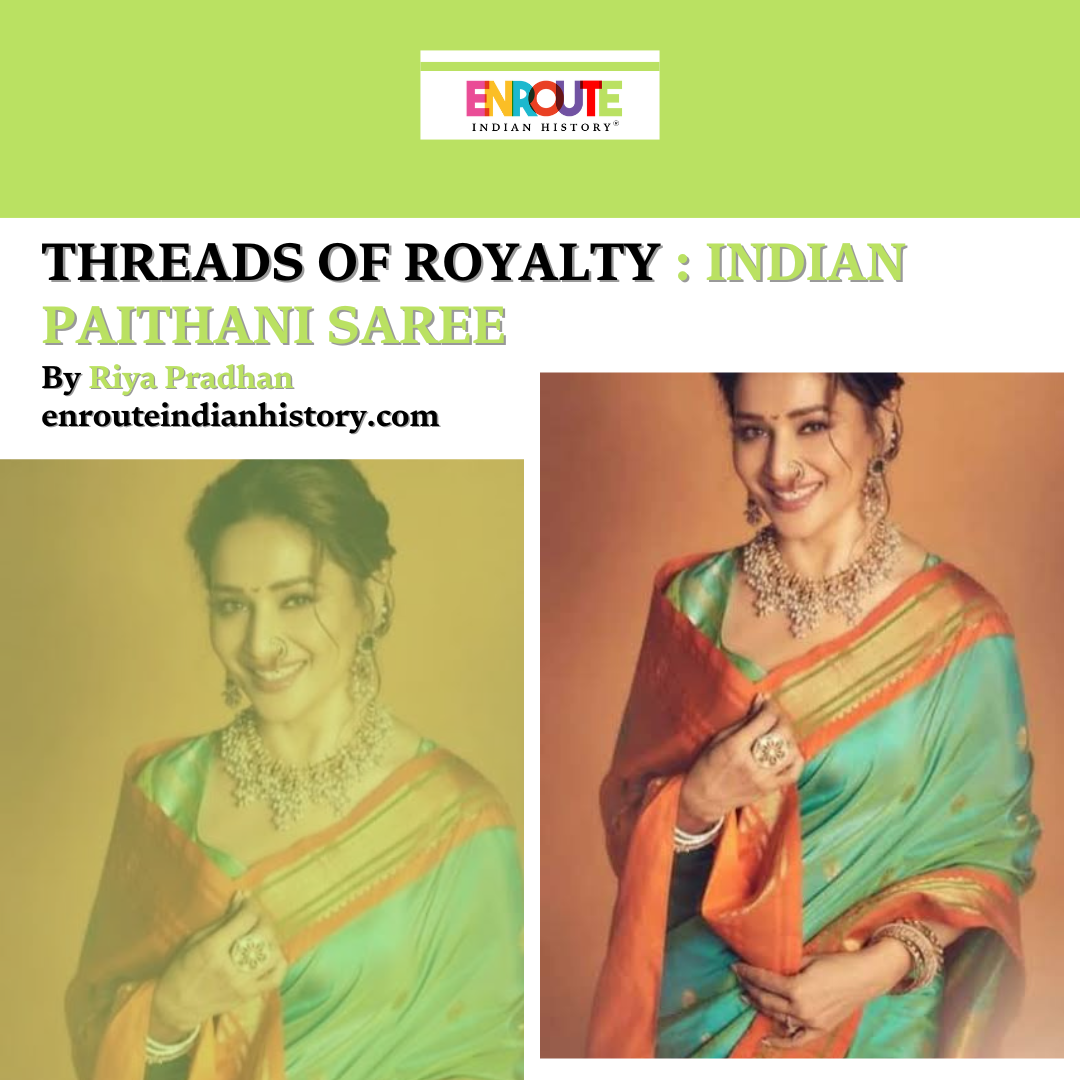
The most celebrated and traditionally fashionable fabric of Maharashtra, is the Paithani Sari. It holds the title of the Mahavastra of Maharashtra (great cloth of Maharashtra). The name Paithani is derived from the city of Paithan where the sarees were being weaved originally. Paithan has been ruled by eleven different dynasties over the centuries, each wanting to reap the benefits from the profits earned due of the prominence of the Paithani weaving art. Despite the changing dynasties, the town maintained its rich art of the Paithani weaving.
The story of Paithani
On the left bank of the Godavari river, often called as the Dakshin Ganga was an ancient town- Pratishthan known as Paithan today. Often termed as the Kashi of Deccan this city was the capital city of the Satvahana dynasty. Paithan had an advantage- The abundance of minerals, fertile soil, and forest resources promoted economic expansion.
In the year 1966, the Archaeological Survey of India discovered light silk threads and pieces of cloth at Nevasa, a town close to Paithan. The silk cloth has authentic designs in the same method applied in Paithani weaving. Therefore, the researchers concluded that Paithani art form is the oldest weaving art which is 2200 years old.
Throughout the ancient and mediaeval centuries, it remained a significant trading and commercial hub. Hala, a poet in the period of the Satvahana dynasty described the process of weaving, dyeing, stitching and embroidery in the literature Gatha-Sattasai.
Cotton and silk, along with other Indian products like ivory and pepper, were much sought after in the Greco-Roman world. Satvahana rulers sent diplomats to Western nations to learn about and analyse their fabric preferences. Greek records describe exquisite Paithani fabrics from Pratishthan, Maharashtra. The ancient record, Peripleus of the Erythrean Sea of Greek stated that Paethana (Paithan) was a mart town renowned for semi-precious stones and exported large quantities of them. The Roman mathematician—Ptolemy and a Greek traveller Arrian also recorded Baithana (Paithan) which is famous for its fine cloth, jewellery and bead industry. The Roman writer—Pliny described the abundance and prosperity of Paithan. He further stated that almost half of the entire amount of money paid to India's imports was approximately ten crore every year and this trade with Paithan was one of the key
elements of such amounts, hence it was actually placed on the world map.
The arrival of Islam into Deccan expanded the horizons of textile activities. In this period, Paithan took over the Islamic methods of textile production, yet simultaneously never gave up on its own characteristic pattern.
The Marathas also supported textile production. It was at the peak of its popularity during the reign of the Peshwas. According to Arshi Ahmed Qureshi, the owner of Bashir Silk Factory in Aurangabad (now Chhatrapati Sambhaji nagar), Paithani Sari was popular among the Maratha-Mandal during the Peshwa time, as evidenced by archives. Due to its rising demand in Maharashtra – Mandal, the mighty Maratha nobility, attempted to establish Paithani weaving businesses at their own headquarters at Poona, Indore, Nagpur, Kolhapur, Miraj, Nasik, and Baroda. These facilities also produced Paithani-brocade saris. However, imitations lacked the texture and ornamentation of real Paithani from Paithan. Only women from the royal household or those linked with the provincial Maratha court could afford these saris, which were highly costly. Wonderfully woven, the royal women wore Paithani saris with pure
gold borders and "pallu" combined with copper for strength.
During the colonial period, Paithan persisted because of the encouragement from the Nizam's family in Hyderabad, who established a centre for weaving turbans, saris, shalus, and patkas (sashes) for the court. In the contemporary times the Paithani saree is a jewel in the case of the Maharashtrian brides. It has become a symbol of elegance grace and royalty.
The make of Paithani
The sari's border or pallu pattern is created by interlocking non-continuous weft silknor jari threads during the weaving process. The intricate and time-consuming procedure leads to high product costs. The sari is weaved with pure silk yarns in both warp and weft. Traditionally, jari, a fine wire made of pure gold or silver, was used to inlay motifs on borders and pallu. Peacocks, lotus, lowers, leaves, mango, parrots, flowery, geometrical, and swan are some of the most commonly used motifs in this saree design. This type of weaving is a tradition in the Koshti and Momin community. Koshti refers to a weaver who teaches his son the craft, which is then passed down to future generations.
Role beyond textile
Traditionally, the Paithani saree has been more than just a luxurious piece of apparel, serving as a valued treasure and an informal medium of transaction in Maharashtrian culture. Its intrinsic value—due to high-quality silk, meticulous handloom weaving, and exquisite patterns—has made it a valuable object in both commercial and social
transactions.
In ancient and medivial times this saree was a mark of economic well-being. They were viewed as a sound investment because of their durability and the prestige attached to possessing them. Families occasionally accumulated Paithanis as a reserve, much in the way they saved gold or land, and they were an informal but real economic instrument. Their worth never depreciated so they could be exchanged at a point of need with financial. That is simply due to the fact that saree edges and motifs, made of gold and silver strings, could be bartered and sold during bad times. It thus
evolved to act as an insurance mechanism for difficult times.
Shubha Mahajan states that the labor-intensive workmanship of Paithani sarees gives much financial and emotional worth to each piece produced. She discusses the fact that not only were these sarees worn to adorn oneself, but they were also collected, exchanged, and even used as collateral, hence serving as alternative currency for other conventional transactions. This dual use illustrates how the saree symbolized both beauty and economic prosperity for families simultaneously. The physical craftsmanship of these sarees allows them to be used as alternative assets. The intrinsic value of these sarees made them a perfect store of wealth, supporting the notion that textiles could be a store of capital over and above their immediate utilitarian or aesthetic function.
When Paithan was ruled by various dynasties it remained an important trading centre due to the demand of the Paithani saree. Even when Paithan lost its title of the capital city it still was shining with pride due to its trade. Multiple sculptures in Ajanta and Ellora, temple in the then empires were made wearing clothes according to the style of cloth produced in Paithan. Thus Paithani saree of Paithan became a showstopper garment. The monopoly of Paithani saree remained untouched for a long period of time.
During the loot led by Khiljis in the city of Paithan among gold coins and other treasures the silk cloth and muslin cloths used to make these sarees were also looted as mentioned in the accounts by Amir Khusroo. This is a clear indicator that people in far away areas also were aware of the importance of the cloth from Paithan region. When Muhammad bin Tughlaq temporarily shifted his capital to Devgiri he was said to be quite smitten by the cloth from Paithan and thus continued to patronize the textile centre of Paithan for many more years. He introduced Persian inspired motifs and colour combinations in this saree which the weavers learnt quickly.
During the Maratha era this saree became a symbol of royalty. The elite class letters and exchange of gifts often had one common name- the Paithani. Gifting this saree became a subject of pride among the rulers and nobels. The make, colour and designs of this saree were so in demand that they were requested to be woven in turbans,
dhotis and anagvastras too.
Essentially, the Paithani saree is more than a beautiful fabric; it is a colorful reflection of Maharashtra's rich economic and cultural heritage. Its excellent craftsmanship demonstrates its status as a priceless treasure and emblem of royal grandeur. The delicate dance of pure silk and glittering zari has made Paithan a significant
commercial hub throughout the years, while also empowering the saree with long- lasting meaning, acting as both an aesthetic wonder and a source of financial security. Paithani sarees are deeply ingrained in Maharashtrian identity, generating awe and sustaining a time-honoured tradition that honours both heritage and creativity for future generations.
References
Shewade, Ruchi, The Craft of Paithani: Challenges and Revival. journal-article.
https://rswordsandmore.wordpress.com/wp-content/uploads/2018/04/research-paper- on-paithani-artisans.pdf.
Mahajan, Shubha. 2021. A research paper “Challenges and Scope of Development: A Case Study of Paithani Weavers of Maharashtra (India)”https://orcid.org/0000-0002- 2149-5036
Bhatia, Reena and Deepti Desai, "Sustaining the Traditional Paithani Saree Weaving of Maharashtra, India," International Conference on Innovative Trends in Multidisciplinary Academic Research 2014 333-38.
Datta, Diptarka. “Paithani Saris and Women in Maharashtra: Patterns of Consumption and Preference Through Time.” International Journal of Multidisciplinary Research and Technology, 2021.
Textile committee, Ministry of Textile, government of India, Mumbai (2008) Study and documentation of paithani saree and dress material. Ministry of Commerce & Industry UNCTAD and DFID.