

Threshold in Motion: How Train becomes a Liminal Space in Satyajit Ray’s Apu Trilogy (1955-1959) and Nayak (1966)
- December 11, 2025

By Ramyani Banerjee
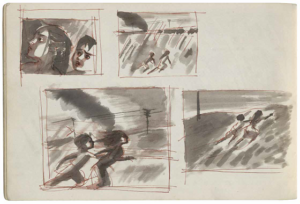
The illustration of the train scene in Pather Panchali, sketched by Satyajit Ray. Ray never wrote a script for the film, relying instead on his own illustrations. Image source: Pather Panchali Sketchbook, copyright: Sandip Ray. Available at: https://www.theheritagelab.in/satyajit-ray-pather-panchali-sculpture/ (Accessed: 3 November 2025).
Life, Motion, and Becoming:
In Ray’s cinematic imagination, the train isn’t merely iron and steam — it is a zone of transition. In his landmark Apu Trilogy (comprising Pather Panchali, 1955; Aparajito, 1956; and Apur Sansar, 1959), the train links the quiet rhythms of rural Bengal to the chaotic hum of the city. But Ray does not treat this connection simply as a line from point A to point B. Instead, the train represents a psychological and emotional threshold — a place where identities shift and destinies are altered.
In Pather Panchali (Song of the Road, 1955), one of the most iconic train moments in world cinema unfolds: young Apu and his sister Durga stand in a field of kaash flowers, their eyes fixed on the horizon, listening to the distant rumble before the train appears. The sound of the train arrives before the machine itself — a vibration, a promise, a disturbance in their pastoral life. As Trisha Gupta writes in The Times of India, what makes that sequence unforgettable is, the rural Bengali landscape ruptured by the sound of the machine before the sight of it.
That rupture is part of what makes the train such a powerful liminal figure in Ray’s films — it first arrives as sound, as premonition, then as physical presence. For Apu and Durga, the train is almost magical, emerging from their imagination as a beast of black smoke that cleaves through their world. It embodies curiosity, adventure, and the promise of a world beyond the familiar horizons of poverty and stagnation. As one critical reading notes, the first appearance of the train at a distance via ‘clouds of smoke above the sea of white flowers’, presents the train as an ostensibly invisible ‘symbol of the modern world cutting upon village life’ As the train rushes past, Ray deliberately cuts to a shot where the moving locomotive dominates the frame, leaving only fleeting fragments of Apu visible— a cinematic disjunction that underlines the force of the machine. Through this sequence, Ray establishes the train as a profound metaphor for life’s movement: unstoppable and transient.
However, what begins as wonder soon moves towards a tragedy. In Pather Panchali, the train’s arrival is juxtaposed with death: the passing of Indir Thakuran, the children’s elderly aunt. The juxtaposition of the two events—the children’s joyous discovery and Indir’s quiet passing—creates a powerful dialectic between vitality and decay, between the continuity of life and the inevitability of death. According to critics, Ray frames this not as a coincidence but a symbolic rupture.
In Aparajito (The Unvanquished, 1956), Satyajit Ray deepens the emotional and symbolic resonance that threads through his celebrated Apu Trilogy. The train—ever-present in Ray’s visual landscape—serves as a recurring motif that shuttles Apu between his rural roots and the urban world, embodying both connection and separation. When Apu departs for Calcutta to pursue his studies, the journey marks more than a change of place; it signifies a rite of passage from childhood into adulthood, and a quiet detachment of the umbilical bond that once anchored him to home. Apu’s return visits grow shorter, his letters fewer. His intellectual awakening in the city distances him emotionally from the world that once defined him. So, for his mother, Sarbajaya, the train assumes a deeply emotional resonance: its distant whistle becomes a haunting reminder of her son’s absence. Each sound of the train is laden with longing, as she waits, hopes, and suffers in solitude. Ray transforms the railway into a powerful narrative and psychological device—one that not only transports Apu physically but also carries Sarbajaya’s yearning, her grief, and her unspoken love across the widening distance between them. Beyond its role as a metaphor for modernity, the train in Ray’s films can be read as a symbol of the ceaseless journey of life, of human striving, of our fragile hopes. Through the rhythmic presence of the railway, Ray crafts a haunting narrative that mirrors the movement of life itself: relentless, forward, and ultimately, irreversible.
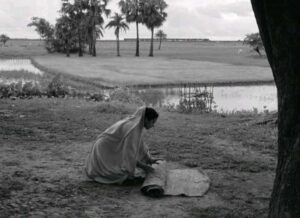
The train shot with Sarbojaya (played by Karuna Banerjee) in Aparajito (1956). Image source: Trains in the films of Satyajit Ray, available at: https://st2.indiarailinfo.com/kjfdsuiemjvcya4/0/6/9/3/5189693/0/fbimg164209515929642465.jpg (Accessed: 3 November 2025).
The Pulse of Grief and Loss:
In The Apu Trilogy, the motion of the train mirrors Apu’s own restless journey through life — a passage from innocence to experience, from wonder to loss. In Pather Panchali (1955), the train emerges as a symbol of discovery and awakening — Apu’s first intoxicating glimpse of a world that lies beyond the narrow lanes of his village. It is the sound of possibility, the shimmer of modernity calling from afar. Yet, by the time we arrive at Apur Sansar (The World of Apu, 1959), that same train carries a different weight. Its whistle echoes with memory and mourning — the reminder of everything time takes away. What once promised beginnings now bears the quiet sorrow of endings. The critics observe that in this final chapter, Ray does not simply use the train to mark progress or escape: the train becomes a site of disjunction, of fragmentation, even of mortality. When Aparna departs by train after marrying Apu, Ray films the scene with quiet foreboding, the rhythm of the wheels underscoring an unease that foreshadows her death. Later, in one of the trilogy’s most haunting moments, when a grief-stricken Apu decides to end his life, a train roars past and leaves behind a dead pig on the tracks — a brutal metaphor for the suddenness of death and the weight of loss. In this way, the train becomes a existential threshold — a space where life’s continuity is manifested in motion. Characters board, disembark, watch from windows, remember, and wait. The constant rhythm of wheels on tracks echoes a human pulse, a heartbeat of becoming.
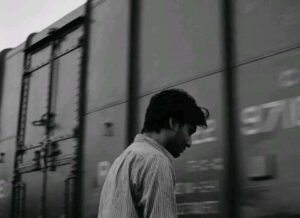
The train shot in Apur Sansar (1959). Image source: Trains in the films of Satyajit Ray, available at: https://st2.indiarailinfo.com/kjfdsuiemjvcya4/0/6/9/3/5189693/0/fbimg164209516738822112.jpg (Accessed: 3 November 2025).
An Experiential Metaphor for Human Striving
Ray himself often expressed a deep empathy for the human condition, and his cinematic technique reflects that. Media scholar Patricia Pisters argues that in Ray’s films, motion (especially via trains) is philosophical — the moving train becomes a mirror of inner lives: desires, anxieties, yearning, metamorphosis. If we think of this as a “threshold in motion,” we see a more profound layer: the train, throughout Ray’s cinema, is neither fully in one world nor another. Ray uses this liminality to express how his characters occupy in-between states — emotionally, socially, temporally. The movement of the train does not mark a straightforward journey from one stage of life to another; instead, it captures the turbulence of human experience — messy, emotional, and uncertain. In Aparajito, Apu’s departure and arrival are filled with longing, regret, and the psychic weight of separation. In Apur Sansar, Apu’s small Calcutta apartment, situated very near to the railway tracks, is perpetually haunted by the sounds of trains — their sharp whistles and rumbling presence serve as reminders of his past, of what he has lost and what continues to linger
However, in Nayak (The Hero, 1966), Ray’s use of the train becomes especially powerful. Nayak’s protagonist Arindam, (played by Uttam Kumar) is a popular film star, who travels from Calcutta to New Delhi to pick up an award. Rather than taking a flight, he opts for a train — allegedly to sleep off his anxieties after a nightclub incident — but the train becomes more than just a refuge. The entire second act of the film is set aboard a train.
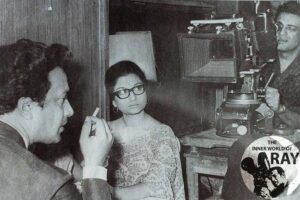
Behind the Scenes of Nayak: Uttam Kumar as Arindam, with Sharmila Tagore and Satyajit Ray. Image Source:- The Telegraph (2025) Satyajit Ray’s 1966 film starring Uttam Kumar and Sharmila Tagore feels more relevant than ever before. Available at: https://www.telegraphindia.com/entertainment/satyajit-rays-1966-film-starring-uttam-kumar-and-sharmila-tagore-feels-more-relevant-than-ever-before/cid/2085843 (Accessed: 3 November 2025).
In this confined, moving space, he is forced to confront his fears, regrets, and the gap between his public persona and private self. As noted by Arshia Dhar, what at first seems like a simple narrative of a star accepting honour is subverted: Ray uses the train journey as a vehicle for introspection, peeling back the layers of stardom to expose the real man. It’s a confined space where the veneer of celebrity gives way to fragility, where movement physically mirrors the inward journey. Ray does not allow Arindam to remain in his star persona; instead, he orchestrates encounters (especially with Aditi, played by Sharmila Tagore) that challenge him to confront his inner self. Yet, by the time the train nears Delhi, the journey closes in ambiguity.
Interestingly, Ray didn’t shoot this on a real train. As narrated by his son Sandip Ray, the train in Nayak was actually a studio set. The illusion of motion was achieved by swinging a canteen hung from the train set, and combining it with real train sounds. The train has served as a temporary sanctuary, a space where the star becomes just a man, and that transformation, temporary though it may be, carries existential weight. This technical artifice underscores the symbolic weight he placed on the train — he wasn’t just representing a real vehicle, but constructing a metaphysical space that could hold inner truths.
Fragility, Desire, and the Motion That Defines Life
Ray’s train motif is not sentimental; it is loaded with precariousness. The train, in his metaphoric world, is less a symbol of triumphant progress and more a reminder of fragility. Life is always in transit — and so are his characters. The very motion of the train suggests impermanence. Passengers ride, but they disembark; relationships formed in motion don’t always last. In Nayak, for instance, the train ride reveals the vulnerable underbelly of fame, success, and solitude. In the Apu Trilogy, continuity is never guaranteed: leaving, returning, starting anew are recurrent motifs.
As critics have pointed out, Ray’s ambivalence toward modernity is not negative, but deeply human. He acknowledges the transformative power of the train — how it connects village and city, memory and desire — but also sees its potential for isolation, rupture, and loss. While Ray was not overtly religious in his filmmaking, his use of the train hints at a kind of spiritual aspect. The train becomes a sacred axis for his characters — a space where decisions are made, grief processed, identities reconfigured.
That space, however, demands a surrender. When Apu listens to the train whistle, he remembers; when Sarbajaya hears its rumble, she yearns. When Arindam opens up in Nayak, he is speaking in transit, in a place that is neither here nor there, and that very in-betweenness forces truth out. Moreover, Ray’s choice to have the train’s sound often precede its visual appearance suggests a spiritual parallel. The train often arrives as a whisper or vibration first — like a foreboding premonition, or a spiritual call. In Pather Panchali, the children sense it before they see it. That moment resonates like a meditation on the unseen forces that shape our lives.
Conclusion:
Understanding Ray’s use of the train as a liminal threshold allows us to appreciate how deeply he engaged with themes of modernity, memory, and mortality. While Ray’s cinematic world is firmly grounded in realism, his recurring train motif introduces a rich layer of symbolism. Through it, he captures the pulse of a nation in transition — from rural to urban, poverty to aspiration, tradition to modernity — without ever losing sight of the personal and the intimate. In celebrating his centenary, critics and cinephiles have revisited this motif with renewed awe — as The Times of India put it, the train remains one of the most indelible images of Ray’s world. It is, in a way, his quiet locomotive, carrying his themes, his characters, his philosophy. It signifies not merely the promise of modernity but the fragility of human desire — the motion that defines life itself.
In doing so, Ray transforms a symbol of modern infrastructure into a profound reflection on the human condition — the ceaseless journey of becoming. By positioning the train as a liminal space, Ray invites us to reflect on life itself as a journey. They are, in his cinematic world, the wheels of becoming — propelling his characters (and his audience) toward a future that is as fragile as it is inevitable.
References
1. Dhar, A. (2025) Satyajit Ray’s ‘Nayak’ & The Unbearable Weight of Being Seen. The Hollywood Reporter India, 27 February. Available at: https://www.hollywoodreporterindia.com/features/insight/satyajit-rays-nayak-and-the-unbearable-weight-of-being-seen (Accessed: 4 November 2025)
2. Film Companion (2020) ‘The Use of Trains in Satyajit Ray’s Trilogy’. Available at: https://www.filmcompanion.in/amp/story/readers-articles/the-use-of-trains-in-satyajit-rays-trilogy (Accessed: 3 November 2025).
3. Gupta, T. (2021) ‘Satyajit Ray’s world of trains’, The Times of India, 8 May. Available at: https://timesofindia.indiatimes.com/india/satyajit-rays-world-of-trains/articleshow/82479581.cms (Accessed: 3 November 2025).
4. Movie Mahal (2019) ‘Genre, Iconography & Ideology: Imaginings of the Train in Indian Cinema – Part 4: The Auteur and the Train – Satyajit Ray & The Apu Trilogy’. Available at: https://moviemahal.net/2019/09/29/genre-iconography-ideology-imaginings-of-the-train-in-indian-cinema-part-4-the-auteur-and-the-train-satyajit-ray-the-apu-trilogy/ (Accessed: 3 November 2025).
5. Media Watch Journal (2020) ‘The Changing World of Satyajit Ray: Reflections on Anthropology and History’. Available at: https://mediawatchjournal.in/wp-content/uploads/2020/05/Satya.pdf (Accessed: 3 November 2025).
6. The Times of India (2018) ‘How Satyajit Ray used optical illusion to create a “real” train in “Nayak”’, 11 May. Available at: https://timesofindia.indiatimes.com/entertainment/hindi/bollywood/news/how-satyajit-ray-used-optical-illusion-to-create-a-real-train-in-nayak/amp_articleshow/64384504.cms (Accessed: 3 November 2025).