

By Anukriti Upreti
Can you imagine a journey on a train without toilets, having the only option to relieve yourself during the long halts at some stations? It’s not easy right? However, this was the situation a century ago, which changed only after a funny letter written by one Indian passenger named Okhil Chandra Sen to the Railway authorities of British India in 1909. Only after this letter did toilet facilities start operating in railways. However, ensuring their installation and functioning has remained a big challenge, leading to the development of various kinds of toilets, which is the subject matter of this article.
In 1853, railways were introduced in India, linking several interior areas of the country to big cities. This radical change facilitated transportation across the country. However, there were no toilet facilities on the trains, making the journey uncomfortable for many people. In 1909, a historic event occurred: a passenger named Okhil Chandra Sen deboarded from the train as the train halted at Ahmedpur station in West Bengal to relieve himself. Unfortunately, he missed the train as the guard blew the whistle, and the train departed from Ahmedpur station. Following this, he wrote a letter to the authorities of the Sahibganj divisional railway office to take action against the guard. After this incident, the British decided to establish lavatories on the Indian Railways. However, at this time, toilets were installed only for the upper class coaches, and it took 30 more years to introduce toilets to lower class coaches.
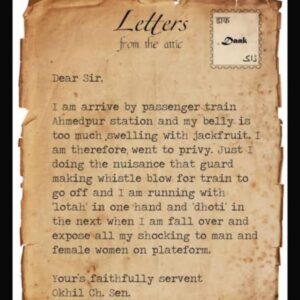
Letter written by Okhil Chandra Sen, Image courtesy Aaj tak Bangla.
The earlier trains had a conventional drop chute toilet, where the end of the commode was connected with a chute that outlets the waste directly on the railway tracks, causing foul smell and nuisance on the tracks. These toilets were unhygienic and caused corrosion in the tracks owing to their acidic contents. To solve this problem, Controlled Discharge Toilet System (CDTS) toilets were installed in trains. These toilets store human waste in retention tanks until the train reaches a minimum speed of approximately 30 km/h, at which point it is discharged onto tracks. They are designed to operate on the principle of high flush, through which the toilet bowl is evacuated by the means of water pressure. The retention tank has two openings: one opening when the flush button is pressed, and the other opening to throw out the effluent. They are easy to clean and still used in trains. However, this was not a complete solution as still the waste was discharged on the tracks causing pollution and leading to health hazards.
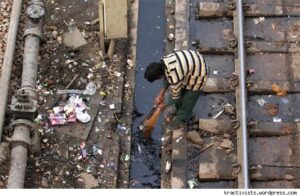
Issue of waste disposal in Indian Railways. Image courtesy, PNRstatuslive.com
To address the issue of the high amount of water used in these toilets, a Vacuum Toilet system was introduced. The vacuum toilet system uses a combination of a high-efficiency vacuum flush and a biodigester tank to handle waste, similar to aircraft systems. They are technological upgrades from traditional toilets and earlier bio-toilets, designed to reduce water consumption, prevent foul smells, and eliminate waste from falling directly on the tracks. This system is hygienic, reduces foul smell, and solves the problem of waste falling onto tracks.
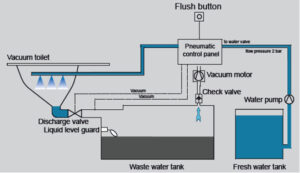
Bio-Vacuum Toilet System. Indianrailways.gov.in
According to a report conducted by Indiaspend on November 23, 2017, based on the study of IIT Madras, India deals with 3,980 tons and 497 truck-loads (at 8 tons per truck) of waste produced by trains every day. To deal with this situation, biodigesters were installed in trains so that the waste generated could be digested by the bacteria. But, the report conducted on 2018 says that these digesters are no better than the septic tanks and the water they let out is no better than “ raw sewage”
“Bio-toilets developed by the Indian Railways and Defence Research and Development Organization have earned praise from Prime Minister Manmohan Singh, but IIT scientists say they are neither environment-friendly nor suitable for trains.” (Times of India, 2012) These bio toilets use ‘cold-active’ bacteria collected from Antarctica to treat waste and convert it into water and gas. However, Vinod Tare, professor of environmental engineering and management, IIT Kanpur, says that there are no magic bacteria that can convert so much waste into water in such a short time. In an interview, he listed some problems with toilets in Indian railways. He says that Indians are in the habit of “wet cleaning” (in toilets) unlike the “dry cleaning” dry cleaning’ practices in Western countries. Therefore, the volume of waste in Indian trains is substantially higher. Moreover, the Indian climate varies from 45°C to as low as 4°C, making the task more challenging as it depends on temperature. He also argues that even if the claim that methane is being produced by bio-digesters is true, it creates another problem, as methane is a hazardous gas. Thus, we need to look at alternatives. However, the government says that the issue highlighted by IIT Kanpur has been resolved, and the bio-toilets along with the vacuum system are eco-friendly and solve the issue of waste disposal.
Keeping these arguments aside, if we want to understand how much the sanitation and hygiene facilities of railways have changed over time, the accounts of passengers provide us with good insights. Many passengers say that facilities such as mobile helplines have made the journey easy, as people can ask the authorities to clean the toilets before use. Trains such as Vande Bharat have bio-vacuum toilets similar to those of aircraft that use less water and help maintain hygiene. The issue of a foul smell has been resolved to some extent, which is a good sign.
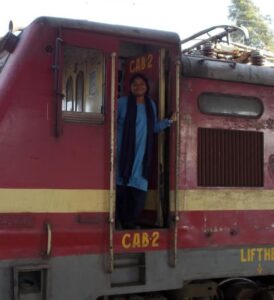
Anjali, a loco-pilot who faces challenges due to the lack of toilet facility. Image Courtesy bhaskarenglish.in
However, there is a group of people who contribute significantly to the functioning of railways but still have no toilet facilities. The loco- pilots have been protesting for a long time, demanding for toilets in locomotives and shorter duration of working shifts so that they can work efficiently. News reports say “India has over 2,000 female loco pilots, yet less than 10% of locomotives are fitted with toilets.” In an interview with Bhaskar English Santosh Singh, a loco pilot from Lucknow said “I hold my urine for hours. Male colleagues sometimes use bottles or bags, but what can women do?” Anjali, a senior assistant loco pilot from Ranchi adds, “During periods, I have no place to change sanitary napkins. In emergencies, I go inside the engine to change,” which shows how the loco-pilots who serve as the backbone of railways struggle with such basic things during their working hours.
The Hindu reports that officials say waterless urinal facilities have been provided in 883 locomotives since 2018, 7,075 locos fitted with ACs and toilets were installed in all new locos, while older ones were retrofitted. (The Hindu, 2025) This suggests that now the government is working for the betterment of our human engines who serve thousands of people everyday through their services in railways. Bio-vacuum toilets are good alternatives to traditional toilets; however, keeping in mind the concerns of recent research on their use and challenges, we should go ahead with more feasible and eco-friendly toilets in trains.
References:
1. https://indianrailways.gov.in/
2. Anurag Roushan (2025). The story of how and when toilets were introduced in Indian Railways. [online] India TV News. Available at: https://www.indiatvnews.com/photos/india-the-story-of-toilets-in-indian-railways-how-a-passenger-s-complaint-brought-a-big-change-in-1909-a-journey-through-timeline-gallery-images-2025-02-04-974666.
3. Rinchen Norbu Wangchuk (2022). Trains In Indian Railways Have Toilets Because of This Passenger’s Letter. [online] The Better India. Available at: https://thebetterindia.com/295758/how-indian-railways-got-their-toilets-okhil-chandra-sen-letter-twitter-history/ [Accessed 16 Nov. 2025].
4. J.P.Singh Toilet systems in Indian Railways https://rskr.irimee.in/
5. Anand, S. (2025). Forced to use bottles to relieve themselves: Railways deny break requests, women loco pilots ask — how do w… [online] Bhaskar English. Available at: https://www.bhaskarenglish.in/originals/news/indian-railways-loco-pilots-toilet-break-women-periods-issues-134848165.html [Accessed 16 Nov. 2025].