
Tracing the Journey of Gīta Govinda From Ancient Scripts to Modern Performance
- October 15, 2025
P. Sanjay
The Gita Govinda had an important role in the cultural and religious history of 12th century eastern India, composed by Jayadeva, during the reign of King Lakshmana Sena (r. 1178–1206 CE) in Bengal, an era marked by great artistic and literary growth, the growing importance of Sanskrit kavya and regional literature. The composition of this text reflects Vaishnava devotionalism , at the same time also filtered the classical Sanskrit literature, Jayadeva’s work has been very different from the works of earlier religious texts, which were narrative in nature, where as Jayadeva’s work was highly lyrical , a fusion of both Theological Ideas and courtly style of writing.
Gita Govinda transformed the whole style of writing, as this became the major style of writing in the whole medieval period. The text is organized into twelve chapters (sarga-s), each containing one or more prabandha-s. There are 24 prabandha-s, with each consisting of eight couplets known as Aṣtapadī-s, which are songs characterized by a unique refrain. Aṣtapadī-s hold an important place in Indian classical dance and music. Their exquisite lyricism, refined vocabulary, use of alliteration, and portrayals of divine love have established them as a significant part of literature. Gīta Goviṇda is filled with ‘Madhura Bhakti,’ one of the nine forms of devotion to God. Consequently, Gīta Goviṇda by Sri Jayadev is acknowledged as a significant text both historically and for its literary and religious value (Dr. Bilambita Banisudha,2024).
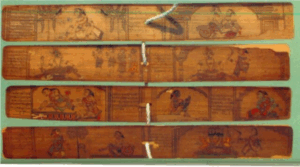
Gita Govinda, Catalogue No. Ext. /166 (Courtesy: Descriptive Catalogue of Illustrated Manuscripts, p. 38)
Gita Govinda’s manuscript tradition gives us great understanding about how the work is usually transmitted and received over time. Usually the royal courts commission their manuscripts in previous materials, but Gita Govinda was written on palm leaves, and its influence was in the regions of Bengal, Odisha and Nepal. This choice of material suggests that this text was not only limited to the royal courts but also for the common public. Manuscripts that are found are also illustrated with paintings of love making others with deep admiration. The Orissa Museum boasts a large number of manuscripts of Gita Govinda by Jayadeva. These are illustrative, non-illustrative and also present in various shapes.
The transmission of Jayadeva’s Gita Govinda is inseparable from the broader sector of Sanskrit manuscript culture. The estimation of paintings flourished in Orissa. Gita Govinda consists of a good number of manuscript illustrations which are preserved. Palm leaf manuscripts are generally called pothis. The manuscripts that are illustrated are called chitrapothis. The materials that are generally used are palm leaves, handmade paper, thin wooden planks covered with cloth or the ivory planks, etc. Different indigenous colours obtained from Hingula, Haritala, Gorachana, Hariotra, Kumkuma, Kajjala and Geru, etc. were used for painting on palm leaf, paper, patta and planks (Bhagyalipi Malla, 2007).
Gita Govinda stood out from other lyrical poems, due its verses being recited as a ritual in Jagannatha temple at Puri, Jayadeva’s verses included in the religious compositions of the temple, which kept the tradition live for generations, spiritual incorporation of this text not only became a cause for its survival, but also developed its religious motive, leading to a living ritual rather than just a mere poem. The combination of the Jagannath Temple and Jayadev’s Gīta Goviṇda showcases the rich cultural and religious tapestry of Odisha(Dr. Bilambita Banisudha,2024). Also, the way the poem was preserved and transmitted shows that it removes the gap between many parts of the society, including kings, temples, and artists. Instead of being stuck in its original time, the Gita Govinda continued to have a powerful influence on religion and culture in South Asia.
The theological vision of the Gita Govinda is remarkable with its depiction of the devotional themes within the Sanskrit literature. The shift of focus from Krishna’s heroic and pastoral exploits, that’s how he is portrayed in the Bhagavata Purana to intensely depicting the emotional relationship between Krishna and Radha. He depicts Radha as the central figure, having a greater significance, transforming her longing and union with Krishna into a paradigm of spiritual devotion. Jayadev’s composition portrays Radha as the very embodiment of bhakti, the yearning soul seeking union with the divine.
The Gita Govinda and the veneration of Radha became the pivotal focus of the theological reflections and ritual practices of the Goudiya vaishanav , the disciples of Sri Chaitanya. Drawn to the sacred traditions of the Jagannatha worship at Puri, Chaitanya found deep spiritual inspiration there. In most contexts, the Gita Govinda is sung in praise of either Radha or Krishna, or on occasion before both. However, at Puri this tradition of recitation was uniquely directed towards the temple deities. of Krishna, Subhadra and Balabhadra . There’s this Unbroken tradition of 700 years in Jagannatha Temple, where Jayadeva’s works are being recited in front of the holy of the holies.
The love between Radha and Krishna in the text expresses the relationship in two forms Sringara Rasa (the erotic form) and the Bhakti Rasa (the spiritual form). Both forms of Sringara can be witnessed, the Sambhoga Sringara (love in union) and the Vipralambha sringara (love in separation). Though love has been depicted not only as abstract but also love is presented through spiritual longing deeply accessible to devotees. A striking feature of Gita Govinda was every individual composition was transmitted using different ragas assigned to each song, for example Raga Nata, Raga Vasanta (Miller, Barbara Stoler, 1977).
Another reason for considering the Gita Govinda as distinctive is its strong connection with Indian traditional stage performances. Unlike most Sanskrit verses that exist mainly in textual form, Jayadeva’s work was composed to be sung and danced, highlighting its deep influence on visual and performance art traditions (including iconography). For instance, murals in Puri and other temples depict episodes from the Gita Govinda, reflecting its visual resonance. Indian classical dances such as Odissi and Manipuri also bear its influence the vivid descriptions of Radha and Krishna’s expressive gestures (mudras) and passionate dance (abhinaya) contributed to the development of diverse choreographies (Vatsyayan, 1977, pp. 142–145).
This work has produced new musical compositions in Kerala and Tamilnadu. From Gujrat to Assam and from Kerala to Kasmir, it has inspired a series of Commentaries. Painters have taken great inspiration from this work. We find specimens of paintings in Assam, Rajasthan, Himachal Pradesh and Gujrat. Its theatrical diction was also known to have been spread into Nepal and Manipur.. Its spread was around various regions , it is widely sung in Vaishnavite centres ranging from Patan in Gujarat to Kumbha of Rajasthan , also outside of the Indian subcontinent, towards Central and Western Asia (Nimai Charan Mohanty, 2008).
The Gīta Govinda holds a distinctive position in the intellectual and devotional landscape of India, serving as a connection between high literary culture and mainstream religious practices. Besides its poetic excellence, it acted as a cultural medium that introduced Sanskrit artistic principles into the vernacular consciousness, impacting the early poetry of Odia, Bengali, and Braj bhakti. Its method of recitation played a pivotal role in shaping the development of temple rituals, and its emotional depth fostered a novel form of closeness between worshipper and divine. The poem’s primary focus on divine love also found resonance within medieval Sufi traditions, highlighting its broader intercultural reach. Furthermore, its impact reached the realm of iconography through depictions of Krishna and Radha, as established by Jayadeva, became standard in miniature paintings, temple decorations, and devotional art across various regions. Therefore, the Gīta Govinda is not merely a work of devotion but a foundational text that transformed aesthetics, theology, and cultural memory throughout South Asia.
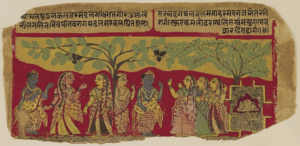
Leaf from a Manuscript of Jayadeva’s Gita Govinda: Dalliance of Krishna and Radha, Source: Norton Simon Museum
References
Banisudha , Bilambita . “JAYDEV’S GĪTA GOVIṆDA and JAGANNATH TEMPLE: A Study of Its Compositions.” Mukt Shabd Journal, vol. 13, no. 2, Feb. 2024, pp. 374–392.
Miller, Barbara Stoler. Love Song of the Dark Lord: Jayadeva’s Gītagovinda. New York: Columbia University Press, 1977, pp. 95, 97, 125.
Malla, Bhagyalipi. “Paintings of Gītāgovinda in Palmleaf Manuscripts.” Orissa Review, April 2007, pp. 61–63.
Vatsyayan, Kapila. Classical Indian Dance in Literature and the Arts. New Delhi: Sangeet Natak Akademi, 1977, pp. 143–145.
Mohanty, Nimai Charan. “Gītāgovinda and Oriya Art Tradition.” Orissa Review, May 2008, pp. 15–16.