

By Saiee Katkar
Introduction
When the first train in India steamed from Bombay to Thane in 1853, it was hailed as the arrival of modernity. The railway promised to bridge the vast
distances of the subcontinent, carrying people, goods, and ideas into a new age of progress. Yet inside its carriages, India’s deep social hierarchies travelled alongside the passengers. What was meant to unite the nation often ended up dividing it further. The railway did not erase caste and class distinctions; it quietly reinforced them in iron and wood.
This article examines how colonial railways became a stage where inequality was both displayed and contested. Drawing on Ian J. Kerr’s Engines of Change (2007), Christian Wolmar’s Railways and the Raj (2017), Gandhi’s The Story of My Experiments with Truth (1927/1993), and official railway reports, it explores how travel in British India reflected not only who could pay, but who was permitted to belong.
The Colonial Promise of Equality
The British presented railways as a gift of civilization to India. Lord Dalhousie’s 1853 Railway Minute described them as a “great instrument of
progress” that would knit together a fragmented land. But as Kerr (2007) points out, this vision was selective. The railway network was primarily designed to move raw materials from the hinterlands to ports and transport British troops efficiently, not to promote Indian mobility or integration.
By the 1870s, most railway companies had introduced four classes of travel: first, second, third, and sometimes an “intermediate” category. These classes were more than economic distinctions; they represented the colonial social order. Europeans and high-ranking officials occupied the plush first-class coaches, Anglo-Indians and elite Indians travelled in the second, while the vast majority of Indians, such as peasants, labourers, and lower-caste travelers, were packed into the third class.
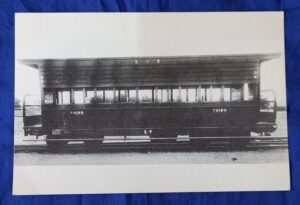
The Railway Board’s Annual Report and Fare Tables (1880) show that a first- class ticket from Bombay to Allahabad cost nearly fifteen times more than a third-class ticket. The difference in experience was just as stark. First-class coaches offered cushioned seats, privacy, and attendants. Third-class passengers had little more than a wooden bench or bare floor, without toilets, ventilation, or protection from coal dust. As Kerr (2007) notes, the colonial train compartment became a “moving metaphor of inequality.” ( Image 1 )
Hierarchies on the Move
Although railways could have been spaces of shared travel, they instead reproduced colonial segregation. Wolmar (2017) observes that British railway
policy simply transferred the hierarchies of the Raj onto the tracks. At major stations, separate waiting rooms were marked “Europeans Only,” and
refreshment rooms were divided for “British” and “Native” customers.
The Pioneer archives from the 1890s contain accounts of Indian passengers being humiliated for overstepping invisible boundaries. In one incident, a
Bengali lawyer was dragged out of a first-class carriage in Allahabad despite having a valid ticket. Such acts were justified under vague claims of “offending European comfort.” The train thus became an extension of a racially public space, yet restricted.
Caste divisions appeared not only among passengers but within the workforce. Upper-caste Hindus found employment as station clerks or supervisors, while lower castes worked as sweepers, porters, or coal-handlers. Even the food stalls reflected social divisions: certain vendors were barred from selling to high-caste passengers due to ideas of ritual pollution.
Gandhi’s Third-Class Journey
Mahatma Gandhi’s experiences revealed the human side of these inequalities. In The Story of My Experiments with Truth (1927/1993), he recounts being thrown out of a first-class compartment in South Africa an event that shaped his lifelong resistance to discrimination. On returning to India, he deliberately travelled third class to experience the realities of the poor.
What he saw appalled him. Gandhi wrote, “The third-class compartments are like sheep-pens. The poor travel to live and live to travel.” Overcrowding, filth, and indifference defined the experience. The colonial authorities excused this neglect as the “habit” of Indian passengers, as noted in the Railway Board Report (1880). Gandhi, however, understood it as a symptom of systemic inequality. For him, the third-class compartment was both a site of suffering and a space for awakening political consciousness.
The Third Class: Suffering and Solidarity
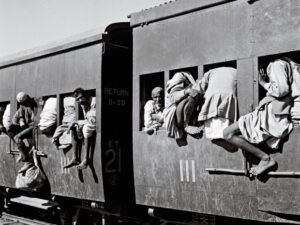
If the first class symbolized privilege, the third class embodied the nation in motion. Mulk Raj Anand’s novel Coolie (1936) vividly captures this space of struggle. His protagonist, Munoo, experiences the railway as a microcosm of colonial exploitation, noisy, crowded, and suffocating, yet full of human resilience.( Image 2)
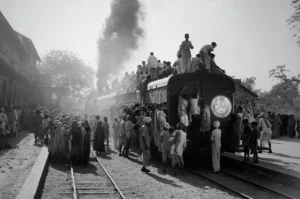
Despite the hardship, the third-class compartment created unexpected moments of unity. As Kerr (2007) notes, it produced an “unintended democracy of discomfort.” People of different castes, languages, and regions shared cramped benches, food, and water. Though caste did not disappear, the rhythm of the train blurred its boundaries. This forced coexistence became an early exercise in equality, one that quietly shaped the collective consciousness of India’s freedom movement. ( Image 3 )
During the nationalist struggle, third-class carriages became vehicles for political pamphlets, speeches, and organizing. Leaders and workers alike
travelled on these trains, spreading the message of self-rule. The same compartments that reflected exclusion also carried the voices demanding its end.
Railways and the Politics of Access
Access to railway spaces was governed by both class and ritual purity. Even within third-class compartments, caste practices persisted. The Pioneer (1893) reported instances of Brahmin passengers refusing food or water from vendors deemed “impure.” Many carried their own utensils and water pots to avoid contamination. Thus, the train symbol of industrial progress also became a moving arena where India’s oldest hierarchies played out.
Colonial officials treated these issues with striking apathy. The Railway Board Report (1880) admitted “grave inconvenience” among third-class passengers but dismissed it as “inevitable for natives accustomed to congestion.” Wolmar (2017) calls this attitude “a bureaucratic blindness that mistook endurance for satisfaction.”
From Compartment to Nation
By the early twentieth century, the third class accounted for nearly ninety percent of all passengers. Gandhi called it “the barometer of India’s condition.” After growing criticism, minor reforms appeared better ventilation, cleaner toilets, and improved ticketing but these came only after decades of neglect.
At independence in 1947, the colonial structure of railway classes persisted. The racial divisions disappeared, but economic hierarchies survived under new names: “First Class” became “AC,” “Second” became “Sleeper,” and “Third” became “General.” As Kerr (2007) aptly notes, the tracks remained the same, only the labels changed.
Even today, the divide between air-conditioned comfort and overcrowded general compartments reflects India’s layered social reality. The railway
continues to be both a unifier and a reminder of inequality, a microcosm of the nation itself.
Conclusion
The story of India’s railways is more than an account of technological triumph. It is the story of a society on the move, carrying with it centuries of prejudice and aspiration. The colonial railway replicated the hierarchies of caste and class while claiming to modernize the nation. Yet, within its crowded coaches, ordinary Indians found shared spaces that subtly challenged those divisions.
Trains remain among India’s most revealing public spaces not because they have erased inequality, but because they expose it so visibly. Each
compartment, from AC to General, tells a story of access and exclusion. As Wolmar (2017) writes, the railway was “the empire on wheels.” And in its third- class coaches, that empire was forced to confront the one thing it sought to suppress: the unstoppable movement of people toward dignity and equality.
References
Anand, M. R. (1936). Coolie. Jonathan Cape.
Gandhi, M. K. (1927/1993). The Story of My Experiments with Truth. Navjivan Trust.
Kerr, I. J. (2007). Engines of Change: The Railroads that Made India.
Praeger. Railway Board. (1880). Annual Railway Report and Fare Tables. Government of India Press.
Wolmar, C. (2017). Railways and the Raj: How the Age of Steam Transformed India. Atlantic Books.
The Pioneer Archives (1890s). Colonial Travel Reports and Passenger Correspondence. National Archives of India.
Image 1
Third-Class carriage on Indian Railways, c. late 19th century – basic benches, minimal comfort, labelled ‘THIRD’. Source: Indian Railways archives via blog reproduction.
The blog “History & Heritage of Indian Railways: Indian Railways in Old Days”
Image 2
Passengers peering from or hanging out of a Third Class coach on Indian Railways, colonial era. Source: 24 Coaches blog archive.A photo featured on
“24 Coaches: Railways of the British Raj: Romance and Reality”
Image 3
Overcrowded train at an Indian station, passengers clambering onto the roof and sides, showing the extreme conditions of lower-class travel. Archive source: Indian Railways photo collection (exact date unknown)