


By Ramayani Banerjee
From as early as the Vedic period (pre-1000 BCE), various texts like the Rigveda, Samaveda, Shatapatha Brahmana and Taittiriya Samhita refer to any stringed instruments as “veena”. Carved from jackwood, with resonating gourds and strings that demand discipline, the veena has been associated with royal courts and Brahminical culture. For centuries, the veena has symbolized India’s classical refinement. Its significance is spelled out in technical treatises of
performance, most notably the Natya-Shastra by Bharata Muni (dating from roughly 200 BCE to 200 CE). The text not only outlines methods of playing the veena but also uses it as a metaphor, likening the human throat to the instrument. This fusion of body, sound, and spirituality highlights how music was conceived as a bridge between the human and the divine.
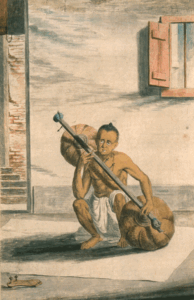
Over time, more defined forms appear: for instance, the Rudra veena (or bin), austere and meditative with its tubular body and twin gourds, became central to Hindustani classical music (Delhi, Gwalior, Varanasi traditions) and was often associated with yogic discipline, echoing Sarasvati’s ideal of ordered knowledge. In Tamil Nadu and Karnataka, the Saraswati veena, carved from jackwood with frets and multiple strings, dominates Carnatic music and is directly
linked with the goddess herself, embodying harmony, refinement, and the rigor of learning. Fretless veenas like the Vichitra veena (in Madhya Pradesh and Uttar Pradesh) and the Chitra veena (gottuvadhyam in Telugu and Tamil cultural sphere), both played with a slide, allow fluid, boundary-crossing tones—sonorities that resonate more closely with Matangi’s realm of transgression and esoteric knowledge. Earlier and symbolic forms, such as the Eka-tantri veena (single-stringed veena) and the Pinaka veena (bow-shaped, linked to Lord Shiva), along with regional variants like the Yazh of Tamil culture and the Bobbili veena of Andhra Pradesh, highlight how the instrument migrates across sacred, classical, and folk domains. Saint- composers like Muthuswami Dikshitar praised it in Carnatic tradition as the goddess of music incarnate.
And during the Mughal era, the veena’s presence actually extended beyond purely Brahminical or South Indian classical spaces. This is evident from the fact how courtly musicians like Naubat Khan and others experimented with Persian-inspired melodies, blending the veena with the aesthetics of gharana traditions and imperial patronage. Yet, even in these cosmopolitan settings, the veena retained its dual symbolism: it represented both elite sophistication and a spiritual conduit.
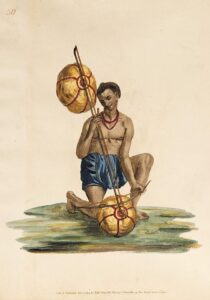
(Left) A musician playing Pinaka-Veena. Edward Orme, London 1807. Wikimedia Commons,
https://commons.wikimedia.org/w/index.php?search=Veena&title=Special%3AMediaSearch&type=image. Accessed 21 Sept. 2025.
(Right) A Bin (Rudraveena) or Kuplyans. 1799. Wikimedia Commons,https://commons.wikimedia.org/w/index.php?search=Veena&title=Special%3AMediaSearch&type=image Accessed 21 Sept. 2025.
Are Sarasvati and Matangi Inversions of Each Other?
In Indian iconography, Sarasvati is often portrayed in white garments, calm, composed and radiant, with a veena in hand. Matangi, by contrast, appears darker and more unsettling, clutching the same instrument with an enigmatic smile. Yet if you walk through India’s great temple cities—Madurai, Varanasi, Puri, Kanchipuram—and you will always encounter towering sanctums for Shiva, Vishnu and his many avatars, Lakshmi, Parvati, and Kali. But Sarasvati? The goddess of learning and music, so alive in our rituals and imagination, is conspicuously absent from the grand stone corridors of permanent worship. But, why does the goddess of knowledge not enjoy the same architectural devotion as others?
The answer partly lies in myth. Devi Sarasvati is one of the prominent goddesses in the Vedic tradition (1500 to 500 BCE) who retains her significance in later Hinduism through Devi Mahatmya as one of the principal Tridevi (alongside MahaLakshmi and Mahakali). However, in mainstream Hinduism, Sarasvati is regarded as the consort of Lord Brahma. There is a myth that Brahma, in some act of serious transgression (Puranas suggesting that Sarasvati was the creation/daughter of Brahma but then he himself lustfully pursued Sarasvati and made her his consort) incurred a curse from gods (or from Sarasvati herself) that he would not be widely worshipped. It is true that temples dedicated to Brahma remain rare across India. By association, Sarasvati too became a goddess invoked ritually but not enshrined in permanent sanctums.
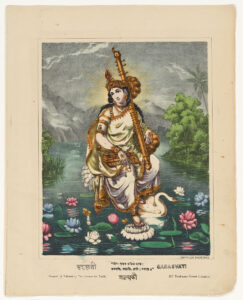
(Left): Goddess Sarasvati, Lithograph, printed in black and hand-coloured, West Bengal, Calcutta, 1878–1883.
The Metropolitan Museum of Art. Available at: https://www.metmuseum.org/art/collection/search/849503 (Accessed: 15 September 2025).
Over centuries, temple-building—funded by kings, Brahmins, or wealthy patrons—tended to privilege deities who embodied protection, prosperity, or power. Monumental shrines thus rose for Shiva, Vishnu, Lakshmi, or Durga, figures closely tied to political authority and community well-being. And, temples were more than religious sites; they frequently served as economic and administrative hubs, overseeing land, providing employment, supporting local crafts, and supervising trade and guilds. Sarasvati, though deeply revered in texts and rituals, did not attract
the same scale of permanent architectural patronage. This is evident from the fact that her worship is often expressed through seasonal festivals, household rituals, or in conjunction with other deities, rather than through large, freestanding temples dedicated exclusively to her.
It is worth mentioning that geography also added another twist. Sarasvati was once a river goddess, linked to the mighty Sarasvati river of Vedic lore. Some scholars argue that as the Sarasvati river dried up (around 1900 BCE), her direct “sacred geography” also disappeared. You’ll notice that many temples that did include Sarasvati in their architecture had her as one among several gods/goddesses, rather than as the principal deity.
Perhaps this ephemerality seems fitting: knowledge, fluid and restless, is always in motion; so it resists being bound in stone. Her veena captures that spirit perfectly—its strings tuned to order, to discipline, to melody that suggests refinement and learning.
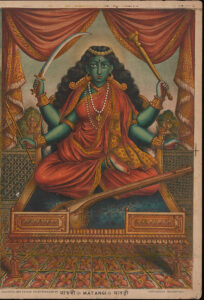
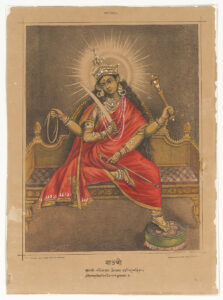
(Right) : Goddess Matangi, Chromolithographic print on paper. Calcutta 1885–90. The Metropolitan Museum of Art. Available at: https://www.metmuseum.org/art/collection/search/688469 (Accessed: 15 September 2025).
Matangi meanwhile, always dwells on the edges and her presence largely remains limited. Despite being the goddess of knowledge and arts, Matangi is surprisingly linked to pollution and ill fortune. Also known as Ucchista Chandalini or Maha Matangini, she is a part of the Dasamahavidya iconography and is widely considered as the Tantric counterpart of Sarasvati. She is green or dark-skinned, decked in unwashed clothes, sometimes surrounded by leftovers, meat, and wine—the very things orthodox Hinduism considers impure. Her veena, streaked with red vermilion, becomes a tool to dismantle purity codes, mocking Brahminical order and inviting the impure into her circle. Some Tantric practices even involve offering cloth stained with menstrual blood to her, because the menstrual blood is revered as a sacred substance central to her worship. Cremation grounds, animal sacrifice, and nocturnal rites mark her worship. In a world, where temples are meticulously governed by purity rules—where menstruating women are barred, where leftovers are taboo, where death’s touch is feared—Matangi is an affront.
Almost absent from mainstream temple cities, Matangi’s most powerful presence pulses only at Kamakhya in Assam. Very few temples—scattered across Belgaum, Rajarappa, Madanapalle, Nangur, and Jhabua—bear her name, but these are exceptions that actually underline the nature of her marginality. It becomes clear why Matangi’s rituals could never be absorbed into the grammar of mainstream or diasporic respectability. Yet within Tantric circles, she endures as a goddess of radical speech, esoteric power, and subversion.
David Kinsley notes that Sarasvati—and by extension, Matangi—was envisioned as a goddess who fosters music, learning, and the attainment of liberating wisdom (jnana). 2 And so, there is the strange duality of the veena in India’s sacred imagination: the embodiment of elegance in Sarasvati’s hands and the embodiment of disruption in Matangi’s.
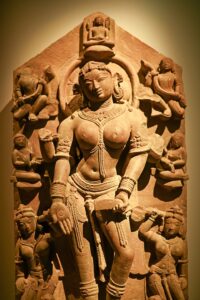
(Left): Jain Sarasvati Sculpture (sandstone, 11th century CE) Wikimedia Commons. Available at:
https://commons.wikimedia.org/wiki/File:Jain_Saraswati_Sculpture.jpg (Accessed: 18 September 2025).
(Right): Goddess Matangi – Hand coloured lithograph print. Calcutta Art Studio (c.1880) Available at:
https://upload.wikimedia.org/wikipedia/commons/archive/f/f2/20201126153838%21Goddess_Matangi.jpg (Accessed 18 September 2025)
The Role of Veena:
Culturally, the veena insists on the centrality of knowledge, music, and art. It is not limited to Sarasvati alone: Shiva is sometimes described as playing the Pinaka-veena, Narada the wandering sage carries his veena as a symbol of celestial music, and even Ravana in the Ramayana is said to have transformed his own body and used his veins as strings into a veena in order to please Shiva. Within temple architecture, veena-players hold an honoured position.
Across South Indian temples—at Chidambaram, Hampi, Thanjavur, and Kanchipuram—carved musicians adorn pillars and walls, frozen in stone with their instruments, eternally venerating the deity with music. The veena here is not just ornament but a marker of sacred sound, suggesting that devotion is incomplete without music. These sculpted figures remind us that the temple was never silent; its ritual life was animated by song and string, the veena carrying prayers as much as mantras did.
Yet the temple, for all its celebration of music, is less a neutral space of worship than a fortress of Brahminical order—its architecture encoding hierarchy, ritual purity, and controlled access. In this context, the veena acquires two strikingly different meanings. Placed in Sarasvati’s hands, it becomes the perfect emblem of structured, disciplined knowledge aligned with upper-caste visions of refinement. In contrast, when Matangi takes that same instrument, the veena becomes a reminder that music and speech also flourish outside polite, sanctioned Brahminical spaces.
Kept side by side, Sarasvati and Matangi suggest that wisdom has two faces: one sophisticated, the other polluted; one acceptable, the other feared. Their absence from mainstream Hindu temples is a revelation of what Hinduism has chosen to institutionalize—the ordered veena of Sarasvati carved onto temple walls—and what it has relegated to the margins—the disruptive veena of Matangi invoked in esoteric rites. The veena becomes not only an elite marker of classical India but also a contested site where questions of purity and impurity, order and disorder, knowledge and transgression, are played out.
Conclusion:
Throughout the Indian landscape, Hindu Temples have always traditionally enshrined those deities who uphold stability, prosperity, and protection. But wisdom, by its nature, is harder to control. Sarasvati flourishes in textbooks, music classes, and seasonal festivals like Vasant Panchami. Matangi, by contrast, survives in esoteric Tantric rituals, where her worship defies purity codes and unsettles our mainstream forms of worship. Together, they form a paradox: Sarasvati’s veena is of order, purity that embodies sanctioned knowledge; Matangi, the subaltern goddess, born of leftovers and impurity, is consecrated by those society deems outcasts. Her veena is a symbol of esoteric, forbidden knowledge.
This is a truth rarely acknowledged: sound and knowledge—whether refined or raw, socially accepted or transgressive—are never neutral. They can reinforce hierarchies or quietly dismantle them, exposing the boundaries of belief, culture, and power itself.
REFERENCES:
1. Kinsley, D., 1988. Hindu Goddesses: Vision of the Divine Feminine in the Hindu Religious Traditions. Berkeley: University of California Press, p. 55–64. https://annas- archive.org/md5/ad0320003edc70f7ce5f2bb0b6844e09 (Also available in https://www.journals.uchicago.edu/doi/pdf/10.1086/488108 )
2. Kinsley, D., 1988. ‘Tara, Chinnamasta and the Mahavidyas’, in Hindu Goddesses: Visions of the Divine Feminine in the Hindu Religious Tradition. 1st ed. Berkeley: University of California Press, pp. 161–177.
3. Kinsley, D., 1998. Tantric Visions of the Divine Feminine: The Ten Mahavidyas. Delhi: University of California Press. https://annas- archive.org/md5/dcd3308cfac71785fa7c020154bab6c3
4. Prasad, R.U.S., 2019. River and Goddess Worship in India: Changing Perceptions and Manifestations of Sarasvati. New York: Routledge. https://annas- archive.org/md5/f49d3746ad19b9619486125d5c0bb18a (Also check:
https://www.routledge.com/River-and-Goddess-Worship-in-India-Changing-Perceptions- and-Manifestations-of-Sarasvati/Prasad/p/book/9780367886714)
5. Rao, N., 2016. Royal religious beneficence in pre-modern India: social and political implications. International Journal of Dharma Studies, 4(7). Available at: https://doi.org/10.1186/s40613-016-0030-z