
By Prishnika Mazumdar
Last year, Payal Kapadia’s All We Imagine as Light (2024) made headlines as it won the prestigious Grand Prix award at the Cannes Film Festival. Instagram was pleasantly flooded with the film crew decked up, posing (and dancing) at Cannes. This, however, was not the first major victory for India. As early as 1946, a film called Neecha Nagar had already won the Best Film award, now the Palme d’Or. This article is a meditation on these two films, as we try to assess and understand the changing depictions and receptions of Indian films from the pre-independence era to the present day.
Neecha Nagar
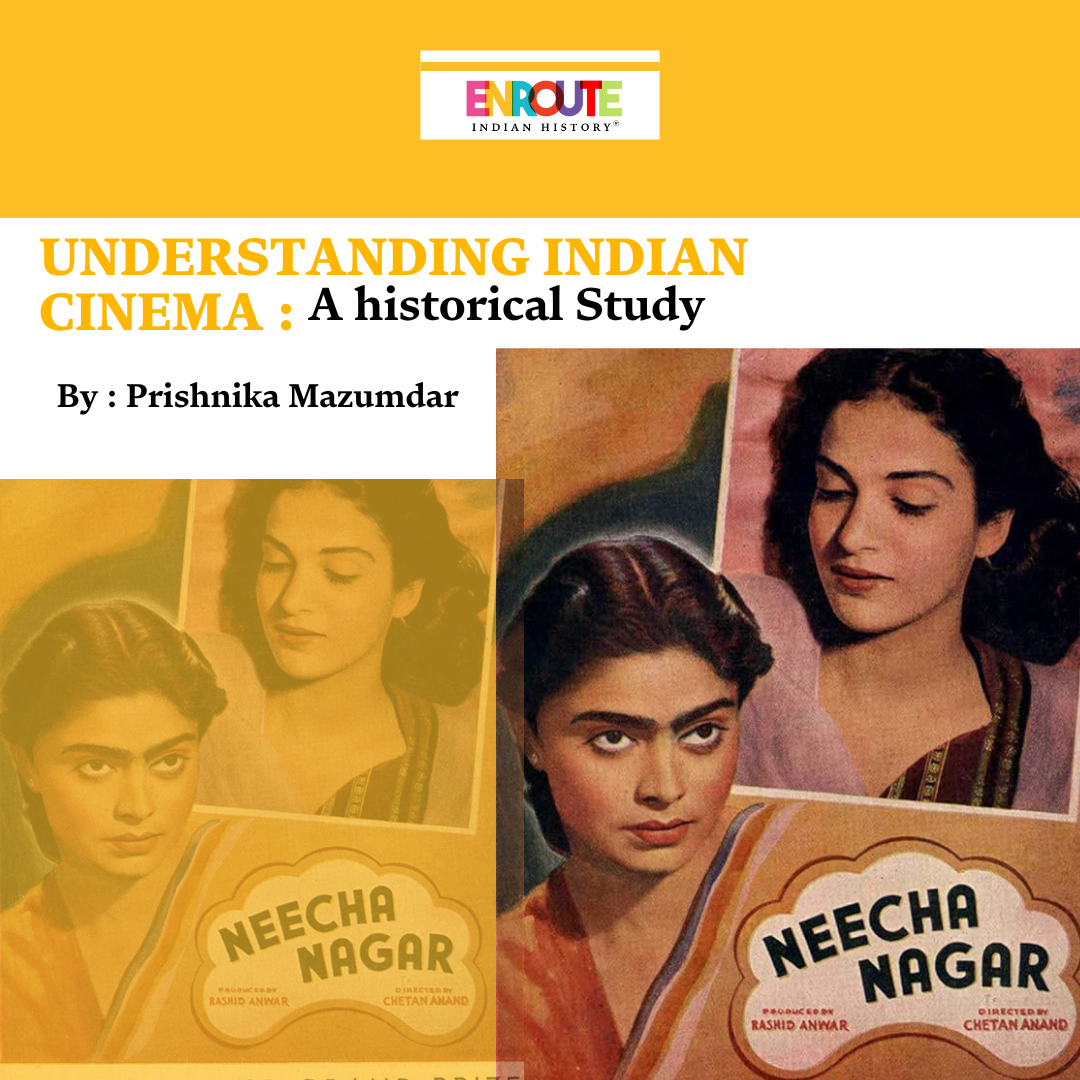
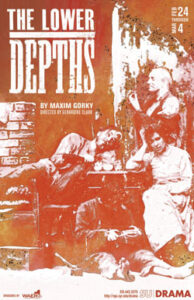
Even before India was an independent country, in 1946, it had secured its first major Cannes victory. The most prestigious award, the Palme d’Or, had been won by Neecha Nagar, making it the best movie of the year at the film festival. This film was inspired by Maxim Gorky’s Lower Depths (1902), it was also Chetan Anand’s directorial debut. Most of us are familiar with the popular actor Dev Anand; Chetan Anand was his elder brother (TNN, 2011). The film was a success at Cannes, but it was never commercially released in India. This was because distributors could not see any commercial merit in a film without many songs and dance sequences. By 1946, partition too had become imminent, and the fact that the film had been produced by Muslim men, Rashid Anwar and A. Halim, did not help in the release of the film (Bhatia, 2015). Only in the 1980s was it broadcast on Doordarshan (Nair, 2021).
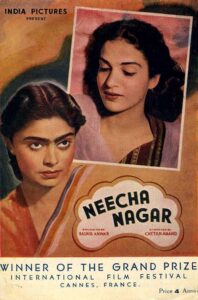
The film Neecha Nagar features Uma Anand, wife of director Chetan Anand, along with Rafiq Anwar, Kamini Kaushal, Murad, Rafi Peer, Hamid Butt, and Zohra Sehgal. It shows the divide between the rich and the poor in society. At its center is a wealthy landlord, Sarkar, who lives in a luxurious mansion on top of a hill, while the poor villagers live below in poverty and hunger. The people of “Neecha Nagar” resent Sarkar, and their anger grows when he decides to direct sewage into their village to clear land for his new housing project. The villagers, led by Balraj, rise up in protest against Sarkar’s plan. Sarkar’s daughter, Maya, supports the villagers and falls in love with Balraj. As sewage contaminates the village, disease begins to spread, putting lives at risk. In the end, the villagers succeed, and Sarkar dies of a heart attack (IMDb, n.d.).
Priya Nair, a critic, author, and filmmaker, reads the mood of the nation in the film. The protagonists of the film are Balraj in a Gandhi cap and his Charkha-spinning sister Rupa. They first request that Sarkar should not redirect the sewage canal into their village. When pleas fail, the inhabitants of Neecha Nagar begin a non-cooperative campaign by boycotting Sarkar’s hospital. The very name of the primary antagonist, Sarkar, means government. He wears Western clothes, representing the oppression of the British Raj (Nair, 2021).
An interesting innovation in Neecha Nagar that would be used later by All We Imagine as Light as well was the use of documentary footage. It remains an important social document with realism at its crux. We will find such sincerity to realism in Payal Kapadia’s All We Imagine as Light.
All We Imagine as Light
All We Imagine as Light became the first Indian film to enter the main competition at Cannes since 1994, marking the end of a 30-year drought. After its world premiere, it received an 8-minute standing ovation. The film was nominated for the Palme d’Or and went on to win the prestigious Grand Prix, becoming the second best movie of the year at Cannes only after Anora (Scott, 2024).
This film was written and directed by Payal Kapadia, who had already won the Oeil d’Or (Golden Eye) award for best documentary at Cannes in 2021 for A Night of Knowing Nothing (Ramnath, 2022). All We Imagine as Light features Kani Kusruti, Divya Prabha, Chhaya Kadam, and Hridhu Haroon, whom many of us are likely to remember from their dancing entry at Cannes. The film features dialogue in Malayalam, Hindi, and Marathi, and is an international co-production between companies from France, India, the Netherlands, Luxembourg, and Italy (Bhattacharya, 2024).
Set in Mumbai, the film follows two nurses, Prabha and Anu, whose contrasting personalities shape the core of the story. Prabha quietly longs for her husband, who left for Germany without signs of return in sight (except for a rice cooker). Anu, who is relatively more defiant and bold, falls in love with a Muslim man. Their stories unfold against a backdrop of everyday struggles, personal silence, and tender resistance. A journey to a coastal village becomes a turning point, allowing moments of reflection, unexpected warmth, and some transformations. The film gently develops themes of love, loneliness, and solidarity, and presents a portrait of women going about their lives in a changing and sometimes challenging world (IMDb, n.d.).
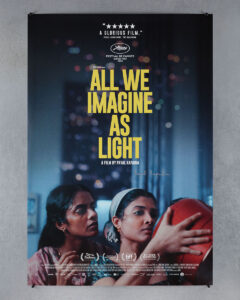
The film does not sweeten or sanitise the stories of the three women to make them more palatable to our sensitivities. It presents a drama about life’s fragility, but also about nurturance. It engages with the realities of urban isolation, social inequality and religious discrimination. Speaking to the Asia Society New York, Payal Kapadia spoke about the creation of exclusionary spaces and inequality, all encouraged by the increasing gentrification of our surroundings (Asia Society, 2024). The Indian film landscape, which is generally identified with escapism and where we find neatly wrapped up stories in larger than life settings, this film is a disruptive force. It expands the idea of what an Indian film can be. It is a portrayal of humanity and a celebration of Indian womanhood (Scott, 2024).
In an interview with Sucharita Tyagi, Kapadia speaks about the gap between what a film reveals explicitly and the viewer’s imagination. All We Imagine as Light does not spoon feed its viewers all details, and it creates a gap between what the film shows and what we, as viewers, make of it. This gap is used in the film to invite the viewers to participate in its making. The film, while being about three women in three different stages of their lives, can very well be about one woman moving from one stage in life to another with corresponding changes in her worldview. Time is another instrument that the film uses to express the inner workings of the characters. While time in the first half, which is situated in Mumbai, seems to roll from one day into another with few pauses. However, when we move to the coastal village of Ratnagiri, it is one long day that stretches to occupy the entire second half. It represents the changing perceptions of time with changes in geography (Tyagi, 2024).

Internationally, the film received great praise as newspapers like The Guardian described it as “a quiet, tender marvel” for its exploration of women’s lives in Mumbai and compared its sensibility to that of Satyajit Ray (The Guardian, 2024). Similarly, The Hollywood Reporter India noted how the film challenged the traditional Western gaze on Indian cinema by portraying everyday realities with empathy and depth (The Hollywood Reporter India, 2024).
In India, however, the film’s release was limited. Initially, it opened only in a few theatres in Kerala in September 2024, mainly to meet Oscar eligibility requirements (Hindustan Times, 2024). A wider release followed in November, but many audiences were still unaware of its screenings. This was because of poor visibility and limited distribution (Hindustan Times, 2024). Kapadia herself spoke about how the Kerala release was “a test,” and she was relieved that audiences accepted the film’s Malayalam dialogues without questioning her familiarity with the language (Variety, 2025).
From Neecha Nagar to All We Imagine as Light, Indian cinema’s journeys to Cannes span nearly eight decades. While Neecha Nagar speaks in the voice of collective struggle, All We Imagine as Light reveals the inner worlds of women coping with loneliness, longing, and care in an unequal urban present. But these films, as remarkable as they are, are not definitive summaries of Indian cinema. The diversity of Indian films cannot and should not be mapped through two Cannes victories alone. What they do allow us, however, is a space to pause and reflect: on how stories are told, how they are received, and how they are remembered in collective memory.
References
Dargis, M. & Wilkinson, A. (2024) ‘Best Movies of 2024’, The New York Times, 30 November. Available at: https://www.nytimes.com/2024/12/31/movies/all-we-imagine-as-light-payal-kapadia.html (Accessed: 3 June 2025).(en.wikipedia.org)
Ramnath, N. (2022) ‘India’s sonic youth are at the front and centre of A Night of Knowing Nothing’, Scroll.in, 11 April. Available at: https://scroll.in/reel/1021502/indias-sonic-youth-are-at-the-front-and-centre-of-a-night-of-knowing-nothing (Accessed: 3 June 2025).
TNN (2011) ‘With Navketan Films, Anand brothers among Bollywood’s first families’, The Economic Times, 5 December. Available at: https://economictimes.indiatimes.com/industry/media/entertainment/with-navketan-films-anand-brothers-among-bollywoods-first-families/articleshow/10989446.cms (Accessed: 3 June 2025).
Nair, P. (2021) ‘Revisiting Neecha Nagar’, The Hindu, 16 July. Available at: https://www.thehindu.com/entertainment/movies/revisiting-neecha-nagar/article37120075.ece (Accessed: 3 June 2025).
Tyagi, S. (2024) ‘Payal Kapadia on All We Imagine as Light’, YouTube, 24 May. Available at: https://www.youtube.com/watch?v=Y6hAo9z2ZVQ (Accessed: 5 June 2025).
Asia Society (2024) ‘In Conversation with Payal Kapadia’, YouTube, 22 May. Available at: https://www.youtube.com/watch?v=q4OyvvhryGY (Accessed: 3 June 2025).
Cannes Film Festival (2024) ‘All We Imagine as Light Press Conference’, YouTube, 23 May. Available at: https://www.youtube.com/watch?v=atZpsrglQ0o&t=2709s (Accessed: 6 June 2025).
Chang, J. (2024) ‘The Gorgeous Mumbai Rhapsody of “All We Imagine as Light”’, The New Yorker, 14 November. Available at: https://www.newyorker.com/culture/the-current-cinema/the-gorgeous-mumbai-rhapsody-of-all-we-imagine-as-light (Accessed: 6 June 2025).
Bhattacharya, R. (2024) Payal Kapadia’s All We Imagine as Light in Cannes 2024’s competition section. The Indian Express, 11 April. Available at: https://indianexpress.com/article/entertainment/bollywood/payal-kapadias-all-we-imagine-as-light-in-cannes-2024s-competition-section-9264595/ (Accessed: 6 June 2025).
IMDb (n.d.) All We Imagine as Light (2024). Available at: https://www.imdb.com/title/tt32086077/ (Accessed: 6 June 2025).
Hindustan Times (2024) Why India’s Cannes winner All We Imagine As Light has released only in limited Kerala theatres. Available at: https://www.hindustantimes.com/entertainment/bollywood/why-india-cannes-winner-all-we-imagine-as-light-has-released-only-in-limited-kerala-theatres-101726903802911.html (Accessed: 30 August 2025).
The Guardian (2024) All We Imagine as Light review – Cannes prize-winning Indian drama is a quiet, tender marvel. Available at: https://www.theguardian.com/film/2024/nov/30/all-we-imagine-as-light-review-payal-kapadia-grand-prix-cannes-mumbai (Accessed: 30 August 2025).
The Hollywood Reporter India (2024) All We Imagine as Light and the revision of the Western gaze. Available at: https://www.hollywoodreporterindia.com/features/insight/all-we-imagine-as-light-and-the-revision-of-the-western-gaze (Accessed: 30 August 2025).
Variety (2025) Payal Kapadia on how All We Imagine as Light connects with young audiences. Available at: https://variety.com/2025/film/asia/payal-kapadia-all-we-imagine-as-light-young-audiences-1236270720/ (Accessed: 30 August 2025).
IMDb (n.d.) Neecha Nagar (1946) Plot. Available at: https://www.imdb.com/title/tt0154942/plotsummary/ (Accessed: 30 August 2025).
Image Sources
Rotten Tomatoes (Poster of All We Imagine as Light)
Rotten Tomatoes (n.d.) All We Imagine as Light. Available at: https://www.rottentomatoes.com/m/all_we_imagine_as_light (Accessed: 6 June 2025).
Syracuse University News (Cover of The Lower Depths by Maxim Gorky)
Syracuse University News (2012) The Lower Depths. Available at: https://news.syr.edu/blog/2012/02/20/the-lower-depths/ (Accessed: 6 June 2025).
IMDb (Poster of the film Neecha Nagar)
IMDb (n.d.) Neecha Nagar (1946). Available at: https://www.imdb.com/title/tt0154942/ (Accessed: 6 June 2025).
The team of All We Imagine as Light at Cannes (2024) NDTV Photos. Available at: https://www.ndtv.com/photos/entertainment/cannes-2024-all-we-imagine-as-light-stars-lit-up-the-red-carpet-and-how-107632 (Accessed: 30 August 2025).