

By Aryan Singh
Tucked behind the lively hustle of Delhi University’s North Campus—where students rush to classes, exchange ideas, and sip chai under the shade of age-old trees—lies a vast green stretch known as the Northern Ridge, or Kamla Nehru Ridge. To most, it’s just a peaceful escape: a spot for morning jogs, cycling, or a cricket match among friends. But hidden in its quiet trails and scattered ruins is a gripping story of courage, chaos, and rebellion. Once a battlefield and lookout post during the Revolt of 1857, this Ridge still shelters monuments like the Flagstaff Tower and the Mutiny Memorial, which silently narrates the story when Delhi trembled at the heart of a historic uprising.
Before we dive deeper, let’s rewind to the fiery days of 1857 and see why Delhi became the beating heart of the revolt. It all began on 10 May 1857, in the bustling cantonment town of Meerut, where sepoys rose in defiance against the East India Company. Fuelled by anger and hope, they swiftly marched to Delhi and toppled the Company’s rule with ease. Seizing control of Shahjahanabad, they rallied behind the ageing Mughal emperor, Bahadur Shah Zafar, proclaiming him their symbolic leader. What started as a mutiny in Meerut soon spread like wildfire across North India, and Delhi emerged once again as a city of power and resistance. Infuriated by the revolt, the British soon mobilized their forces and throughout the summer months, they stationed their forces on the ridge, which became a battleground b/w sepoys and the Britishers. This article will focus on the two monuments: Flagstaff Tower and Mutiny Memorial, which stand as sentinels of revolt and remembrance.
Source: Wikimedia Commons, Southeast view of Delhi from the flagstaff tower
Strategic importance of the Ridge
The Northern Ridge stretches just a few kilometers north of the walls of Shahjahanabad, and its elevated position provided a crucial advantage for any military force attempting to control Delhi. When the British army, under Brigadier-General Barnard, arrived in June 1857 to lay siege to the city, the Ridge became its most vital stronghold. From this location, the British forces could fire artillery into the heart of Delhi while simultaneously shielding themselves from the full force of the rebellion occurring within the city.
The strategic importance of the Ridge was clear: it provided the British with high ground from which they could launch their attacks and withstand the sepoys’ artillery fire. From the Ridge, they could safely position their artillery, monitor sepoys’ movements, and maintain secure supply lines from Punjab, which was essential for receiving troops and resources. Its elevation also made it difficult for the sepoys to dislodge them, giving the British a decisive advantage in the prolonged siege that followed.
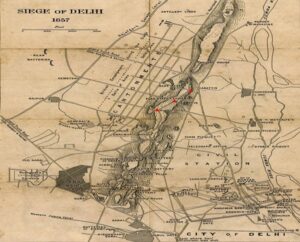
Source: Kevin Standage Photography, Map of Delhi during Siege of 1857
Flagstaff Tower
Hidden amidst the tranquil greenery of Delhi’s Northern Ridge, the Flagstaff Tower rises proudly at the highest point of the ridge — fondly known as the “Baota.” More than just an old brick monument, it stands as a silent witness to the drama, bravery, heartbreak, and resilience of the Revolt of 1857, one of India’s most defining moments in history. (Kevin Standage, 2025)
Built in 1828 as a signal tower, this circular, castle-like structure, with its winding staircase and narrow gun slits, once kept watch over the expanding colonial city. Its elevated perch offered sweeping views of the surrounding plains, making it the perfect vantage point for spotting movement and relaying vital messages to nearby military units.
For modern-day explorers, the trip to this historic tower begins at Vishwavidyalaya Metro Station on the Yellow Line, situated in the bustling North Campus area. Take a rickshaw and follow the shaded path marked with signs, and after about 10–15 minutes, you’ll reach the old red tower. It stands quietly among the trees, holding memories from the past.
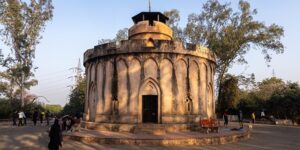
Source: Kevin Standage Photography, Flagstaff Tower on Delhi’s North Ridge
On May 11, 1857, chaos erupted. After the sepoys from Meerut stormed into Delhi and killed British officers and civilians, those who survived made a desperate run for safety. Their destination? The Flagstaff Tower.
In just hours, the tower was packed “to suffocation” with terrified men, women, and children. Among them were officers, civilians, and families from the nearby Kashmiri Gate and cantonments. Hope began to vanish after the blowing up of the British arsenal, and soon the group abandoned the tower, fleeing northwards toward Ambala, praying for survival.
The tower didn’t stay empty for long. It became a crucial stronghold in the bloody tug-of-war between British forces and Indian sepoys. At one point, the sepoys took control of the tower, using it to resist British forces with fierce gunfire. Later, it was retaken by the British in a brutal clash. (Rishley Gordon, 1906)
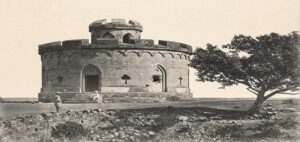
Flagstaff Tower after the Revolt of 1857, Albumen silver print by Felice Beato (1832-1909)
By 14th September 1857, fresh reinforcements — Sikhs, Punjabis, and Gurkhas stormed into action. With a thunderous blast, they breached the historic Kashmiri Gate, and after a week of fierce street-to-street fighting, Delhi was recaptured by the British. Though the flames of revolt were brutally crushed, the Flagstaff Tower survived the storm, standing firm as a silent sentinel of those turbulent days. Today, it is under the protection of ASI.
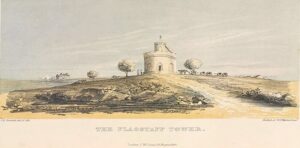
Flagstaff Tower — depicted as one of fourteen tinted lithographs created by Brevet Major J. R. Turnbull of the 13th Light Infantry. Featured in Sketches of Delhi Taken During the Siege, published by T. McLean in 1858, this artwork highlights how stark and barren the landscape around the tower used to be
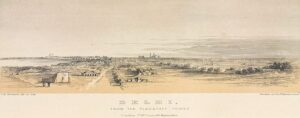
From the Top of Flagstaff Tower, from ‘Sketches of Delhi taken during the Siege’, by Brevet Major J R Turnbull
Mutiny Memorial
In the aftermath of the fierce revolt, the British chose to honour their fallen soldiers with a striking tribute. In 1863, they raised this grand memorial — an impressive blend of power and artistry. Crafted from red sandstone and built on an octagonal base, it proudly displays the elegance of Victorian Gothic architecture. Resting on a two-tiered platform that adds to its imposing height, the memorial stands as both a statement of empire and an architectural marvel of its time. (Ashutosh, 2019)
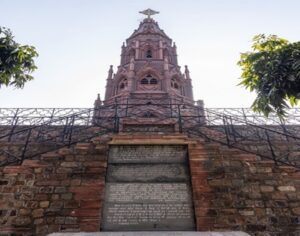
Source: Kevin Standage Photography, Mutiny Memorial
To reach this forgotten relic, go to Pulbangash Metro Station on the Red Line or Vishwavidyalaya on the Yellow Line. From there, catch a rickshaw that winds through the leafy Northern Ridge, near Hindu Rao Hospital. This secluded spot rarely gets visitors — so don’t be surprised if your only company at the memorial is a few curious monkeys and a lone guard keeping watch.
This memorial was built on a site that was used for artillery fire called Taylor’s Battery. The Placard on the structure’s lowest tier read, “In Memory of the officers and soldiers, British & native of the Delhi field force, who were killed in action or died of wounds or disease between 30th May & 20th September 1857. Out of 1029 army men who lost their lives, only 47 are specifically mentioned on the memorial.
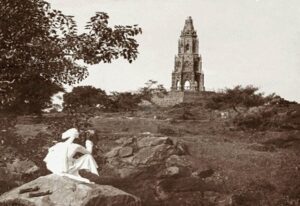
Source: Alamy.com, 1857 Mutiny Memorial circa 1910
Here we can find a total of 8 plaques (a flat piece of stone on which the names of the officers who were killed were engraved), but during construction, there were only seven plaques, and one plaque was put at its pedestal in 1972. These plaques are made up of marble. Three of them narrated the event in English, Hindi & Urdu. Out of the four plaques, one names the regiments in Delhi, another details the battles fought nearby, and the other two honour the fallen, wounded, and missing, grouped as Europeans, natives, officers, and non-commissioned ranks. (Ashutosh, 2019)
Renamed the memorial ‘AJITGARH’: Place of the Vanquished
This question is very general among the people as to why the government renamed it from the Mutiny Memorial to Ajitgarh?
When the memorial was built in 1863, in memory of soldiers who lost their lives defending the British flag during the sepoy mutiny of 1857. To the British, it was just a mutiny. But for Indians, it was the First War of Independence—and they were right to see it that way. The colonial name never felt right to the people. So, in 1972, as India marked 25 years of freedom, the government gave the memorial a new name: Ajitgarh—the ‘Place of the Fearless.’ The Mutiny Memorial was no longer a tribute to British forces, but a proud remembrance of the Indian heroes who sacrificed their lives for freedom. (Indian Express, 2023)
Bibliography
1.Vidheesha Kuntamalla. “Signal Tower, Refuge during 1857 Revolt, to a Monument: The Many Faces of Flagstaff Tower.” The Indian Express, 27 Mar. 2023, indianexpress.com/article/cities/delhi/signal-tower-refuge-during-1857-revolt-to-a-monument-the-many-faces-of-flagstaff-tower-8520669/lite/. Accessed 23 June 2025.
2. Vidheesha Kuntamalla. “In Memory of Soldiers Who Died, Mutiny Memorial Tells Story of 1857 Revolt.” The Indian Express, 13 Mar. 2023, indianexpress.com/article/cities/delhi/in-memory-of-soldiers-who-died-mutiny-memorial-tells-story-of-1857-revolt-8455239/lite/. Accessed 23 June 2025.
3. kevinstandagehotography. “Ajitgarh (1857 Mutiny Memorial) – Delhi.” Kevin Standage, 19 Feb. 2025, kevinstandagephotography.wordpress.com/2025/02/19/ajitgarh-1857-mutiny-memorial-delhi/.
4. Risley, Gordon. The Seven Cities of Delhi. 1906.
5. Lahiri, Nayanjot. “Commemorating and Remembering 1857: The Revolt in Delhi and Its Afterlife.” World Archaeology, vol. 35, no. 1, Apr. 2003, pp. 35–60, https://doi.org/10.1080/0043824032000078072. Accessed 21 June. 2025.
6. Dwivedi, Ashutosh. “Mutiny Memorial (Research Paper).” Academia.edu, 6 May 2019, www.academia.edu/39030306/Mutiny_Memorial_Research_Paper_. Accessed 21 June 2025.