
Varthamanapusthakam: Insights into Ecclesiastical Struggles through Travel Writing
- April 13, 2026
By Tehreem Asad
There are several instances of travellers in history who have turned to writing travelogues to recount their journeys to distant lands. These writings try to make sense of this new world that is introduced to the authors and reflect on their personal experience. Indians, of course, have been avid wayfarers and travellers since the beginning, but before modern times, they have left very little writing to document their journeys. The very first such known account of travel writing in an Indian language was written only in the 1790s.
Composed by Paremmakkal Thomma Kathanar (also known as Thomas Paremakkal), Varthamanapusthakam recounts his long and arduous journey undertaken with Mar Joseph Kariyattil (which took them to four different continents) in an effort to heal the divisions between Jacobites and Catholics among the St. Thomas Christians of Kerala. Their journey, as recounted in the book, is connected with historical and institutional hardships endured by the St. Thomas Christian community. Varthamanapusthakam articulates dissent against the hegemonic and colonial structures imposed by European missionaries upon the Indian Church. Writing as early as the late 18th century, Fr. Thomas Paremakkal asserts that Indian Christians must be governed by Indians rather than by foreigners. Linguistically, the text shows the development of Malayalam prose, moving away from ornate and overly Sanskritised styles toward a more direct and contemporary mode of expression. Varthamanapusthakam can be said to be a travel narrative that transcends geography to become a record of the pushback of St. Thomas Christians against their unfair treatment by the European clergy.
Background to the events of Varthamanpustakam
Saint Thomas Christians, also known as Nasrani Mappilas, are a community of Indian Christians believed to have been residing in the Malabar region (present-day Kerala, India) since the first century AD. They regard Apostle Saint Thomas as the founder of the church. From the very beginning, the St. Thomas Christians followed the East Syriac liturgy, which originated within the Persian Empire and was established by Saint Thomas. This was likely due to the fact that even before the advent of Christianity, Malabar already had long-standing cultural and commercial relations with West Asia. The practices of the St. Thomas Christians were also culturally influenced by the local high-caste Hindu traditions. They were accorded privileges equal in standing to those of the Hindu nobility.
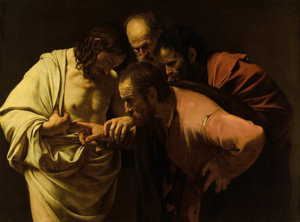
The Incredulity of Saint Thomas by Caravaggio
(Courtesy: https://en.wikipedia.org/wiki/The_Incredulity_of_Saint_Thomas_%28Caravaggio%29#/media/File:Der_ungl%C3%A4ubige_Thomas_-_Michelangelo_Merisi,_named_Caravaggio.jpg)
The Church derived its bishops from the Church of Persia proper (present-day Iran) till the end of the 16th century, and later from the Seleucia-Ctesiphon of Mesopotamia, or the East Syrian Church (present-day Iraq). Although the East Syrian Church was Nestorian and rejected the Council of Ephesus, they acknowledged, at least in theory, the authority of the Roman Pontiff. However, there was little direct contact between this Church and Rome until the time of the Crusades due to their physical distance and the prevailing political conditions. From 1553 onward, some of its Patriarchs began to be recognised by Rome, which led to the emergence of two lines of Patriarchs: those who were aligned with Rome and those who were not. Although both of these groups had influence in India during the 16th century, the St. Thomas Christians were mainly under bishops from the line recognised by Rome. While the nonnative bishops held the power of order, the Archdeacons of India (who were priests from Malabar) were the de facto leaders of the St. Thomas Christians.
This order, however, was challenged with the coming of the Portuguese in the 16th century. The Portuguese sought to impose Latin ecclesiastical authority and liturgical practices on the Christians of India. In 1558, Goa became a Roman Catholic archdiocese, and Cochin (in Malabar) was erected as its suffragan see. Thus, this area came under the patronage of the Portuguese crown. The Portuguese declared all non-Latin practices as heretical. They also wanted to put the St. Thomas Christians under their Latin Padroado jurisdiction, which faced strong resistance from the latter. By the late 16th century, the autonomy of the ancient Church of St. Thomas Christians and its social structure were under serious challenge from Portuguese ecclesiastical and political intervention. The rising tensions led to a major protest known as the Coonan Cross Oath (1653), when a large group of St. Thomas Christians publicly resisted Portuguese authority. Thereafter, the community permanently split into two different groups, the first being those who retained the old East Syriac tradition or today’s Syro-Malabar Church (Pazhayakuttukar or ‘old party’) and the other comprising those who accepted a West Syriac Jacobite bishop (Puthankuttukar or ‘new party’).
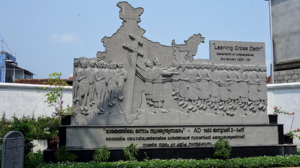
Coonan Cross Oath memorial
(Courtesy:https://en.wikipedia.org/wiki/Coonan_Cross_Oath#/media/File:Coonan_Cross_Oath.jpg)
By the 18th century, the St. Thomas Christians had been divided into several factions due to the interference of foreign clergy. The non-Catholics were facing competing efforts to increase their jurisdiction from West Syrian Bishops on one hand and the British on the other. Meanwhile, both the Portuguese Church through the Padroado system and the Carmelite missionaries sent by the Pope through the Propaganda Fide system were attempting to similarly increase their authority over the Catholic segment. All of these different Church administrations wanted to extend their control over the indigenous St. Thomas Christian community, all the while disallowing them from coming together under their own bishop.
The Jacobites (the non-Catholic group of St. Thomas Christians) did have their own indigenous bishop, but from 1748, with the arrival of the new West Syrian Bishop from Babylonia, the importance of the indigenous bishop decreased. By the 1770s, this disregard caused the indigenous bishop, Mar Thoma VI, to want to reconcile with the Catholic Church. The European Carmelite missionaries and the European Bishop of Verapoly, however, refused to accept Mar Thoma VI into Catholicism. This nonacceptance offended the Catholic St. Thomas Christians since they were mistreated by the European Carmelite missionaries. Thus, the Mahayogam (representative body of the Christian community) convened at Angamaly and decided to send representatives who would take the grievances of the community to the Pope and the ruler of Portugal and would request approval for admitting Mar Thoma VI to Catholicism. The main aim of the journey was to inform the Pope and the Queen of Portugal to protect the community from the discrimination and persecution of the top-down authoritarianism of the Europeans, as well as to help them in reuniting the divided Syrian Christian Church. It was decided that two delegates would travel to Europe, Fr. Joseph Kariyattil and Fr. Thomas Paremakkal. It was this journey that Fr. Thomas Paremakkal would document in the Varthamanapusthakam.
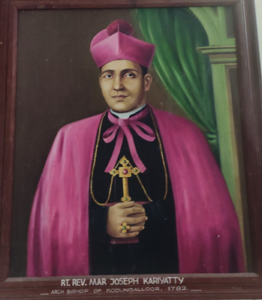
Painting of Mar Yawsep (Joseph) Kariyattil
Courtsey:(https://en.wikipedia.org/wiki/Kariyattil_Yawsep#/media/File:Mar_Yawsep_Kariattil.jpg)
The Subject Matter of Varthamanpustakam
Varthamanpustakam is divided into 78 chapters, though the description of the journey begins only from the 17th chapter. Each chapter is divided further into two parts, where the first one recounts the actual events and the second part, titled reflections, consists of the personal observations of the author. Varthamanpustakam, as mentioned before, is considered the first instance of a travelogue in an Indian language. It naturally falls into the category of a travelogue or travel writing due to the fact that the account details the journey of Fr. Paremakkal, and contains the description of foreign lands, their landscape and spatial organisation, as well as the society and culture of these regions.
Varthamanpustakam gives us a thorough account of the journey undertaken by Fr. Kariyattil and Fr. Paremakkal. For six months before leaving for Europe, Fr. Kariyattil and Fr. Paremakkal travelled from central Kerala to Madras (a distance of nearly 400 miles) on foot and boat. They departed for Europe on 14 October 1778 from Chinnapatanam (Madras), where they boarded a Portuguese business ship. Their journey started four days later, and after a few months on the ship, they reached South Africa. They stayed there for 14 days, visited South America, and then left for Lisbon. They arrived in Lisbon in July 1779 and met the Queen of Portugal, with whom they shared their concerns. Afterwards, they left for Rome in October 1779 and reached there via Genoa on 3rd January 1780, where they stayed for five to six months to meet the Pope. Following their time in Rome, they visited several holy and historical sites in Europe before returning to Lisbon, where they spent nearly five years. Finally, they set sail from Lisbon for India on 23 April 1785 and reached Goa in May 1786. As for the outcome of their mission, although it was not entirely successful, Fr. Kariyattil was made the Archbishop of Cranganore by the Pope on the recommendation of the Queen of Portugal. The Cranganore Archdiocese in Kerala spanned from Trivandrum in the south to Cannanore in the north.
However, the background against which Varthamanpustakam was written influences its subject matter to a large extent, so much so that it is not possible to look at it as a mere geographical narrative. Although there is an account of the journey to four different continents, different cities therein and their layouts, the book makes minimal effort to admire or document these foreign lands and provide the experience of ‘armchair traveling’ to its readers. Varthamanpustakam is concerned much more with the ecclesiastical conflict that its narrator had set out to resolve. The crisis faced by the Christians of Malabar was a result of the discrimination they faced based on their religious affiliation, race, and identity. The book also recounts how both the priests faced strict hierarchies and unequal treatment, even in places like Lisbon and Rome. Thus, the community faced marginalisation in India due to the lack of authority and in Europe because of their status as outsiders. The resulting resentment and demand for restoration of indigenous leadership are reflected amply in the book.
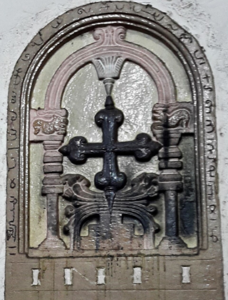
Saint Thomas Christian Cross
(Courtesy: https://en.wikipedia.org/wiki/Paremmakkal_Thoma#/media/File:Nasrani_cross.jpg)
The text is also important because of the understanding it provides us about the pre-colonial Eastern Christian tradition in India. The propagation of Christianity in India is often believed to be the product of European colonisation. The Varthamanapusthakam, however, challenges this assumption. Simultaneously, the book talks about the oppression of Indian Christians by Portuguese and Carmelite missionaries and the ensuing resistance to Western ecclesiastical control by the community. The author criticises the exploitation of the Kerala church by the European church and clergy. The book documents the conversion of faith into a ground from which political and institutional dissent emerges. Finally, apart from representing Indian Christianity as a non-colonial phenomenon, it also shows us how Indian Christians were a part of the global Christian community.
Although Varthamanapusthakam was written in 1790, it got misplaced for quite some time. It was only in 1936 that it was rediscovered and printed. It is acknowledged as the earliest travel narrative in an Indian language, but it is also a historically situated text that documents the conflicts of an indigenous Christian community about authority and identity with competing foreign ecclesiastical powers. The text shows how religious affiliation, race, and political control intersect to marginalise the community it represents. According to scholar Clara Joseph, the text itself is granted only a marginal position in literary studies. This can be understood through three interrelated factors, namely its status as a religious narrative in a largely secular canon, its association with Indian Christianity that unsettles colonial narratives, and its origin as a Malayalam text translated into English outside the dominant circuits of European literary translation. These conditions have contributed to the text being overlooked despite its literary, historical, and cultural significance. As a source of history, the text tells us of the socio-cultural situations of the 18th-century Malabar region and also contributes to our understanding of Malayalam literature.
Bibliography
1. Kathanar, Paremmakkal Thoma. The Varthamanappusthakam. Translated by Placid J. Podipara, Oriental Institute of Religious Studies, 1971.
2. Malekandathil, Pius. “Narratives of Travel, Voices of Dissent and Attacks on the Colonial Church Fabric of the European Missionaries.” Devotion and Dissent in Indian History. Ed. Vijaya Ramaswamy. Foundation Books, 2014. 330–347.
3. IRUMBAYAM, GEORGE. “Books of Yesteryears—I: ‘Varthamanapusthakam’: The First-Ever Travelogue in Indian Languages.” Indian Literature, vol. 30, no. 4 (120), 1987, pp. 81–85.
4. K. Nayar, Pramod. “Travel Writing and Translocal Subjectivity: The Varthamanappusthakam.” Jadavpur University Essays and Studies, vol. 35, 2020, pp. 160–173.
5. Joseph, Clara AB. “The Varthamanappusthakam or Is there Justice for the Narrating Subaltern?.” University of Toronto quarterly 84.4 (2015): 153-169.