
By Vaibhavi Danwar
Standing as grand relics of a bygone era, havelis are more than just architectural marvels; they are silent storytellers of history, culture, and heritage. These opulent mansions, once home to aristocrats and merchants, continue to echo the grandeur of their past. The walls of these havelis are canvases that depict stories of mythology, romance, and mundane life in the form of colorful murals. Two of the finest artistic traditions that are a part of these mansions are the Shekhawati frescoes and Mandana paintings, which still mesmerize fans and carry the torch for Rajasthan’s artistic heritage.
The Timeless Art For Havelis
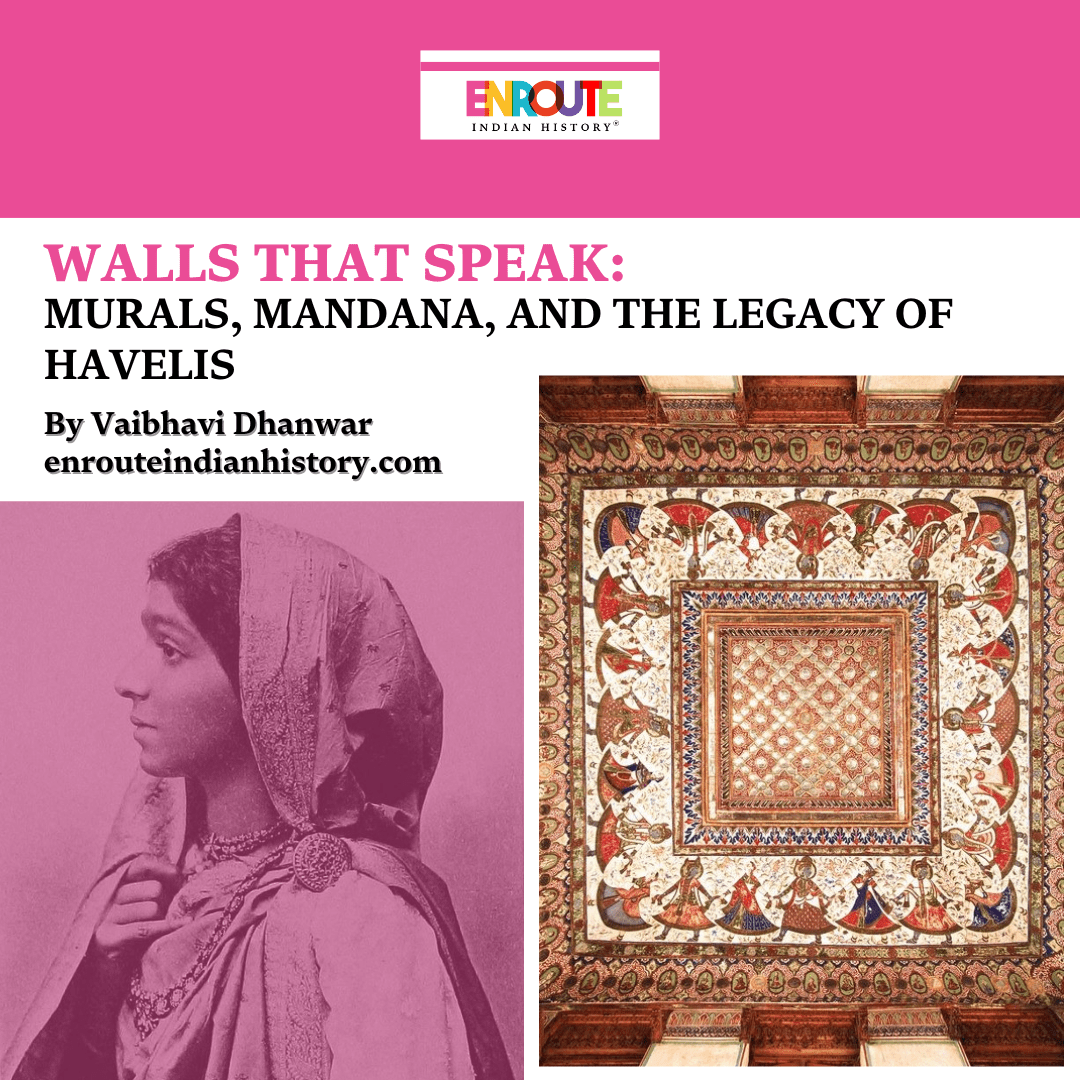
It was not overnight that havelis attained grandeur but through assiduous work. Mural painting, which is a meticulous and time-consuming art form, needed several layers, varied material, and professional techniques. The subjects of murals can be categorized broadly under ten categories: ornamental motifs, daily life, religious, raga mala (music modes), folk mythology, historical personalities or events, flora and fauna, erotic scenes, maps and places, and representations of the British along with their technological innovations. Beyond well-known love sagas like Laila-Majnu and Heer-Ranjha Shekhawati’s murals frequently depict Rajasthan’s beloved romance; The story of Moomal and Mahendra is one of Rajasthan’s favorite love stories, which is frequently painted on haveli murals. Moomal was a princess of great beauty who resided in Kak Mahal, a palace full of illusions to challenge suitors. Several failed, but Mahendra, a chivalrous nobleman from Umerkot, succeeded and captured her heart. Every evening, he traveled across the Sindhu River to be with her. One evening, when he was late, Moomal playfully dressed her sister, Soomal, in her attire and slept next to her. Mahendra found another woman with her, he thought of betrayal and went away, not willing to listen. Moomal, heartbroken, burned down her palace. Mahendra saw the fire, he understood his error and returned, but perished along with her in the fire. Their tragic fate and love are immortalized in Rajasthan’s art and folklore. All of this was put forward in abundant colors, before the 19th century, artists relied on natural pigments like lampblack, as well as red, green, and yellow ochres. Lime served as a substitute for white and was also used to lighten other shades. More luxurious pigments such as indigo, ultramarine, vermilion, verdigris, gold, and silver were reserved for prayer rooms and bedrooms. Indian Yellow, derived from the urine of cows fed on mango leaves, was occasionally used but remained rare.
Seth Anandilal Podar constructed this grand haveli in 1902 as a residence for his family, called The Podar Haveli. In 1955, his son, Ramnath, relocated with his family to Bombay. Decades later, in 1995, his great-grandson, Kantilal Podar, transformed the haveli into a museum. It stands out for both its historical value and architectural brilliance. Its Toran Darwaja, exquisite frescoes, expansive façade, and stunning interiors are unmatched in the region. In fact, its main entrance and interior doors are among the finest examples of craftsmanship in India. Today, the museum showcases a rich collection of historic artifacts, including costumes, jewelry, handicrafts, stone and marble art, and paintings.
The family of this haveli had a successful textile business in Calcutta. But like the trend those days, they decided to build this Haveli for social status and posterity. It was only recently in 1996, two of his great grandsons renovated the house and converted it into a museum. Seth Arjun Das Goenka Haveli was carefully constructed for efficient functionality and aestheticism. After much research, consultation, and review best men were hired to construct the haveli with water storage rooms, kitchens, a pooja room, copper urns, corners for grinding stones and churning butter, pulley-and-rope fans, water harvesting provisions, and special ladies’ quarters (zenana) for privacy. The Chhatri (cenotaph) hosts wall paintings of Krishna-Lila, Mahabharat, and Vishnu Purana. The Chahatri of Shiv Baksha Goenka and Dharmashala was built in 1903 with Rs. 18,361, 8 Annas, and 2 Paise. [SAGHH Museum]
The Enduring Legacy Of Mandana Paintings
Mandana paintings are one of the oldest and longest-lasting tribal arts, having been handed down through generations. Practiced mainly by the Meena community, these complex patterns are painted on the walls and floors of houses, both within and outside the house. Not merely an ornament, Mandana has a protective and religious function; it is said to repel evil spirits and bring divine blessings into the home. Traditionally painted with white chalk or lime on a red ochre (geru) ground, these paintings frequently include geometric designs, animals, gods, and nature motifs. They are especially important during festivals, weddings, and other special events, representing prosperity, protection, and harmony in the home. Although modernization has taken place, there are attempts to conserve and rejuvenate this revered art form as a vital portion of India’s tribal and folk heritage. In many houses of Rajasthan, even in the metropolitan city, such paintings are still practiced on auspicious days like diwali, gowardhan, holi.
Mandana is the most popular and widely used folk design drawn by the most of the tribal and rural folks throughout the length and breadth of Rajasthan. The term Mandana means kriya or sanja with definite hypotheses. In Indian tradition out of sixty four kalas, Bithikala or wall and floor painting is most important and significant. [Tilak Bagchi and Pritish Chaudhuri, 2015] Mandana painting is mostly done by women, although there are no formal restrictions against men indulging in this painting tradition. The paintings feature an abundance of geometric patterns, floral and faunal designs, and representational forms of deities, sometimes depicted in their real forms and sometimes symbolically. Apart from religious and spiritual motifs, these paintings also depict hunting scenes, farm work, everyday life, and cultural practices. Most tribal artworks also include depictions of clan goddesses (Gotrej), Lord Ganapati, and other deities. Peacocks with more than 150 different design types, elephants, horses, and human beings, particularly those dressed in royal or bridal wear, are among the most frequently depicted motifs. Depictions of cosmic forces and natural forms again enhance the art form used in Rajasthan’s tribal paintings. These are primarily practiced in the mud houses which are made of clay mixed with dung and lime or chalk powder is used for painting the theme or the motif. Only two colors are used, red or mud brown (as a background) and white for the drawings. [Anil yadav, 2013]
Modern Day Revival and Adaptation
With the revival of classic architectural forms, Mandana paintings and Shekhawati frescoes are being revived in modern spaces like contemporary residences, boutique hotels, and high-end resorts to make sure that cultural heritage continues to be a part of design aesthetics.In city life, most homeowners now include wall stencils and hand-painted murals with Rajasthani motifs as part of their interior design, thus blending traditional creativity with contemporary design. Not only does this provide a better visual appeal but also creates a stronger sense of India’s artistic heritage. Luxury heritage hotels such as Neemrana Fort Palace and Samode Haveli have made major restoration attempts to save their frescoed historic walls. These hotels show how traditional art and contemporary hospitality can harmoniously coexist, providing tourists with a holistic cultural experience. Through intricate paintings and architectural elements, these properties preserve their historical appeal but add modern amenities, so that the beauty of Rajasthan’s art traditions is not only preserved but also flourishes in a contemporary setting.
Rajasthan’s havelis, their murals and architectural splendor, are living museums of a diverse and rich heritage. From the colorful frescoes of Shekhawati to the sacred Mandana paintings of tribal societies, these arts have carried cultural histories for generations. Modernization has changed traditional spaces, but continuous conservation in museums, heritage hotels, and modern design ensures these arts will not be forgotten. The use of Mandana paintings and Shekhawati frescoes in modern interior design is a sign of increased respect for heritage in modern aesthetics. As these traditions become relevant once again, they not only pay tribute to the past but also encourage future generations to preserve and protect India’s artistic heritage.on
References
[P.Ganpathy and A.Malick. 2015] Inside the painted havelis of shekhawati on Cntraveller
[S.Rout. 2024] Havelis of Shekhawati: awe inspiring, but forgotten on Stampedmoments
[A.Yadav. 2013] Mandana Paintings as House Art in Rural Rajasthan on cliber and explorer
[T.Bagchi and P.Chaudhuri. 2015 ] Tribal Paintings Of Rajasthan: A Micro-Study Of Continuity And Change on Man In India, 95 (3) : 463-482