

Water Management System in Dholavira: An Ancient Model of Sustainable Urban Planning
- July 3, 2026
: by Yusra Naqvi
Abstract:
Dholavira, a Harappan site located in the arid region of the Rann of Kachchh in present-day Gujarat, represents one of the most sophisticated examples of ancient water-resource management systems in South Asia. Unlike other cities such as Mohenjo-Daro, which highly relied on wells, Dholavira developed a unique, large-scale system of reservoirs, channels, dams, and rainwater harvesting structures. Excavations led by archeologist R.S Bisht of the Archaeological Survey of India between 1990 and 2005 revealed an efficiently planned urban settlement integrated with advanced mechanisms and technology. This article argues that the water management system of Dholavira was not merely a functional response to environmental scarcity but a deliberate and highly organised model of sustainable urbanism. Through an analysis of its reservoirs, stream diversion, hydraulic infrastructure, and spatial planning, it becomes evident that Dholavira exemplifies an early understanding of ecological adaptation and resource optimisation.
Keywords: Dholavira, Indus Valley Civilisation, water management systems, reservoirs, urban planning, resource management
Introduction: Environment and Innovation
Dholavira’s water management system must be understood within its ecological constraints. Situated between the seasonal streams of Manhar and Mansar, the city lacked access to perennial freshwater sources. The salinity of groundwater further limited the viability of wells, compelling the inhabitants to depend almost entirely on surface water collection and storage. This limitation led to the need for advanced mechanisms and was foundational in shaping the city’s infrastructure. Instead of perceiving scarcity as a hindrance, the people of Dholavira transformed it into an urban design by organising techniques. As Michel Danino argues, Harappan settlements often demonstrate a ‘deep ecological intelligence’, wherein natural constraints are systematically incorporated into planning. In Dholavira, this is evident in the deliberate positioning of reservoirs and the alignment of channels with natural gradients. The necessity of water conservation thus acted as a catalyst for innovation, resulting in a system that was both resilient and adaptive.
Dams, Reservoirs, Channels, and Rainwater Harvesting: Water-Resource Management in Dholavira
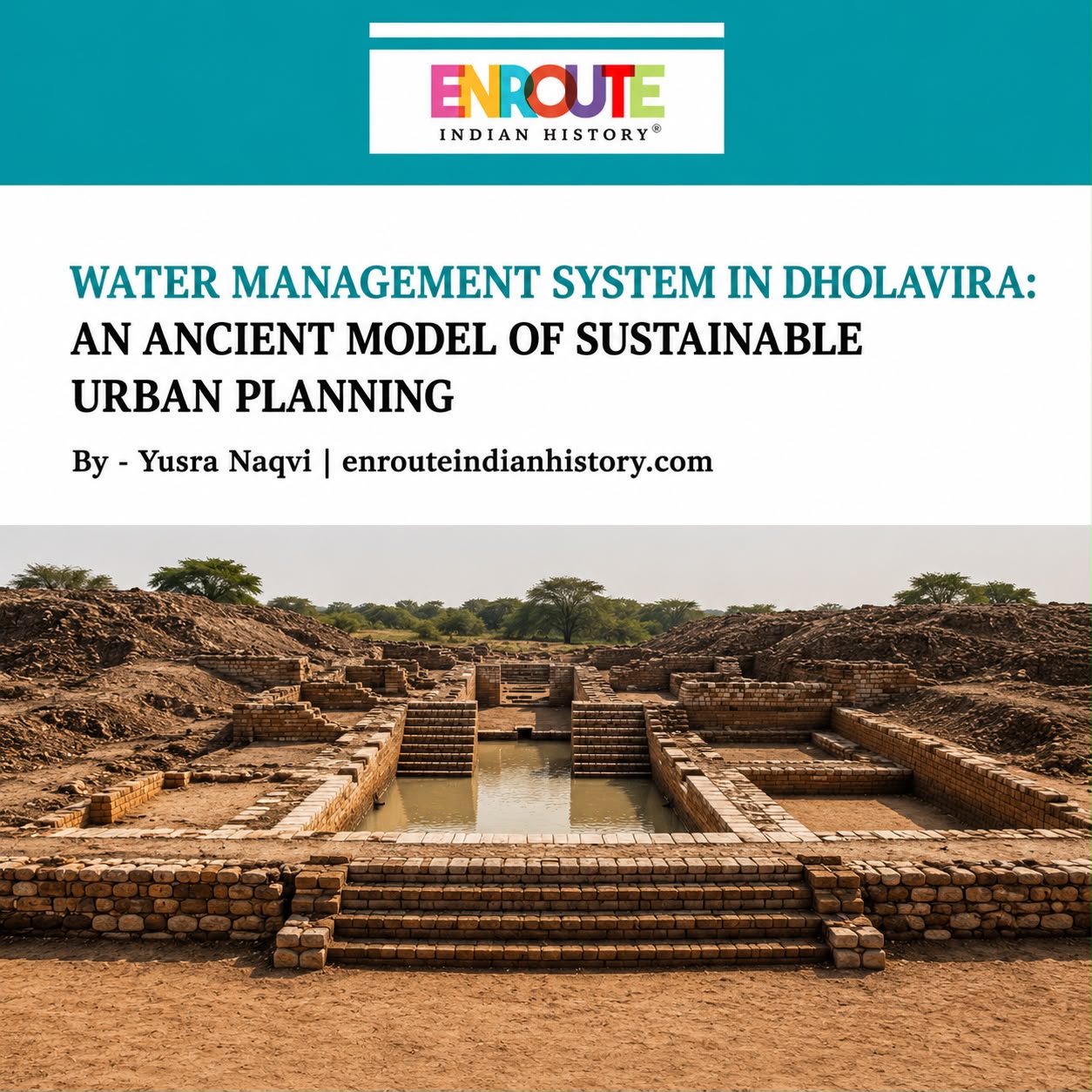
The most striking feature of Dholavira’s water management system is its network of large reservoirs, which fundamentally redefine the relationship between urban space and natural resources. These reservoirs were central components of the city’s layout, occupying substantial portions of the fortified area. Their construction involved a combination of rock-cut excavation and masonry, and the use of stone blocks and interlocking brick technology. Excavations suggest that at least sixteen reservoirs were constructed within the city walls, integrated well into the urban divisions. Sealing materials such as clay were applied to prevent seepage. Staircases leading into the reservoirs have also been discovered, allowing access to water at different levels. Archeological evidence shows that one large reservoir measured approximately 73.5 meters in length and 29.3 meters in width, with multiple access points. The construction techniques reflect a hybrid approach. The rock-cut foundations ensured structural stability, while finely dressed stone masonry provided durability. This indicates a high level of planning and technical expertise.
The reservoirs in Dholavira were often arranged in a cascade system, particularly in the southern part of the city. Water flowed sequentially from one reservoir to another, allowing sediment to settle gradually. This multi-stage storage system served several purposes. First, initial reservoirs acted as settling tanks where silt accumulated and helped in sediment filtration. Cleaner water flowed into subsequent reservoirs. Second, reduced siltation increased storage capacity and longevity. Such sedimentation techniques indicate a sophisticated understanding of water purification processes, comparable to later technologies.
A crucial aspect of Dholavira’s water management was the diversion of water from nearby streams into reservoirs. Some channels were cut into rock, and others were constructed with masonry, transporting water from the Manhar and Mansar streams. These channels carefully calculated gradients to control water flow. Moreover, stone-lined conduits prevented erosion. Scholars suggest that water from the Manhar stream was diverted through a series of smaller tanks before reaching the main reservoirs. This process reduced turbidity and controlled the velocity of incoming water. The presence of such channels demonstrates that the Harappans at Dholavira were not merely storing water but actively managing its movement and quality.
To regulate water flow from seasonal streams, the people of Dholavira constructed dams and bunds across the Manhar and Mansar. Archeological evidence points to at least three dams on the Manhar and two on the Mansar. These structures were responsible for slowing down floodwaters during the monsoon, diverting water into channels leading to reservoirs, enhancing groundwater recharge, and preventing soil erosion. Bunds (embankments) also separated reservoirs and acted as pathways within the city. Additionally, smaller check-dams were constructed using locally available materials such as stone and boulders. These low-cost structures reduced water velocity and allowed percolation, reflecting an early understanding of sustainable water conservation.
Further, rainwater harvesting formed the backbone of Dholavira’s water-management system. The city was equipped with an extensive network of drains exclusively to collect rainwater. Stone-lined drains, running through streets and public spaces, were connected directly to reservoirs. Surface apertures facilitated airflow and efficient water movement. This was a set-up distinguished from the usual wastewater drainage systems. Rainwater from rooftops, streets, and open spaces was systematically directed into storage tanks. This separation of clean water and waste reflects a high degree of urban sanitation planning, distinguishing Dholavira from many other ancient cities.
Water Storage, Urban Planning, and Social Organisation
The water-management system of Dholavira was not a separate feature but an integral part of its urban design. The city was divided into three main parts: the citadel, the middle town, and the lower town, each with access to water resources. The reservoirs were strategically located along the city’s periphery and within its walls, ensuring equitable distribution. The city also utilised its natural topography. A slope of approximately thirteen meters from northeast to southwest enabled gravity-driven water flow, creating a cascading system of reservoirs. Such planning highlights the efficient use of natural landscape, minimisation of energy requirements, and integration of infrastructure with environmental conditions.
The presence of multiple reservoirs suggests a collective water management system, unlike the private well-based system of Mohenjo-Daro. Access points such as staircases and entry platforms indicate that water retrieval was carefully organised. Some scholars argue that different reservoirs may have served different sections of the population or specific functions, such as drinking, ritual use, or storage.
These structures exhibit several technological innovations. The use of stone masonry instead of baked bricks is a rare feature in Harappan sites. Alongside, rock-cut reservoirs ensuring durability, waterproofing techniques using clay and other sealing materials, and the interlocking construction methods enhancing structural stability is unique in Dholavira. These innovations highlight adaptability to local environmental conditions, particularly the availability of stone in the Kachchh region. This scale and complexity of the system also implies centralised planning and administration, skilled labour and construction knowledge, as well as community participation in maintenance.
Conclusion: Ancient Sustainable Solutions to Water Crisis
Modern scholars like Michel Danino have highlighted the ecological wisdom of the Harappans. R.K Iyer has examined the technological aspects of ancient Indian water systems and describes Dholavira as an early example of sustainable urban planning. He focuses on the resource optimisation and decentralised storage strategies of the people, whereby every drop of water was captured and reused, which resulted in a reduced risk of scarcity. Also, environmental adaptation, particularly infrastructure suitable to the landscape, as well as environmental conservation by controlling floods and droughts through dams and reservoirs, is a much-appreciated strategy by researchers like R.S Bisht and Amit Prashant.
Therefore, Dholavira stands out as a model of intelligence and planning, where water management was central to both survival and urban space. Its reservoirs, channels, dams, and drainage systems collectively form a coherent and sophisticated network that reflects advanced engineering, environmental awareness, and social organisation. The elaborate system demonstrates that sustainability was a deliberate design embodying several principles that are relevant even today.
References:
- Bisht, R.S, Excavations at Dholavira (1990-2005): An archeological Report, Archeological Survey of India, 2015
- Bisht, R.S, Urban Planning at Dholavira: A Harappan City, 2000
- Danino, Michel, Water Management in Ancient India
- Ghosh, Satyajit, Modelling Water Resources in the Ancient Indus Valley City of Dholavira, 2020
- Iyer, R.K, Hydrology and Water Resources Management in Ancient India, Hydrology and Earth System Sciences, 24, 2020
- Wright, Riya, The Ancient Indus: Urbanism, Economy, and Society, Cambridge University Press, 2010