
By Prishnika Mazumdar
The Indus Valley Civilisation (IVC), generally dated between 2600 and 1900 BCE, is one of the earliest known urban societies, known for its planned cities, sophisticated drainage systems, and craft production. Spread across present-day Pakistan and northwest India, it boasted major urban centres and specialised hubs of production (Possehl, 2002). Among these, we have the focus of our article: the site of Chanhudaro. Herein, we try to explore how our understanding of Chanhudaro has evolved through archaeological excavations conducted over the decades, from the initial explorations by Nani Gopal Majumdar and Earnest John Henry Mackay in the 1930s to the more recent investigations by the French Archaeological Mission in 2015.
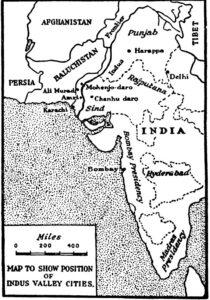
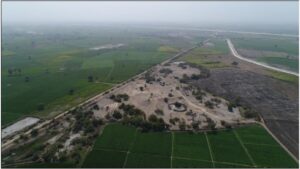
Chanhudaro is situated to the east of the river Indus, some hundred and thirty kilometres south-west of Mohenjo-Daro. The site consists of a complex of two large mounds and a small one (Possehl, 2002). In ancient times, these three mounds formed a single city. Over time, recurrent flooding cut through them. E.J.H. Mackay opines that it was the flooding that led to many phases of desertion and later abandonment of the settlement (Mackay, 1937).
In archaeological literature, Chanhudaro is described as one of the most important craft production centres of the Indus Valley Civilisation. The proximity of the site to the Indus River indicates that it may have functioned as a strategic production and distribution centre within IVC’s economic system. Evidence of all stages of beads, from raw material to finished, suggests that the site was a great centre of bead making. Metalworking in copper and bronze was extensively practised as well. Hoards of metal utensils and tools were found together. Such evidence has prompted interpretations that Chanhudaro was primarily a craft production hub. Excavations have revealed extensive workshops for bead-making, shell and ivory carving, and copper and bronze work, confirming a specialised economy that likely supplied luxury goods to other Harappan cities (Mackay, 1937).
Between 1929 and 1931, N.G. Majumdar, Assistant Superintendent of the Archaeological Survey of India, made a tour of the ancient sites of Sindh (Majumdar, 1934). Among these sites was Chanhudaro. Inspired by his reports, the site was then picked up for study by E.J.H. Mackay in 1935-36. Over the many years since its discovery and many studies later, our understanding of the site has evolved. To understand this evolution, we will look at the early excavations by Mackay and the most recent round of excavations conducted by the French Archaeological Mission in 2015, directed by Aurore Didier.
Early Excavations and Findings
In 1931, when N.G. Majumdar discovered Chanhudaro, he considered it to be a small site. However, studies by Mackay demonstrated that the site was much eroded and would have covered an area beyond the three mounds above the level of the surrounding plain (Mackay, 1943).
To explain the growth of the city and its history, Mackay begins with the lowest levels reached. Among the Mounds, Mound II, being the largest, was chosen for initial investigation. The initial trenches were cut in close, parallel alignments. One of the early discoveries in this process was a large, massive wall indicating an important city enclosure, made with well-baked bricks and mud mortar. While not as expansive as Mohenjo-daro, Chanhudaro did emerge as an important site with urban planning (Mackay, 1937).
Further excavations revealed a multi-period occupation history, established through stratified masonry and debris layers. The lowest levels accessed, just above the subsoil water table, yielded artefacts and architecture consistent with early Harappan culture. No pre-Harappan culture could be identified beneath these layers, considering the fact that they had already reached the water table and further depth would require pumping the water out (Mackay, 1937).
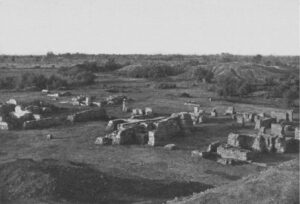
Flooding emerged as a key factor impacting stratigraphy. Layered bands of river-deposited silt in construction debris confirmed repeated inundations, each leading to abandonment and subsequent rebuilding. In contrast to Mohenjo-daro, where new structures were superimposed directly on earlier foundations, Chanhudaro’s rebuilding was more haphazard. Floods erased previous street alignments, and returning inhabitants rebuilt with little reference to earlier urban plans (Mackay, 1937).
One of the features uncovered through stratigraphic excavation was the sophisticated drainage system. Brick-lined bathroom drains and pottery-pipe outflows ran along residential zones. Even poorer quarters maintained bathing areas and drainage (Mackay, 1937).
The excavation revealed five distinct Harappan occupation levels above the waterline. Two of these uppermost strata were fully excavated across Mound II. Elaborate drains, aligned street plans, and ritual bathing spaces belonged to these levels. Above the Harappan levels, there is evidence of the arrival of a culturally distinct group around 2000 BCE, associated with the Jhukar phase. This group, identified through the material culture found in the topmost layers of Mound II, introduced polychrome pottery with different shapes, decorative techniques, and colours compared to Harappan ware (Mackay, 1937).
Even further above, there were signs of a third occupation associated with Jhangar ware: simple, hand-made, polished grey pottery. The minimalist and incised nature of these artefacts suggested either a brief or seasonal occupation, perhaps by nomadic or semi-settled groups. Material-specific studies augmented stratigraphic findings. Ceramic typology was used to differentiate cultural phases, identifying Harappan painted ware by its burnished red slip and black haematite designs. In the second Harappan level, excavators uncovered what Mackay interpreted as a hot-air bath (sweat bath), with a system of flues for circulating heated air. Similar structures had been found at Mohenjo-Daro (Mackay, 1937).
Recent Excavations and Findings
Modern archaeological methods have expanded our understanding of Chanhudaro. Recent excavations conducted between 2015 and 2017 employed more rigorous stratigraphic, architectural, and material analyses that illuminated the complexities and depth of the site’s occupational history.
One of the key excavation strategies involved the opening of several test trenches: Trench 1, Trench 2, and Trench 3, to revisit previously explored zones and extend into unexcavated areas with high potential for early occupation layers. Trench 1, a small test trench between Mound II and III, revealed four primary architectural levels. Stratigraphy showed sequential layers of mudbrick walls, debris with terracotta artefacts, kiln wasters, and significant ceramic deposits. These findings, particularly painted ceramics and vitrified kiln remains, suggested the presence of craft activities such as pottery and terracotta production as early as the first Indus period (2600/2500–2300 BCE), a phase that was previously underrepresented in Sindh’s archaeological record (Didier et al., 2017).
In Trench 2, opened in Mound II, the core area that was previously excavated by Mackay, the French-Pakistani team exposed seven architectural levels. Interestingly, the “platforms” noted by Mackay were revealed to be massive mudbrick buildings with quadrangular cells, often lined with fired bricks, rather than simple elevation bases for flood protection (Didier et al., 2017).
Trench 3, situated on the slope of Mound III, revealed six architectural levels, including stratified mudbrick buildings, domestic installations, and decorated ceramics consistent with the first Indus period. The presence of large quantities of fine painted pottery, along with craft debris, indicated a contemporaneous but possibly residential function in this part of the site, compared to the more industrial character of Trench 2 (Didier et al., 2017).
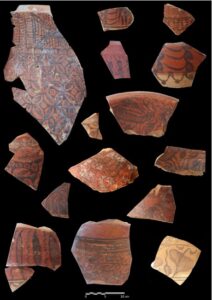
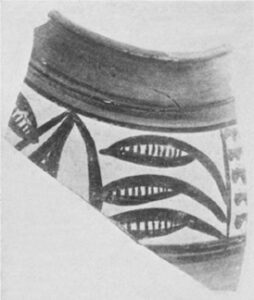
Several new studies on the material assemblages of Chanhudaro have been conducted. However, no elaborate excavations had been carried out since Mackay’s fieldwork. The architectural sequence of the Mature Indus Period established at Chanhudaro remains more or less unchanged even in view of significant advances achieved in our understanding of the chronological sequence of the Indus Valley Civilisation (Didier et al., 2017). This points towards possible gaps in our understanding. As archaeological techniques continue to develop and as previously unexplored areas of the site are revisited or newly examined, there remains great scope for further refinement in our understanding of Chanhudaro’s role within the Civilisation.
References
1. Mackay, E.J.H., 1943. Chanhu‑Daro Excavations, 1935–36. American Oriental Series, Vol. 20, New Haven, Conn.: American School of Indic and Iranian Studies & Museum of Fine Arts, Boston.
2. Mackay, E.J.H., 1937. ‘Excavations at Chandhu‑Daro, Sind’, Nature, 139, pp. 557–558. doi:10.1038/139557a0.
3. Majumdar, N.G., 1934. Explorations in Sind: Being a report of the exploratory survey carried out during the years 1927–28, 1929–30 and 1930–31. Memoirs of the Archaeological Survey of India, No. 48. Delhi: Manager of Publications.
4. Didier, A., Sarmiento‑Castillo, D., Mongne, P. & Shah, S.S.A., 2017. ‘Resuming excavations at Chanhu‑Daro, Sindh: first results of the 2015–2017 field‑seasons’, Pakistan Archaeology, 30, pp. 69–121. halshs‑02975449.
5. Possehl, G.L., 2002. The Indus Civilisation: A Contemporary Perspective. Walnut Creek, CA: AltaMira Press.
Image Sources
1. Image Title: Location of Chanhudaro
Source: Excavations at Chanhu-daro by the American School of Indic and Iranian Studies and the Museum of Fine Arts, Boston: Season 1935–36
Reference:
Mackay, E.J.H., 1943. Chanhu-daro Excavations 1935–36. New Delhi: Government of India, Archaeological Survey of India, Memoir No. 50.
2. Image Title: Aerial view of Chanhudaro
Source: Resuming excavations at Chanhu-daro, Sindh: First results of the 2015–2017 field-seasons
Reference: Didier, A., Didier, N., and Beltoise, T., 2017. Resuming excavations at Chanhu-daro, Sindh: First results of the 2015–2017 field-seasons. Pakistan Archaeology, 51, pp.1–35.
3. Image Title: Mound I of Chanhudaro in distance, Mound II in the foreground
Source: Excavations at Chanhu-daro by the American School of Indic and Iranian Studies and the Museum of Fine Arts, Boston: Season 1935–36
Reference:
Mackay, E.J.H., 1943. Chanhu-daro Excavations 1935–36. New Delhi: Government of India, Archaeological Survey of India, Memoir No. 50.
4. Image Title: A Selection of Painted Ceramics from Indus Valley Civilisation (2600/2500–2300 BCE)
Source: Resuming excavations at Chanhu-daro, Sindh: First results of the 2015–2017 field-seasons
Reference:
Didier, A., Didier, N., and Beltoise, T., 2017. Resuming excavations at Chanhu-daro, Sindh: First results of the 2015–2017 field-seasons. Pakistan Archaeology, 51, pp.1–35.
5. Image Title: Polychrome Ware from Jhukar Culture
Source: Excavations at Chanhu-daro by the American School of Indic and Iranian Studies and the Museum of Fine Arts, Boston: Season 1935–36
Reference:
Mackay, E.J.H., 1943. Chanhu-daro Excavations 1935–36. New Delhi: Government of India, Archaeological Survey of India, Memoir No. 50.