
What Grew in the Valley 5,000 Years Ago? Inside Burzahom’s Forgotten Field
- October 10, 2025
By Ananya Vishnu
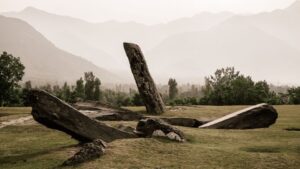
Stunning Visuals of the Site of Burzahom (Lakhani, 2022)
Unearthing a Neolithic Legacy
Nestled within the unique geological formations of the Kashmir Valley’s odiyars, approximately 16 km northeast of Srinagar, lies the pivotal Neolithic site of Burzahom. Literally meaning “place of birch” in Kashmiri, the site derives its name from the abundant birch bark (Betula utilis) discovered there, used by its ancient inhabitants. Discovered in 1935 by H. De Terra and T.T. Paterson and extensively excavated by T.N. Khazanchi from 1960 to 1971, Burzahom stands as the type site for the distinctive “Northern Neolithic” culture of South Asia (Fonia,1971).Its stratigraphy reveals a remarkable transition from subterranean pit dwellings (Aceramic Neolithic, Period I) to above-ground structures with sophisticated pottery and tools (Ceramic Neolithic, Periods IIA & IIB), spanning roughly 3000 to 1500 BCE. Crucially, Burzahom provides unparalleled evidence for the shift from a hunter-gatherer economy to early food production in the Himalayan region, with plant resources playing a central role in subsistence, technology, and settlement.
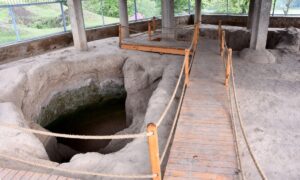
Excavations at Burzahom under Archaeological Survey of India
Agricultural Practices and Paleoethnobotanical Insights from Burzahom
Paleobotanical research at the Neolithic site of Burzahom—chiefly led by G.M. Buth, Farooq A. Lone, and Maqsooda Khan—has significantly expanded our understanding of early agriculture in the Kashmir Valley. Analysis of soil samples from Periods I and II reveals a complex and dynamic subsistence system anchored in crop cultivation, foraging, and animal domestication.
The Neolithic inhabitants of Burzahom cultivated a range of crops, many of which trace their origins to West Asia. Among these, wheat emerged as the staple, with two key hexaploid species identified: Triticum aestivum (bread wheat) and Triticum sphaerococcum (Indian dwarf wheat). The latter holds particular significance. Its presence at Burzahom, prior to its documented appearance in Harappan contexts, hints at a possible local origin. Scholars propose that T. sphaerococcum may have evolved in situ from T. aestivum and wild Aegilops species, making Kashmir a potential center for its early development (Lone et al.,1993). Its short growing season suggests an adaptation to the valley’s environmental conditions.
Alongside wheat, barley (Hordeum vulgare), specifically the six-rowed cultivated variety, was widely grown. Originating in West Asia as well, barley’s diffusion into Kashmir around 3000 BCE likely occurred through established agricultural corridors such as Mehrgarh. Impressions of barley husks and grains found embedded in mud bricks and floors suggest its integral role in daily life and construction.
Lentils (Lens culinaris), descended from Lens nigricans, formed the primary pulse crop. Their occurrence in Burzahom is not only archaeobotanically significant but historically unique—based on the initial findings ,this is possibly the earliest and sole record of lentil cultivation from Neolithic Northwest India. Alongside this evolving cultivated base, the Burzahom community continued to actively exploit wild plant resources; their association with wheat and barley cultivation mirrors patterns from West Asia around 5000 BCE, reinforcing the idea that Burzahom was embedded in a broader network of agrarian exchange.
Additional legumes like peas (Pisum sativum) were also part of the Neolithic diet, enhancing dietary protein intake and crop diversity. The shift in Period III (Megalithic phase) toward rice (Oryza sativa) and millet (Panicum miliaceum) cultivation reflects an evolving agro-economic strategy, perhaps driven by climatic adaptation or cultural diffusion.
Beyond cultivated crops, the Burzahom Neolithic community actively exploited wild plant resources, pointing to a mixed subsistence economy. Nutritious tree crops such as walnut (Juglans regia), apricot (Prunus armeniaca), peach (Prunus persica), almond (appearing in the later Ceramic Neolithic, Period II) and grape (also Period II)—were essential supplements, especially during Kashmir’s long winters. These provided fats, sugars, vitamins, and storage-stable calories through dried fruits and seeds (Bhat & Dubey, 2017).
Archaeozoological evidence supports a close association between plant cultivation and animal husbandry. The presence of domesticated dogs, likely used to guard crops, indicates a growing reliance on organized agriculture. Moreover, the co-occurrence of weeds and cereals suggests an early, transitional phase of farming, where wild and domesticated plant species overlapped—whether due to rudimentary agricultural practices or the collection of edible weeds.
Taken together, these findings underscore a significant transformation in subsistence strategies at Burzahom. As agricultural knowledge deepened and diversified, reliance on foraging and hunting began to decline. Yet, hunting and animal domestication remained vital components of the diet, underscoring a holistic approach to survival in the valley’s challenging environment.
Trees for Construction and Fuel
Birch (Betula utilis): Central to the site’s identity (“Burzahom”). Its bark was a primary roofing material for pit dwellings, evidenced by abundant burnt fragments. Sourced from higher elevations, it was ideal for insulation against snow.
Pine (Pinus wallichiana – Himalayan Blue Pine): The dominant timber source identified from charcoal in post holes. Used extensively for structural elements in dwellings, especially as roofing transitioned above ground (Period IIB).
Elm (Ulmus wallichiana), Willow (Salix spp.): Primarily used as firewood.
Deodar (Cedrus deodara), Fir (Abies webbiana), Spruce (Picea smithiana): Other conifers likely used for timber and fuel, part of the mixed conifer-broadleaf forests surrounding the site. Pollen studies (e.g., from nearby Harwan) show deliberate clearance of pine forests, attributed to Neolithic land clearance for farming.
Agricultural Practices and Technology
The transition to farming required specific tools and techniques (Kaw,1987):
Land Management: Microwear analysis (R.K. Pant, 1979) on stone tools revealed:
Stone Axes: Used for forest clearance (wood cutting, chopping, dressing wood).
Adzes: Used for digging/working the earth, likely for field preparation.
Evidence from pollen diagrams indicates deliberate clearance of pine forests to create arable land.
Initial cultivation likely involved small, isolated patches cleared within forested areas near water sources.
Archaeological evidence indicating a transition from solely winter-sown wheat cultivation at the Neolithic site of Kanispur to potentially mixed winter and spring wheat regimes at contemporaneous sites Burzahom and Gufkral suggests that the Kashmir Valley functioned as a critical conduit for the dispersal of Triticum sphaerococcum. This variety’s adaptation likely facilitated its adoption by nomadic and agro-pastoral populations inhabiting the higher altitudes of Central Asia and the Tibetan Plateau. These groups could integrate this short-season spring crop into their transhumance patterns and cultivation practices, overcoming local environmental limitations (Spengler, 2015).
Harvesting: Flake knives were identified as the primary tools for reaping cereal crops like wheat and barley.
Processing:Querns, Pestles, Pounders: Ubiquitous finds, used for grinding grain into flour and pounding both grain and meat. The dental health condition of the Burzahom people points to a diet of coarse food that was hard to chew.
Perforated Stones: Possibly used as weights for digging sticks.
Storage: The invention of handmade pottery was driven by the need to store agricultural surplus. Predominant Coarse Grey Ware vessels – globular jars (matha), pitchers (noat, tsoad), and deep basins (dulla) – often with mat impressions on their bases, were essential for storing grains, water, milk, oils, and other products (Fonia,1971). Shallow pits near dwellings also served as storage.
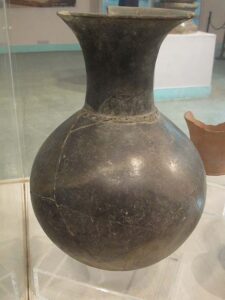
Grey-Ware Pottery from the site
Dietary Patterns: A Mixed Economy
The diet at Burzahom reflected a strategic blend of new food production and established foraging practices:
Plant-Based Staples: Cultivated wheat and barley formed the carbohydrate backbone of the diet, processed into coarse flour or meal using querns. Lentils and peas provided essential plant-based protein. Wild fruits and nuts (walnut, apricot, peach, later almond, grape) added crucial vitamins, minerals, fats, and sugars, especially vital during winter months. The association of weed seedswith cereal remains suggests either primitive farming techniques where weeds were contaminants or the deliberate use of some wild plants as food supplements.
Animal Protein: Despite agriculture, hunting remained significant. Faunal analysis shows bones of wild animals (Kashmiri stag/cervus elaphus, ibex, bear, wolf) alongside domesticated species (sheep, goat, cattle, dog). The famous engraved stone slab depicting a stag hunt vividly illustrates this. Fishing is evidenced by bone harpoons and the use of dulla-like basins. The proportion of domesticated animal bones increased over time (Period IIA-IIB), indicating a gradual shift, but wild resources remained important. The dog likely served roles in both hunting and guarding crops.
Balanced Subsistence: This mixed strategy – combining winter-sown cereals (wheat, barley, pulses), seasonal fruit/nut gathering, animal husbandry, hunting, and fishing – was essential for survival in the valley’s environment, ensuring food security across seasons, particularly the harsh winter (Fonia,1971). The coarseness of the food, inferred from dental wear, underscores the reliance on minimally processed grains.
Conclusion: Burzahom’s Agricultural Significance
Burzahom offers a crucial window into the Neolithic agricultural revolution in the Himalayan corridor. Its inhabitants successfully adapted a West Asian agricultural package (wheat, barley, lentil) to the local highland environment during the 3rd millennium BCE. They supplemented this core with gathered fruits and nuts and managed animal herds, developing a mixed subsistence economy that sustained growing populations across distinct cultural phases (Aceramic to Ceramic Neolithic). The archaeobotanical record reveals not just dietary staples but also critical technological adaptations and significant environmental manipulation. The potential local development or early dissemination role regarding Triticum sphaerococcum highlights Kashmir’s importance within Neolithic exchange networks. While providing a balanced diet overall, the reliance on stone-ground cereals left a distinct mark on dental health. Burzahom exemplifies the complex interplay between plant domestication, environmental management, dietary patterns, and regional interactions that defined early food-producing societies in mountainous South Asia.
References
1. Bhat, S.A. & Dubey, M.C., 2017. Burzahom (Burzohama): A Neolithic Site in Kashmir. International Journal of Creative Research Thoughts.
2. Fonia, R.S., 1971. Excavations at Burzahom (1960–1971). New Delhi: Archaeological Survey of India.
3. Kaw, R.N., 1987. Discovery of Plant Husbandry in Stone Age Period – Kashmir. Jammu and Kashmir: Department of Archaeology.
4. lone, F.A., Khan, M. & Buth, G.M., 1987. Palaeoethnobotany: Plants and Ancient Man in Kashmir. Jodhpur: Scientific Publishers.
5. Spengler, R.N., 2015. Agriculture in the Central Asian Bronze Age. Journal of World Prehistory, 28(3), pp.215–253.
Images:
1. Lakhani, H., 2022. Burzahom: The Story Behind Srinagar’s Stonehenge, Kashmir. Condé Nast Traveller India. Available at: https://www.cntraveller.in/story/burzahom-the-story-behind-srinagars-stonehenge-kashmir/ [Accessed 5 Jun. 2025].
2. Archaeological Survey of India, n.d. Explorations & Excavations. Government of India. Available at: https://asi.nic.in/pages/Explorations-&-Excavations/HQ [Accessed 5 Jun. 2025].
3. Ministry of Culture, Government of India, n.d. Burzahom. Indian Culture. Available at: https://indianculture.gov.in/snippets/burzahom [Accessed 5 Jun. 2025].