

WHAT IT MEANS TO FILM INDIA HONESTLY: SHYAM BENEGAL AND THE NATION’S UNFINISHED PROJECT
- April 30, 2026
By- Arpita Jain
Emerging in the 1970s, Shyam Benegal’s cinema didn’t simply reflect India, but diagnosed it. Constructed from the voices of those socially erased, this article situates Benegal’s cinematic tradition to one that treats cinema as a civic instrument capable of bringing in real political consciousness.
AN INDIAN NEW WAVE
Grappling with post-independence identity and socio-political turbulence, the Indian New Wave emerged as a response to the growing dissatisfaction with formulaic mainstream narratives that ignored urgent social questions and were entrenched in spectacle-driven star-centered melodrama and musical excess.
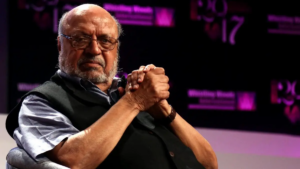
Shyam Benegal (1934-2024). Source- Frontline Magazine
Drawing inspiration from international neorealist traditions such as Italian cinema and the films of Satyajit Ray, this wave sought to root Indian film narratives in real social experience rather than escapist fantasy.
THE RURAL TRILOGY
Although not conceived formally as a trilogy, Benegal’s early rural films—Ankur, Nishant, and Manthan are often referenced together because of their consistent engagement with rural India’s social structures and forces of transformation. His first feature film Ankur, 1974, refused mainstream spectacle and examined the intersections of caste, class, and gender in rural Andhra Pradesh. Released after the 1970s peasant movement, Ankur became a voice of rarity in Hindi cinema for the oppressed.
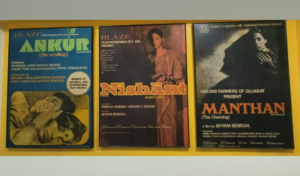
The Rural Trilogy film posters in Benegal’s office. Source- The Wire
Using non-stars and authentic locations, Benegal exposed how caste privileges and gender subordination operate in everyday life, inviting the audience into the highly stratified woven fabric of rural India. Similar stories of feudal oppression and rural way of living were told subsequently in Nishant and Manthan. 1975 Nishant extended the interrogation of Ankur into power politics and justice in pre-independence Telangana. Dramatizing the abuse of rural authority and sexual exploitation of women, the film not only reflects on how entrenched power oppresses the vulnerable, but also how solidarity can upend unjust norms.
In 1976, Inspired by the real story of the cooperative dairy movement led by Verghese Kurien, Manthan was crowdfunded by half a million rural farmers each contributing Rs. 2 and becoming literal producers of their cinematic narrative.
Through Manthan, Benegal framed development as a struggle for challenging existing power structures that require grassroot participation rather than elite policy alone. Owned and financed by the people it represented, the film mirrored the transformation of rural India’s economic landscape through the White Revolution.
A POLITICAL AESTHETIC
‘What will happen to me when your young wife comes of age and is sent here to live with you,’ Lakshmi asks Surya, aware that she has no agency.
Built around discomfort, silence, and structural critique rather than fantasy, Benegal emphasises on what mainstream cinema often erases. For instance, in Ankur, the relationship between Surya and Lakshmi is not framed as romance, but as a transaction enabled by unequal power structures. While Surya’s modern education does not dismantle his inherited privilege, rather only changes the vocabulary with which he exercises it, Lakshmi’s suffering is not shown extraordinary, which this normalisation is precisely what the film exposes.
Similarly, in Nishant, the central plot device is not the violence, but the silence as the abduction and assault of a school teacher’s wife reflects a political demonstration where power alone can violate bodies. While Lakshmi got to voice herself, Susheela became a spectacle of destruction as well as a stern warning of the times that lie ahead. Conditioned into helplessness, oppression survives as much through force than through psychological submission. With Manthan, Benegal frames development as a struggle for challenging existing power structures that require grassroot participation rather than elite policy alone.
CINEMA AS CIVIC RESPONSIBILITY
Robert Cross argues that Ankur operates as a cinematic parable of Nehruvian hope and its post-Nehru betrayal. Deeply influenced by Nehru’s writings, Belegan read Letters from a Father to a Daughter, Glimpses of World History, and The Discovery of India at formative stages, and later adapted Nehru’s historical imagination into Bharat Ek Khoj. Through this television series Benegal treated the everyday living room as a space for public inquiry by confronting the contradictions of post-independence development.
Benegal’s greatest contribution was not simply the creation of parallel cinema as an aesthetic category, but the creation of cinema as a civic intervention. He transformed Indian cinema from escapist entertainment into a vehicle for social critique and cultural introspection. Through an oeuvre rooted in realism, critical engagement with caste, class, gender, and nationhood, and a commitment to portraying marginalised voices, Benegal not only pioneered the Indian New Wave of parallel cinema, but also demonstrated how cinema can function as a medium of social change and nation building.
This movement was further enabled by state-sponsored institutions like the Film Finance Corporation which helped produce a new generation of filmmakers trained in world cinema aesthetics, while allowing them to challenge commercial norms and present cinema that spoke directly to the masses. Benegal, himself, served as an educator and chairman for Film and Television Institute of India (FTII), thereby contributing in the institutional shaping of the ecosystem in which socially responsible cinema could survive.
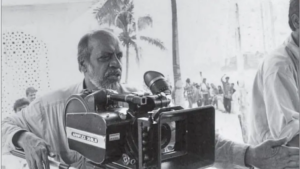
Shyam Benegal, Director of National Film Development Corporation from 1980-86. Source- National Herald
His portraits of women were particularly significant, as they were presented as complex agents of their own destinies; struggling, resisting, and reconfiguring their own narratives. For instance, Ankur takes a feminist approach with Lakshmi being the only one coming to help her husband and voice protest against the atrocities, while all men remain silent bystanders. Similarly, another woman refuses to be treated as gambling property by comparing her humiliation to Draupadi’s disrobing in the Mahabharata. Benegal does not isolate gender oppression as a women’s issue, instead as a national issue, repeatedly foregrounding women’s experiences as a way to critique broader social systems.
Inspired by the life of actress Hansa Wadkar, the film Bhumika reflected on a woman who becomes famous in public yet remains trapped in private. While applauded on stage, she is punished at home. In Mandi, Benegal pushes this critique into satire. Centering on sex workers, the film’s real subject lies in the hypocrisy of respectable society. As the elites use women’s bodies while publicly condemning them, the brothel becomes a mirror of the nation—a place where morality is traded like currency.
In 1992, after witnessing the communal riots post the demolition of Babri Masjid, Benegal made three films Mammo, Sardari Begum, and Zubeidaa about muslim women caught in webs of history and patriarchal oppression trying to restore normalcy. In the last stage of his career, Benegal moved to a more comic tone through films such as Welcome to Sajjanpur and Well Done Abba. According to him, it was a deliberate choice as he wanted the audience to laugh along and also ask questions at the end of the film. For instance, in Sajjanpur Benegal provides a clever commentary on a town trying to come to terms with changes it cannot fully comprehend.
BHARAT EK KHOJ
The last gesture in Ankur is not dialogue or music, it’s a stone—hurled up at the landlord’s window, acting as a metaphorical closure of turning a historical pressure into rupture. Benegal cinema is built of many such small gestures revealing that nation building is not merely happening in parliament and legislations, but also in kitchens, courtyard, and cooperatives.
“There are no simple solutions to complex problems” –Benegal.
His films function as political documents, capturing equally how power and exploitation operates in the countryside to how resistance is brought up slowly and unevenly, at great cost. In doing so, Benegal’s cinema participates in the effort of nation building not by idealising India, but by urging it to confront its shortcomings while imagining more equitable futures.
Benegal’s cinema treats the countryside not as a mere romanticised cultural background, rather as an active site where the nation is constantly made and unmade. He does not represent the oppressed as victims, rather scripts them as the nation’s unfinished conscience. With a constant and relentless focus on the marginalized voices, while unearthing layered questions and experiences of systemic inequities, Benegal continues to encourage decades of audiences to grapple with the unfinished projects of Indian democracy.
And finally, the stone thrown through the landlord’s window is not merely rebellion, but a refusal to sentimentalize marginalized lives.
It is a reminder that cinema can create as much political imagination as it can disturb complacency.
REFERENCES
Cross, R. (2010). Shyam Benegal’s Ankur and the Nehruvian Woman. Doshisha Studies in Language and Culture, 13(2), 89–115.
Chatte, S. (2024). Shyam Benegal has a Profound Impact on Indian Cinema. E-CineIndia, 2024
https://thewire.in/film/shyam-benegal-ankur-indian-new-wave-cinema
https://www.thecreativelauncher.com/index.php/tcl/article/view/1304
https://www.academia.edu/85820850/Shyam_Benegal_and_his_contribution_to_Indian_Cinema
https://frontline.thehindu.com/other/obituary/tribute-shyam-benegal-history-post-independent-mujib-nehru-bharat-ek-khoj-rebellion-of-1857/article69025773.ece
https://indigenousweb.com/blog/shyam-benegal-rural-trilogy/
https://www.ndtv.com/people/shyam-benegal-the-legacy-of-a-visionary-who-shaped-indian-parallel-cinema-7341221