
What Lies Beneath:Rakhigarhi’s Burials May Change What We Know About the Indus Valley
- October 15, 2025
P. SANJAY
The site at Rakhigarhi was subjected to excavation during the year 1997-98 (Nath
1998), 1998-99 (Nath 1999) and 1999-2000 (Nath 2001).3 A total of seven mounds were
identified as RGR-1, RGR-2, RGR-3, RGR-4, RGR-5, RGR-6 and RGR-7. The surface survey of the Deccan College Post-Graduate and Research Institute team later brought to light two additional habitation mounds, termed as RGR-8 and RGR-9, to the north and south of RGR-4, respectively, both at a distance of 1 km from it. There are other two mounds RGR-10 and RGR-11 also found in the site of Rakhigarhi which are yet to be excavated. RGR-7 is a necropolis that was found in the agricultural fields. The remains collected from the RGR-7 have been crucial to understanding the funerary rites and practices of the Harappans. The skeletal remains of the people of Rakhigarhi help in concluding the origin of the people as well.
The people of Mature Harappan Rakhigarhi used the site as a burial ground for a very long time, possibly over many generations, which led to graves being placed on top of one another (overlapping). Archaeologists have divided the burials into three phases—Early (Phase I), Middle (Phase II), and Late (Phase III) based on the layers of soil in which the graves were found.One of the main burial areas, called RGR-7, was further separated into three parts: RGR-7.1, RGR-7.2, and RGR-7.3. (Shinde and Dong Hoon Shin, 2022)
Burying the dead was not the only method to dispose of the dead. The graves in this area were grouped into three types depending on how the bodies were placed: primary burials – where the whole body was laid to rest, secondary burials – where only parts of the body were available, maybe they were buried after cremation practices , and symbolic burials – where there were no actual remains, only symbols. Among these burials the best preserved are from the first two phases, but the 3rd phase burials are not well preserved, probably due to constant agricultural activities. These findings give us insight into how the people of Rakhigarhi buried their dead and how their funeral practices evolved over time.(Shinde et al. 2018b)
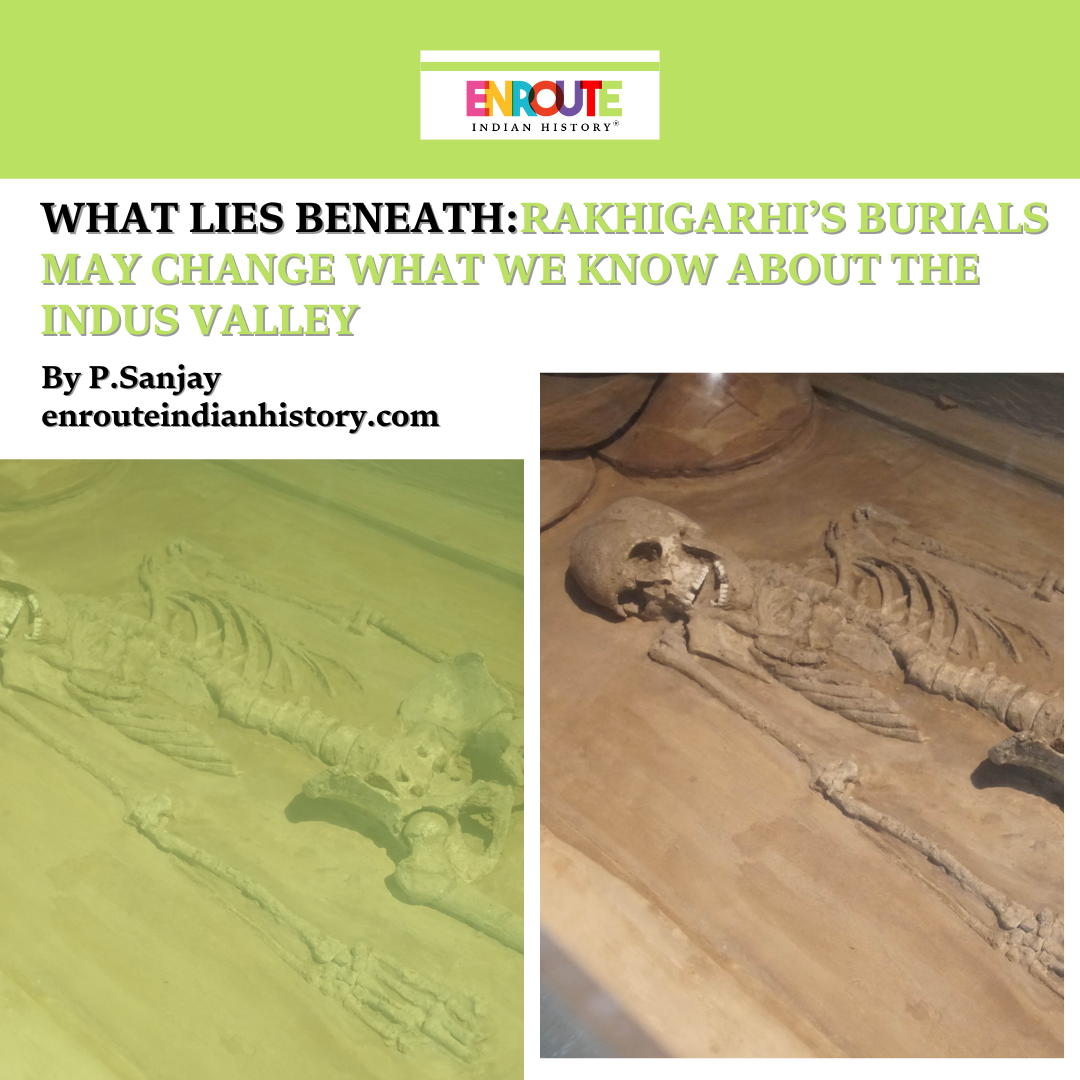
Generally we find primary burials throughout RGR – 7. A total of 46 skeletal remains were uncovered at the Rakhigarhi burial site. Primary burials are present in more numbers than the secondary burials. Most primary burials had the bodies placed in a supine position, where the dead had been placed in the north-south position, though a few were found lying in a prone position(face-down). Burials of usually all the age groups have been excavated.
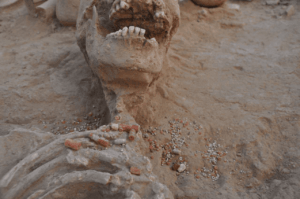
A closer view of BR35 (Shinde et al. 2018b)
One thing which stood out in the burials of Rakhigarhi was the use of ornaments, especially in female graves. Items like beads, microbeads, necklaces, bangles, rings, and anklets were commonly found, but mostly with women. Ornaments were made up of rare and semi precious materials like steatite, semi precious stones like Agate, Jasper, Lapis Lazuli, Carnelian, Chalcedony, Chert, Quartz and Faience (Nath, 2014).But not all graves were having ornaments, Children’s graves, in particular, were often simpler, usually with just five small pots placed nearby.
Interestingly, a copper ring was found on the left hand of a juvenile in a Phase III burial, whose sex couldn’t be confirmed. This shows that while ornaments were common in some burials, they weren’t used for everyone. Range of potteries have been found with the burials in different numbers varying to each burial. Since subadult graves included fewer votive pots than those of adults, it is likely that the deaths of adults and subadults were viewed in different ways by society (Shinde et al. 2018b).
Apart from the regular burials, there were some that seemed different or special. These are called symbolic burials. One grave from Phase II was fully prepared but never used; it might have been meant for someone related. In some cases, the symbolic burials are left without burying the body inside, the pit which symbolises the missing body. Interestingly these burials can also be “Cenotaph”, a type of monument that functions as a symbolic burial for commemorating an individual.
In another rare case, a woman between 21 and 35 years old was buried in a prone position in an oblong pit. Her body was placed on a slightly raised bed of soil, and bricks were carefully arranged above her head, which suggests that this burial held some special meaning. Burials are also found with an inner brick lining which is unique. In BR12 (Burial marking) individual from Rakhigarhi, a fracture above the “hat brim line” is an indicator of interpersonal violence only for this grave. But the fractured cranium in Rakhigarhi doesn’t identify it as structured violence. Another interesting burial BR02, five individuals were buried together in the same pit. In which two were Primary burials and the rest secondary burials. The skeletons of the primary burial were male, one in supine and another one in a prone position. The burial had a huge amount of burials as compared to other grave goods.
What could these burials teach us about the people who once lived in the Indus Valley?
More than just bones and pottery, these graves hold traces of the daily lives, health, and even struggles of the Harappan people. Early research into their physical and pathological traits has already given us important clues about their way of life. For instance, evidence of injuries caused by interpersonal violence. This challenges the idea that the Harappan civilization was entirely peaceful. However, reports of cemeteries are still limited, and we don’t yet have the full picture of their society and how it functioned. Burials can be used to understand the physiology of the Harappan people.
Interestingly, the shape of long bones like the femur of the burials can tell us about a person’s physical activity and lifestyle. At Rakhigarhi, differences in the diaphyseal shape were noticed between men and women. Platymeric indices reflect on the shape of the proximal femur. In Rakhigarhi males had a lower mean platymeric index than female, indicating that there were differences in physical behaviour between the sexes. The pilasteric index measures the breadth of the femoral midshaft and is linked to muscle activity linked to muscle use. The values are higher than recorded in any other areas which suggest they had a physically very active lifestyle.
By examining dental health, theories have been drawn about their diet and everyday activities. The study of dental remains plays a major role in understanding The dietary practices of the population. Severe dental attrition was common. The food of the Rakhigarhi population might have been rich in dietary fibre, which could have caused heavy tooth wear, especially on the lingual surfaces. This kind of tooth attrition may also suggest that they were using their teeth for other purposes like softening or trimming animal skins.
What Does Ancient DNA Reveal About the People of Rakhigarhi?
Rakhigarhi stands out as an important site due to the skeletal remains of the Indus Valley Civilisation which provides the DNA evidence to understand the ancestry of the inhabitants of the civilization. Out of the 61 skeletons studied from the ancient site of Rakhigarhi, only one gave scientists enough DNA to study, a woman who lived over 4,000 years ago. When researchers looked closely at her genetic makeup, they discovered something fascinating. It belonged to a rare genetic group, which is mostly found in people from South Asia even today. (Shinde, Vasant, et al., 2019)
Interestingly, this genetic line hasn’t been found in ancient Central Asian populations, suggesting that the roots were deeply and uniquely connected to the Indian subcontinent. It has been marked as I6113 that revealed a fascinating mix of ancient roots.The ancestry traced back to populations related to ancient Iranians and Southeast Asian hunter-gatherers, the latter represented by groups like the Andamanese. (Shinde, Vasant, et al., 2019)
These findings challenge the Anatolian hypothesis, which suggests that Indo-European languages spread to South Asia along with early farmers from Anatolia. Instead, the evidence supports the Steppe migration theory, the idea that Indo-European languages arrived much later, around 2000–1500 BCE, through migrations from the Eurasian Steppe, as seen in the later appearance of Steppe ancestry in the region.(Shinde, Vasant, et al., 2019).
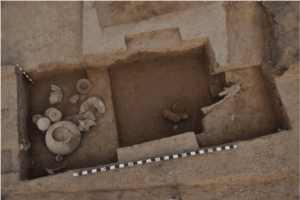
Symbolic burial of Rakhigarhi without any skeletal remains but with lots of votive pots (Source : Rakhigarhi Project Team under Shinde and Dong Hoon Shin).
The excavations and scientific studies at Rakhigarhi have provided a window into the lives of the people of the Indus Valley Civilization. Though there are certain limitations on studying the burials and drawing conclusions. Through careful analysis of burials, artifacts, and skeletal remains, researchers have uncovered rich details about Harappan social customs, gender roles, health, and physical activity. These findings suggest that the Harappans were not only urban and technologically advanced but also deeply spiritual and culturally expressive.
Most notably, the DNA analysis of an individual known as I6113 has offered groundbreaking insight into the ancestry of the Harappan population. Her genetic makeup revealed a blend of ancient Iranian-related ancestry and Southeast Asian hunter-gatherer lineage, but no evidence of Steppe or Anatolian farmer ancestry. This challenges earlier theories of large-scale west-to-east migrations shaping South Asian civilization. Instead, the evidence points to a largely indigenous origin for the Harappans, with minimal external genetic influence during the Mature Harappan period. New findings and excavations will change the whole course of history.
REFERENCES
Nath, A. 2014. “ Excavations at Rakhigarhi [1997-98 to 1999-2000], unpublished report from the Archaeological Survey of India.” unpublished report from the Archaeological Survey of India.
Nath, A. 1998. “ Rakhigarhi: a Harappan metropolis in the Saraswati-Drishadvati divide.” Puratattva 39-45.
Nath, A. “Rakhigarhi 1999-2000.” Puratattva 43-45.
Shinde, Vasant, and Dong Hoon Shin, editors. New Perspectives on the Harappan Culture in Light of Recent Excavations at Rakhigarhi: 2011–2017. Volume 1: Bioarchaeological Research on the Rakhigarhi Necropolis. Archaeopress Publishing Ltd, 2022, pp. 64–138.
Shinde, Vasant S., et al. “Archaeological and Anthropological Studies on the Harappan Cemetery of Rakhigarhi, India.” PLOS ONE, edited by Michael D. Petraglia, vol. 13, no. 2, Feb. 2018, p. e0192299, https://doi.org/10.1371/journal.pone.0192299.
Shinde, Vasant, et al. “An Ancient Harappan Genome Lacks Ancestry from Steppe Pastoralists or Iranian Farmers.” Cell, vol. 179, no. 3, 2019, pp. 729–735.e10. Elsevier, https://doi.org/10.1016/j.cell.2019.08.048.