

By Prishnika Mazumdar
2025 marks seventy-nine years since independence. Independence for India, though it brought many opportunities, also created some wounds that remain fresh to this day. Among these wounds, the greatest were inflicted by the partition of the nation. Countless were displaced and forced on a journey of thousands of kilometres to settle at a place that was more or less alien to them. Many of these journeys and their complications were documented by writers of the time. Contemporary writers of fiction recorded in their stories what historians either intentionally shied away from or details that were unintentionally lost in the celebration of independence. The horrors, madness, and trauma created by it, along with some heart-warming acts, were immortalised in the writings of Khushwant Singh, Ismat Chughtai, and the focus of this article, Saadat Hasan Manto. Manto, as we will observe, was a man himself traumatised by partition and someone who remained in touch with the underbelly of outwardly gleaming and flashy societies, where the vulnerable are exploited. To know the stories of these exploited people, during the partition era, Manto is crucial.
Manto, the Man
He could record with empathy the lives of the marginalised and brutalised, and at the same time attack with sardonic humour the carelessness of the privileged ….. Manto is perhaps at heart a moralist, but he isn’t naïve. Indeed, his strength lies in his ability to gaze hard at the real world without sentimentality, illusions or hope.
– Alok Bhalla in the introduction to the ‘Life and Works of Saadat Hasan Manto’
Saadat Hasan Manto (1912–1955) was one of the most powerful voices of twentieth-century Urdu literature. His writings on Partition were not created in isolation, but they were shaped by his life experiences, his rebellious youth, his uneasy association with the Progressive Writers’ Association, and most importantly, by the violence and dislocation of 1947.
Early Life and Formation of Worldview
Manto was born in 1912 in Samrala, Punjab, in a Kashmiri Muslim family. His father, Maulvi Ghulam Hussain, was a stern sessions judge who created a strict environment at home. Manto’s mother, Sardar Begum, was the second wife of his father. He shared a close relation with his mother; this close, affectionate relation is often noted as a potential reason by the biographers of Manto for the portrayal of more sympathetic female characters in his narratives (Jalal, 2013).
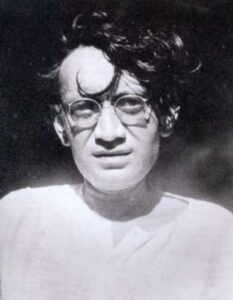
From an early age, Manto struggled with studies. He failed his matriculation twice before finally passing with a third division, he later recalled with humour: “When I passed my matriculation after many failures, I felt as though I had conquered the world” (Rekhta, 2023). In 1931, he joined Hindu Sabha College in Amritsar, only to drop out after a year due to poor academic performance.
His formative years in Amritsar coincided with a period of political turmoil, as the city had witnessed the Jallianwala Bagh massacre and there were ongoing anti-colonial protests. These surroundings exposed young Manto to colonial violence and the energy of resistance.
At the same time, Manto grew up among diverse communities; Hindus, Muslims, Sikhs, and this everyday closeness across religious lines shaped his humanistic outlook. It is no surprise that when Partition later tore these bonds apart, he wrote with rage and despair about its absurdity and violence (Rekhta, 2023).
The Progressive Writers’ Association
In 1934, Manto joined the Aligarh Muslim University (AMU), where his time was cut short because of a bout of tuberculosis. During this time, he had begun contributing to a literary society that would later become the All-India Progressive Writers’ Association or PWA. This was a group of writers who believed that literature should fight social injustice and promote reform. The PWA, formed in 1936, tried to combine art with politics, and Manto published many stories in its journals.
But Manto resisted being confined by ideology, insisting, “I am not a reformer. My job is to show things as they are” (Rekhta, 2023). Many differences started to emerge between Manto and PWA. While the Association encouraged him to confront injustice, it also wanted writers to adhere to socialist ideals, but that was not always the case with Manto’s stories. He frequently wrote about taboo subjects such as prostitution, sexuality, and the brutalisation of women during Partition. These were areas that most progressives at the time avoided. Finally, in 1948, Manto was blacklisted from PWA for being a ‘reactionary’ writer (Jalal, 2013).
Partition and Move to Lahore
In 1939, Manto was married to Safiya Begum at the insistence of his mother. By this time, he was in the grip of alcoholism. The Partition in 1947 came as the most decisive turning point in Manto’s life. At that time, he was well-settled in Bombay, working in the film industry and surrounded by a cosmopolitan literary circle. But the communal violence of Partition shook him. It is said that Manto was in conversation with his best friend and actor Shyam, who admitted that after listening to stories of Muslims killing Hindus and Sikhs, he too felt that he could kill the Muslim Manto (Bhatia 2018). This event might have finally triggered Manto to leave Bombay.
His decision to leave Bombay and move to Lahore was painful. He left behind professional success and friendships across communities. In Pakistan, he felt alienated and struggled with poverty, while also facing repeated obscenity trials for his frank writings. Yet, he defended himself: “If you are unaware of the times through which we are passing, read my short stories. If you cannot tolerate them, it means this age is intolerable…How can I disrobe civilisation, culture and society when it is in fact already naked?” (Rekhta, 2023).
At the age of 43, within eight years of partition Manto died of alcoholism. He, however, left us with many stories that reveal the madness of partition along religious lines. In the following section, we expand on some of his partition stories.
Looking at Partition through Stories of Manto
In his short stories, Manto often used ordinary characters to show extraordinary suffering. He authored a great number of works on partition, here we will focus on three of them: Khol Do (1950), Thanda Ghosht (1950), and Toba Tek Singh (1955). These stories bring out the chaos, brutality, and moral collapse that accompanied India’s partition. The first two stories were written a short while after partition. Toba Tek Singh, however, was published in 1955, the year Manto passed away, and perhaps to this day, it remains one of the best stories to capture the madness of partition quite literally through the portrayal of a lunatic asylum.
Khol Do (1950), ‘open up’ in English, captures the horror of sexual violence during the refugee crisis. The story follows Sirajuddin, a father searching for his lost daughter, Sakina. Muslim volunteers claim they have rescued her, but in the end, she is discovered in a hospital, broken by repeated assaults. When the doctor asks for a window to be opened (Khol do in Urdu), Sakina automatically loosens her shalwar (trouser), as if trained by her abusers to obey such commands (Ghosh, 2022). The scene shows how Partition’s violence invaded women’s bodies, turning them into sites of both communal revenge and betrayal, even by supposed protectors.
Thanda Ghosht (1950), ‘cold flesh’ in English, is about Ishwar Singh, a Sikh man who participates in communal killings during Partition. In a fit of passion, he tries to be intimate with his lover Kulwant Kaur, but fails. Later, he confesses that he cannot respond because, during the riots, he had tried to violate the body of a Muslim girl he thought was alive, only to discover she was already dead (Fair, 2016).
Both of the above-mentioned stories deal with rape and violence against women. On many occasions, when a woman is raped, the intention is to dishonour a community. This is because raping a woman means not only dishonouring the individual woman but also attacking the honour of the other community, where women are seen as symbols of purity (Gautam, 2022).
In Toba Tek Singh (1955), Manto sets his story in a lunatic asylum where Hindu, Muslim, and Sikh inmates are to be exchanged across the new borders of India and Pakistan. The central character, Bishan Singh, cannot understand in which country his hometown, Toba Tek Singh, has fallen. When the exchange happens, he is being sent to India. He, however, realises that his village lies in Pakistan and refuses to move to India. At the end, after having resisted for too long, the man collapses at the border between India and Pakistan, but neither India nor Pakistan (Manto, 1955). This ending, where a madman lies between two hostile states, stands for the absurdity of Partition. Manto shows how borders drawn on paper shattered people’s sense of belonging.
The Brutality of Partition
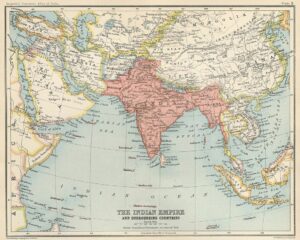
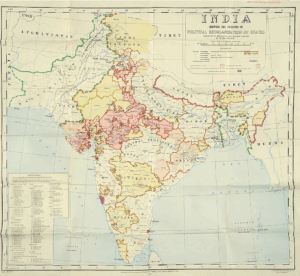
The partition of India took place in August 1947, at the same time as the end of British colonial rule. On the night of 14-15 August 1947, India became independent, while Pakistan was created a day earlier on 14 August. The once united British Indian empire was divided into two separate dominions: India and Pakistan (Bandopadhyay, 2015).
Partition marked one of the largest human migrations in modern history. Between August and November 1947, about 4.5 million Hindus and Sikhs moved into East Punjab, while around 5.5 million Muslims left for West Pakistan. In Delhi alone, nearly 500,000 non-Muslim refugees arrived during 1947-48, while about 330,000 Muslims left the city for Pakistan. Bengal too saw large-scale displacement: by June 1948, about 1.1 million Hindus had migrated from East Pakistan to West Bengal (Bandopadhyay, 2015).
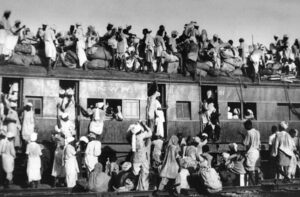
The journeys of these refugees were often extremely violent. Trains carrying migrants were attacked, and in many cases, they arrived at their destinations filled with dead bodies. Long caravans of people moving across the new borders were attacked by rival groups seeking revenge. Women, as we have observed, were abducted, raped, and even killed by their own families in so-called honour killings to “protect” them from violation by the other community (Bandopadhyay, 2015). In some other cases, women were pressured into suicide before their honour could be violated. One such case was the collective suicide of 90 or more women who drowned themselves by jumping into a well in Thoa Khalsa, Rawalpindi district, in March 1947 (Pandey, 1997). For some women, the decision of suicide might have been their own, but many others may have felt compelled by the circumstances of their situation to take their own lives (Butalia, 1993).
The historical reality of Partition is close to the themes of brutality that have been described in literature. As it happens in Toba Tek Singh, where the governments of India and Pakistan decide to exchange their lunatics, the governments of the countries did in fact run a Central Recovery Operation between 1948 and 1956, where it was agreed that women who had been abducted during partition chaos should be returned to their families and native homes. However, in many cases, women had already been converted to other religions, married, and given birth to the children of their abductors. Some had settled happily, but they were then uprooted again to be returned. Many women who had been returned to their original families found it difficult to gain acceptance. So, those women who had found some semblance of a home and settled existence were often reluctant to risk everything again and expose themselves to similar uncertainties when the recovery operation began (Pandey, 1997).
The real Partition experience often corresponded closely with the dark themes preserved in literary depictions. And when it comes to literary depictions of partition, Manto’s work is unmissable. Perhaps throughout his life, Manto acted as a provocateur to the gatekeepers of morality. But this man, who was so despised by the gatekeepers of morality, also made the hidden underbelly of societies visible and amplified the voices of the unheard. Decades after his death, Manto remains one of the most piercing chroniclers of Partition. Through his stories, he forces us to confront the brutalities that official records missed, especially the gendered violence that marked this period.
References
1. Bandopadhyay, S. (2015) From Plassey to Partition and After: A History of Modern India. 2nd edn. New Delhi: Orient BlackSwan.
2. Pandey, G. (1997) Community and Violence: Recalling Partition. Economic and Political Weekly, 32(32), pp. 2037–2045.
3. Jalal, A. (2013) The Pity of Partition: Manto’s Life, Times, and Work across the India-Pakistan Divide. Princeton University Press.
4. Ghosh, S.S. (2022) ‘Saadat Hasan Manto’s “Khol Do”: In Search of a Lost Daughter’, IIS Univ. Journal of Arts, 11(2), pp. 93–101.
5. Dubrow, J. (2019) ‘The aesthetics of the fragment: Progressivism and literary modernism in the work of the All-India Progressive Writers’ Association’, Journal of Postcolonial Writing, 55(5), pp. 589–601.
6. Fair, C.C. (2016) Cold Flesh: A Translation of Saadat Hasan Manto’s Thanda Ghosht. The Punch Magazine. Available at: https://thepunchmagazine.com/the-byword/fiction/cold-flesh-a-translation-of-saadat-hasan-manto-amp-rsquo-s-thanda-ghosht-by-c-christine-fair
7. Rekhta (2023) Saadat Hasan Manto – Profile. Available at: https://www.rekhta.org/authors/saadat-hasan-manto/profile (Accessed: 16 August 2025).
8. Manto, S.H. 1955. ‘Toba Tek Singh’. South Asia Citizens Web. Available at: http://www.sacw.net/partition/tobateksingh.html (Accessed: 9 August 2025)
9. Bhalla, A. ed., 1997. Life and Works of Saadat Hasan Manto. Shimla: Indian Institute of Advanced Study.
10. Gautam, D.P., 2022. Coercion and cruelty: Female characters in Manto’s Partition stories. International Journal of English Language, Literature and Translation Studies (IJELR), 9(3), pp.99–103.
11. Bhatia, Sidharth (2018) Saadat Hasan Manto and the Art of Writing What Others Would Not. The Wire. Available at: https://thewire.in/books/saadat-hasan-manto-writing-book-review (Accessed: 17 August 2025).
12. Butalia, Urvashi. 1993. Community, State and Gender: On Women’s Agency during Partition. Economic and Political Weekly, vol. 28, no. 17, pp. WS12–24. JSTOR, http://www.jstor.org/stable/4399641. Accessed 18 Aug. 2025.
Image Sources
1. Wikimedia Commons (2011) Train full of refugees during Partition. Available at: https://commons.wikimedia.org/wiki/File:Partition_of_Punjab,_India_1947.jpg (Accessed: 20 August 2025).
2. Wikipedia (2017) An Image of Saadat Hasan Manto. Available at: https://en.wikipedia.org/wiki/File:Saadat_Hasan_Manto_photograph.jpg (Accessed: 20 August 2025).
3. Wikimedia Commons (2022) Map showing Undivided British India (1931). Available at: https://commons.wikimedia.org/wiki/File:Map_of_the_partition_of_British_India.jpg (Accessed: 20 August 2025).
4. Wikimedia Commons (2025) Map showing new borders that resulted from the Partition of India (1948). Available at: https://commons.wikimedia.org/wiki/File:Map_of_British_India_and_surrounding_countries,_published_in_the_%27Imperial_Gazetteer_of_India%27_(Vol._XXVI,_Atlas;_1931_revised_edition;_plate_no._2).jpg (Accessed: 20 August 2025).
















.jpg)