
When Ravana Burned beneath the Red Fort: Ramayana, Ramlila, and Delhi’s Past
- November 10, 2025
By Anusha Khan
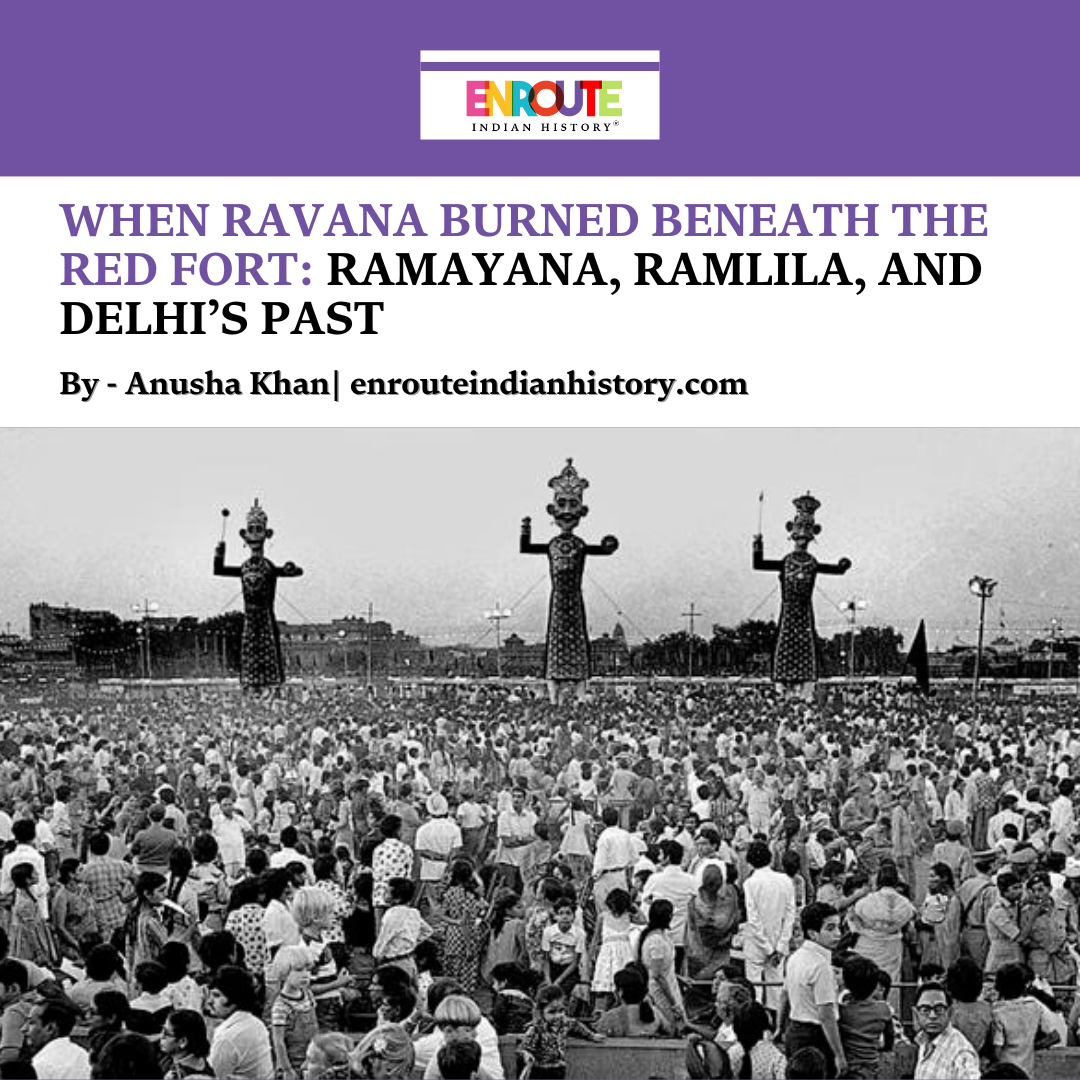
Every autumn, when the effigies of Ravana, Meghnath, and Kumbhkaran go up in flames against the red sandstone of Shahjahanabad’s fort, Delhi remembers a story older than the city itself. The crackle of fireworks, the cries of vendors selling bows and arrows, the chanting of “Jai Shri Ram”—all of it folds into a rhythm that has pulsed through the city for centuries. Ramlila has long been performed across North India, from Banaras to the villages of Awadh, but the Delhi tradition took on a distinct shape in and around the Red Fort. Long before the Ramlila Maidan drew lakhs of spectators, Mughal emperors were commissioning illustrated Ramayanas, sponsoring Dussehra rituals, and watching actors in Chandni Chowk perform the exile of Rama. Like the Yamuna flowing past the Red Fort, the Ramayana has wound through Delhi’s history—sometimes as miniature paintings, sometimes as courtly festival, sometimes as street performance—leaving behind a layered archive of memory.
The story in Delhi begins with a brush and manuscript. In Akbar’s taswirkhana, the royal atelier, the Ramayana was translated into Persian and painted into vibrant miniatures, where Rama, Sita, and Hanuman took form on the page. These were not private devotions but imperial gestures, embedding Hindu epic within Mughal aesthetics and politics of kingship. Later, in Shah Jahan’s Delhi, this interest in the Ramayana found public form in festivals, when Dussehra was staged for soldiers and citizens along the Yamuna’s edge. From manuscript to performance, the Ramayana moved seamlessly across registers—text becoming theatre, devotion becoming spectacle.
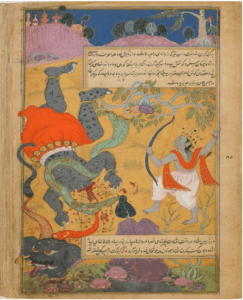
Kumbakarna’s death in Freer’s Ramayana
By the nineteenth century, under Bahadur Shah Zafar, Ramlila had become Delhi’s most beloved carnival. Effigies of Ravana were erected by artisans, fireworks packed by craftsmen of Shahjahanabad, and Rama’s chariot processed through Chandni Chowk in the Savari. Here was the city’s composite life on display: courtiers and artisans, Hindus and Muslims, emperors and commoners sharing in the retelling of an ancient story. Even after the empire’s fall, when the British pushed Ramlila out of the Red Fort into the Maidan, the performance survived, adapting to industrial sponsorship and later nationalist politics. To watch Ravana burn in the Ramlila Maidan today is to glimpse this long continuity, a memory that ties together Mughal ateliers, Zafar’s processions, and Delhi’s present-day performances into one unbroken stream.
Akbar’s Atelier: Painting the Ramayana into Empire
Under Akbar, the Ramayana became a mirror of kingship as an advisory text. Scholars suggest that Akbar himself may have seen Rama as a symbol of the ideal ruler, patient in exile, just in power, and magnanimous in victory. In this sense, the Persian Ramayana was not only a religious text but, as Abu’l Fazl framed it, an advisor to the king. To translate it was to fold Hindu ideas of sovereignty into Mughal political imagination.
For the painters of the taswirkhana, this commission was a new challenge. Until then, the atelier had largely worked with Persian epics and animal fables and were largely unfamiliar with Indic ways of visualisation. The problem was solved by recruiting Hindu painters into the workshop, men who knew the conventions of depicting Rama, Sita, and Hanuman. As Abira Bhattacharya notes, the Ramayana project was one of the most extensive ventures ever undertaken by the Mughal atelier, involving both indigenous and Persian artists, each contributing their particular skill. Lal and Keshav executed dozens of paintings each; Basawan and Miskin contributed their luminous colours and expressive faces; while Mahesh, Mukund, Bhagwan, and others filled out the folios with new iconographies. Even lesser-known artists like Mandu left their imprint.
The manuscripts systematised a new iconography: Rama and Lakshman with bows and crowns, clad in dhotis; Sita in Rajasthani skirts and veils; Hanuman rendered as both monkey and prince. In one folio from Jaipur, “Nishada King Guha meets Rama, Sita, and Lakshman,” the protagonists sit in exile beneath a tree, identifiable by their attributes, while the Nishada king’s retinue wears unmistakably Mughal coats and turbans. Here, the Ramayana’s forest world is refracted through the lens of Akbari couture.
Another Jaipur folio shows “Sita shies away from Hanuman,” mistaking him for Ravana in disguise. She sits in a Mughal-style pavilion, pietra-dura inlay gleaming on the walls, her diaphanous blouse and skirt drawn in Persianised lines. Hanuman, crowned and princely, kneels before her in a gesture of obeisance. The artist collapses Lanka into Shahjahanabad: Sita’s captivity imagined through Mughal architecture.
The painters also revelled in movement. In the Jaipur “Nala and the monkey army building the bridge to Lanka,” monkeys strain under boulders, waves curl and swell, aquatic life swirls around the stones. A sense of momentum carries the scene forward. Another folio, “Hanuman snatching Ravana’s crown,” crowds the pavilion with demons clad in Persian short skirts and grotesque faces, while Hanuman slips away with the golden diadem. In both, naturalism and chaos pulse across the page.
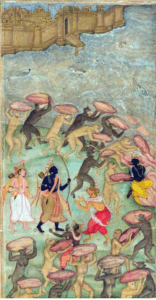
Nala and army of monkeys helping Rama build a bridge
Sometimes, metaphors entered quietly. In the Freer “Indra prevents Trisanku from ascending to heaven,” the fire altar dominates the composition: fire as both purifier and cosmic trial. Gregory Minissale reads such motifs as visual metaphors borrowed from Persian cosmology: caves as sites of revelation, fire as judgement, water pots as life. Mughal painters did not simply copy Hindu iconography; they reinterpreted it through their own symbolic repertoire.
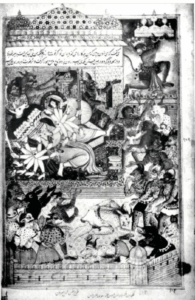
Hanuman snatching Ravana’s crown
What emerged was a new Ramayana: not just translation, not just illustration, but a Mughal reinvention of an Indian epic. At once familiar and strange, indigenous and Persianised, devotional and political, the Mughal Ramayana embodied the efflorescence of Akbar’s reign. It allowed the emperor to claim Rama’s image as a model of sovereignty, while giving his artists a canvas to experiment with hybrid forms that no regional school had attempted before.
From Palace to Streets: Delhi’s Dussehra
When Shah Jahan shifted his capital from Agra to Delhi in 1648 and raised the red sandstone walls of Shahjahanabad, the Ramayana followed. Although the emperor did not commission a new manuscript on the scale of Akbar’s, he ensured that the epics did not remain confined to books and paintings. Historian Irfan Habib notes that Shah Jahan actively supported Hindu festivals observed by both his soldiers and the public. Dussehra, in particular, was celebrated along the banks of the Yamuna, just behind the Red Fort, where soldiers gathered in rows and families spilled onto the ghats to watch the spectacle. In this way, the Ramayana moved from page to performance. What Akbar’s painters had once captured in indigo and gold now unfolded as ritual and public celebration. Shah Jahan’s Delhi thus became a hinge in the story: not a rupture but a continuation, carrying the Ramayana out of the atelier and into the streets of the capital.
Nearly two centuries later, Bahadur Shah Zafar, the last Mughal emperor transformed Delhi’s Dussehra into a citywide spectacle, one that bridged palace and street, royalty and commoner, spectacle and devotion. From the first day of Navratri to Dussehra, the streets of Shahjahanabad became the stage for a living epic. The emperor’s own courtiers, glittering in brocade, sat alongside merchants and townsfolk, all turning their eyes toward the Red Fort as the city braced itself for the Ramlila Savari that Zafar had introduced.
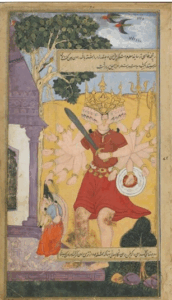
Ravana seizes Sita by the hair to abduct her to Lanka
Delhi chronicler R.V. Smith notes that the main Ramleela celebrations from the 17th to 19th centuries were held behind the Red Fort, along the banks of the Yamuna. Shah-Ka-Talab, now Ramleela Ground, offered a natural stage for the boatman scene of the Ramayana, in which Ram, Sita, and Lakshman were ferried across the Saryu River. Even Bahadur Shah Zafar himself visited the lake to witness the spectacle, as floating boats served as bridges for enthralled spectators. Though the lake was later filled in—some say after 1857, others for the burning of effigies—the imagination of Ramleela on the water’s edge adds a layer of wonder to the memory of the city’s celebrations.
Munshi Faizuddin, in his Bazm-e-Aakhir, recalled the city aglow with lamps strung across rooftops and bazaars, the emperor inspecting hennaed horses and rewarding his stables’ superintendent, and the zenana alive with anticipation. Birds, effigies, parading animals, and music were all intertwined with ritual and spectacle, each gesture imbued with layers of symbolism. The burning of Ravana and his kin, the climax of the celebration, held the city in collective suspense; the direction in which the demon king fell was believed to foretell the year to come, and every cheer, every spark, every explosion became part of the city’s living memory.
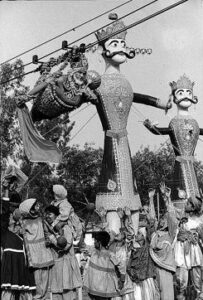
courtesy of Hindustan Times
On the morning of Dussehra, a Neelkanth bird, the Indian Roller, was released from the ramparts of the Red Fort, its flight signaling both the triumph of good over evil and the mingling of Hindu and Mughal ritual. Hawks and falcons followed, perched briefly on the emperor’s wrist before taking wing as a reminder of victory and nobility and of the Timurid court’s love for both ceremony and spectacle. From the balconies of the zenana, women craned their necks to watch the unfolding drama, their gazes tracing the effigies that lined the parade route.
The effigies themselves were masterpieces of collaboration and community. Crafted by Muslim artisans from Uttar Pradesh, the same hands that shaped Muharram’s tazias, these towering figures of Ravana, Kumbhkaran, and Meghnad were built from bamboo, paper, and cloth, their interiors packed with fireworks. When set alight, they exploded in brilliant showers, echoing through the galis and mohallas of Old Delhi, the sound of firecrackers mingling with gasps, cheers, and laughter from the crowd. Children clutched miniature bows, masks, and swords sold by hawkers who trailed the procession, while families lined rooftops and riverbanks, waiting for the final fall of the demon king.
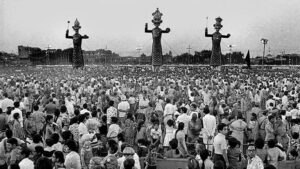
Dussehra celebrations on October 11, 1978.(Virendra Prabhakar / HT Photo)
But the Savari was more than a spectacle; it was a moving theatre of the city. Horses and camels, elephants swaying under embroidered cloth and tassels, led the way, while musicians on nafir, shehnai, and drums filled the streets with rhythm. Each tableau, or jhanki, presented a scene from the Ramayana—Rama drawing his bow, Sita in her prayers, Lakshman guarding with vigilant eyes. Every day brought a new scene, a new page of the epic unfolding as the procession wound its way from the Dauji Temple at Esplanade Road through Chandni Chowk, Dariba, Nai Sadak, Chawri Bazaar, and Chowk Hauz Qazi, finally reaching Ramlila Maidan by evening. For a few hours, the Walled City became Ayodhya, and the people—Hindu and Muslim alike—moved within it as actors, spectators, and witnesses to a shared story.
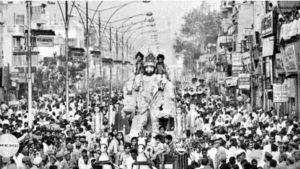
October 1975 photo of a Ramlila Sawaari at Chandni Chowk in Delhi. (Rane Prakash/HT Archive)
Bahadur Shah Zafar’s Savari was thus both ritual and carnival, imperial display and civic theatre. It invited the city into a story, let the streets themselves become a stage, and turned the ephemeral magic of the Ramayana into something tangible, communal, and enduring. Over 180 years later, the Savari continues along much the same route, a living echo of an emperor who sent the Ramayana walking, through lanes, across bridges, past rooftops, and into the hearts of a city still remembering the magic of Dussehra.
From Royal Patronage to Public Spectacle: Ramlila in Post-Mughal Delhi
After the fall of the Mughal Empire, Ramlila performances gradually moved from the Yamuna banks behind the Red Fort to new public stages. The venue shifted first to Tees Hazari Bagh and later outside Ajmeri Gate, eventually settling at Ramlila Maidan. Industrialists, notably the Shri Ram family of Delhi Cloth Mills, sponsored productions, introducing innovations like revolving stages and spectacular aerial effects. One of the most memorable was Hanuman “flying” over the audience, suspended on wires, thrilling spectators as he swooped across the stage, embodying the epic’s grandeur and heroic drama. Committees formalised the organisation of performances, turning a once-spontaneous carnival into structured theatre.
Over the last six decades, Ramlila in Delhi has grown in scale, spectacle, and budget, yet it continues to draw on centuries of tradition—from Mughal-era patronage to modern civic participation. The festival remains a living bridge between past and present, royal and popular, ritual and performance. Even as technology, urbanisation, and formalisation have changed the way the Ramayana is staged, the heart of the celebration endures: a city coming together to witness a story of devotion, courage, and triumph, echoing the magic of Dussehra through generations.
References
Bhattacharya, Abira. “The Visualisation of Ramayana in the Mughal Paintings under Akbar’s Patronage.” [Journal/Book details if available].
Das, Asok Kumar. “Akbar’s Imperial Ramayana: A Mughal Persian Manuscript.” The Legend of Rama: Artistic Visions, edited by Vidya Dehejia, Marg Publications, 1994.
Hajianfard, Ramin. “Mughal Miniature Painting: An Analytical Study of the Akbar’s Ramayana.” Kupas Seni, vol. 11, 2023, pp. 53–66. https://doi.org/10.37134/kupasseni.vol11.2.6.2023.
Nazim, Yusra. “The Cultural Mosaic of Dussehra in Old Delhi.” The Patriot, 11 Oct. 2024, thepatriot.in/culture/the-cultural-mosaic-of-dussehra-in-old-delhi-59260.
Sultan, Parvez. “Mughals to Machines: How Ramlila Lived through Ages in Delhi’s Streets and Royal Courts.” Hindustan Times, 28 Sept. 2017, hindustantimes.com/delhi-news/mughals-to-machines-how-ramlila-lived-through-ages-in-delhi-s-streets-and-royal-courts/story-nU53QoKvBXq4TbxCPW84VK.html.
Seyller, John. “A Sub-Imperial Mughal Manuscript: The Ramayana of Abd Al-Rahim Khan Khanan.” The Legend of Rama: Artistic Visions, edited by Vidya Dehejia, Marg Publications, 1994.