
When the Emperor Lit the Sky: Muhammad Shah Rangeela and Delhi’s Festival of Lamps
- November 10, 2025
By Anusha Khan
A City of Light and Memory
Every autumn, Delhi glimmers with light. Streets fill with flickering diyas, the Yamuna sparkles with floating lanterns, and fireworks punctuate the night with bursts of colour. Families gather on rooftops, children squeal as their paper lamps drift into the sky, and for a few hours, the city forgets itself, glowing as one.
Yet this luminous Delhi has an older history. Long before fairy lights and firecrackers, the city’s night sky belonged to emperors. From the ramparts of the Red Fort, a thousand lamps once shimmered over the Yamuna, when Diwali was known as Jashn-e-Chiraghan—the Festival of Lamps. In those evenings, the palace itself became a constellation, each flame a reflection of royal grandeur and the mingling of the different faiths that defined Delhi’s soul.
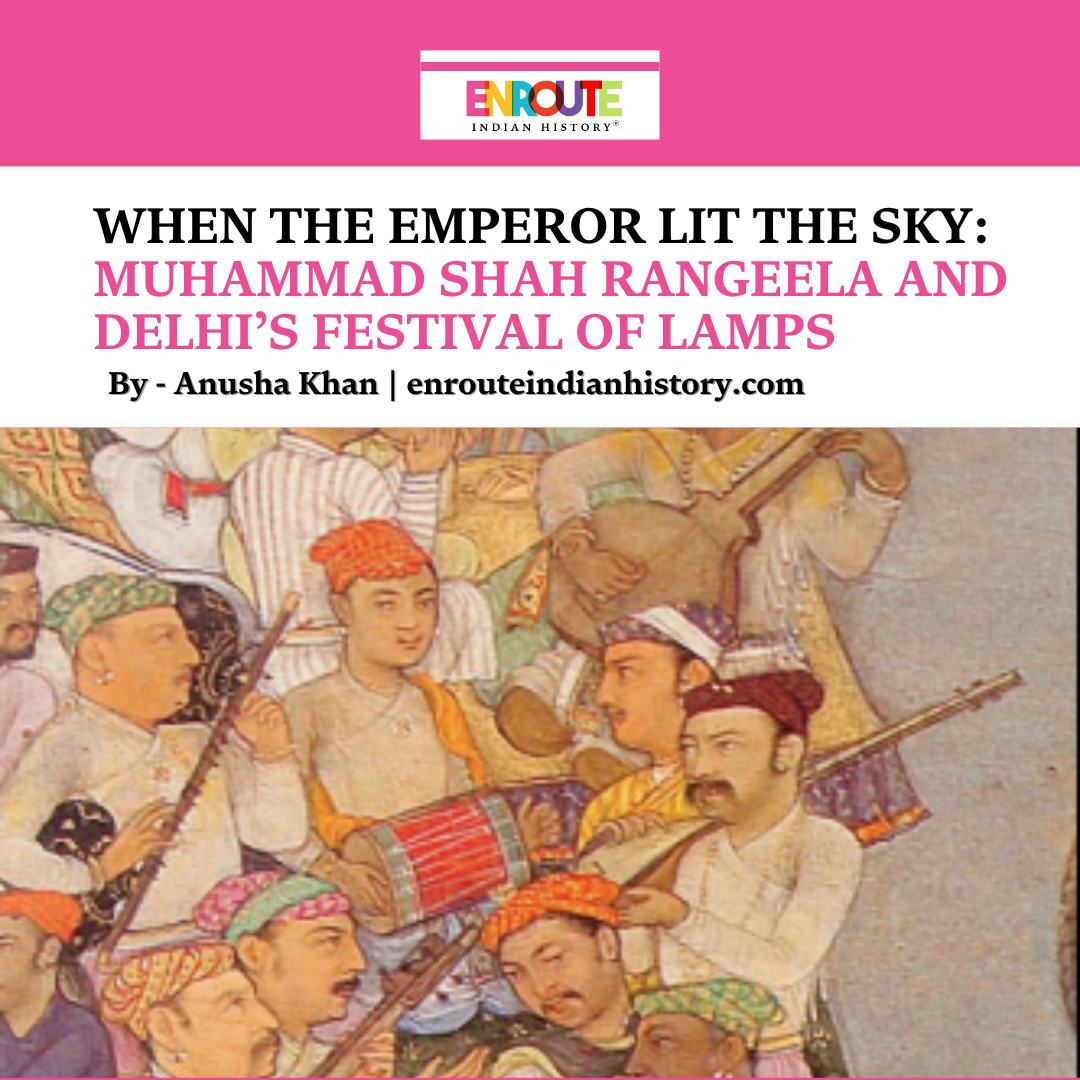
At the centre of this glittering world stood Muhammad Shah Rangeela, the eighteenth-century Mughal emperor who ruled amid decline but dreamed in colour. Rangeela turned Diwali into a theatre of sound, scent, and spectacle. Fountains spouted coloured water, dancers circled lamps, and the colossal Akash Diya—the “Lamp of the Sky”—rose high above Shahjahanabad, its glow visible from Chandni Chowk.
Rangeela’s reign was one of contradiction: fragility and splendour intertwined. Music, painting, and celebration became tools of survival, even resistance. His Diwali was not merely indulgence but remembrance, a gesture toward the emperors who came before him, and a promise that Delhi’s light would not fade quietly into history.
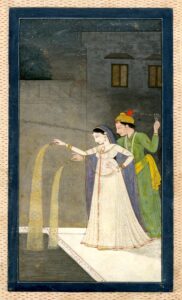
Pahari style painting depicting lovers celebrating Diwali with fireworks. 1800 circa. Credit: British Museum
But how did a festival rooted in Hindu devotion come to embody the dreams of Muslim kings? How did this city learn to speak through flame, turning ritual into art and politics into illumination? To answer that, we must look back toward the first lamps lit in Sultanate harems and the celestial fires of Akbar and Shah Jahan, whose own Diwalis laid the path for rangeela’s night of a thousand lights.
Light on Harmony: From the Sultans to the Mughals
The earliest glimpses appear in the Delhi Sultanate. In the fourteenth century, Sultan Muhammad bin Tughlaq, allowed his Hindu wives and concubines to celebrate Diwali inside the harem. Inside the fortress of Tughlaqabad, his Hindu wives and concubines arranged rows of lamps, shared sweetmeats, and gossiped deep into the night.
That faint glow survived dynasties. Babur mentions fireworks and feasts in his memoirs, but it was his grandson Akbar who formally brought Diwali into the court calendar. Akbar, guided by his principle of sulh-i kul—universal peace—saw in Diwali a bridge between his subjects. At Agra Fort and later Fatehpur Sikri, the palace terraces sparkled with oil lamps. Courtiers of every creed exchanged trays of sweets—petha, jalebi, kheer, phirni, shahi tukda—and fireworks flared above the Yamuna.
Abul Fazl, Akbar’s chronicler, describes the emperor himself lighting the first diya. He also had the Ramayana translated into Persian and illustrated with 176 paintings so his courtiers could read of Ram’s return to Ayodhya as part of the same festival they celebrated. In Akbar’s hands, Diwali became pedagogy through pleasure: a lesson in how light could unite faiths.
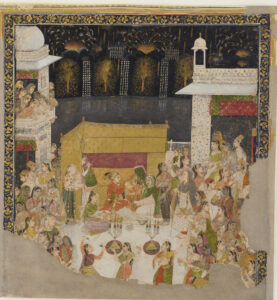
Zenana scene with fireworks, freer collection, 17th century.
His successors made the celebrations grander. Jahangir introduced organised fireworks along the Yamuna, while Shah Jahan, the master-builder of Shahjahanabad, brought Diwali’s splendour to its zenith. He incorporated Persian Navroz customs into Diwali, making it the empire’s most spectacular celebration. The preparations began months in advance. Water was brought from seven holy wells for the emperor’s ritual bath, while the city’s khansamas—cooks of every region—prepared the Chappan Thal, fifty-six kinds of sweets and delicacies scented with saffron and rose. After prayers with his Hindu queens, Shah Jahan would walk through the palace courtyards, where thousands of lamps mirrored the Yamuna’s moonlit surface.
He also added the ritual of the Surajkrant—the celestial stone that caught the sun’s rays and ignited the imperial flame. This sacred fire lit the Akash Diya, a massive sky-lamp raised on a forty-yard pole to illuminate the whole of Shahjahanabad.
Even the austere Aurangzeb did not entirely extinguish these customs. He sent Diwali sweets to his generals and allowed fireworks to be lit at the fort’s outer walls.
The Emperor of Colour: Rangeela’s Diwali
By the time Muhammad Shah “Rangeela”—the colorful one—ascended the throne in 1719, the empire was shrinking. Provinces rebelled, armies mutinied, and Delhi trembled under the threat of invasion. Yet within the walls of the Red Fort, beauty persisted. The emperor, known for his flair for art, music, and ornament sought to restore splendour to a fading world. His reign, often dismissed as decadent, was in truth an act of remembrance: an attempt to preserve the empire’s soul through ceremony and light.
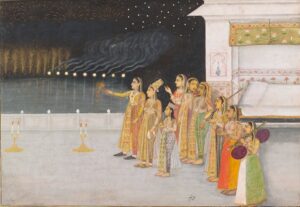
Celebrating with Fireworks, Opaque watercolor and gold on paper; Late Mughal, Muhammad Shah period; or Oudh; Second quarter of the 18th century Credit: San Diego Museum of Art.
Every year, as Diwali approached, the city seemed to hold its breath. Orders for oil were sent out weeks in advance. Telis—the oil sellers of Shahjahanabad—worked day and night to fill the imperial vats. Confectioners from Agra and Lucknow brought recipes rich with saffron and rosewater. The Mir Atish (master of fireworks) inspected the fort’s walls and gardens, while artists designed new motifs for faanooses (pedestal chandeliers) and chiraghdans (lamp stands). Courtiers contributed through duwazdihi, voluntary donations that financed the grand spectacle.
It was during Muhammad Shah’s reign that one of Shah Jahan’s most magnificent innovations, the Akash Diya, blazed again after years of neglect. According to Historian R. Nath, this sacred fire originated from the Surajkrant stone, which caught the sun’s rays at their zenith when the sun entered the nineteenth degree of Aries. A cotton wick placed near the stone burst into flame, which was preserved in a vessel called the Agingir or fire-pot. This celestial fire was then used to light the Akash Diya, a massive lamp raised atop a forty-yard pole, its glow said to reach Chandni Chowk itself. Fed with maunds of cottonseed oil and supported by eighteen ropes, it blazed like a second sun above the domes of the fort.
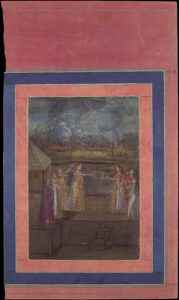
“Fireworks on the Night of Shab-i Barat Feast”, Folio from the Davis Album; 18th century. Credit: The Metropolitan Museum of Art
Around this ritual of fire, Diwali became both cosmic and courtly. Chandni Chowk, designed by Jahanara Begum, filled with traders from Persia and China displaying glass lamps and silks. Inside the fort, courtyards were reserved for the women of the harem, who watched the festivities unveiled, their laughter echoing through latticed corridors. The kitchens prepared chhappan thal, fifty-six dishes laid out on silver trays. Guests were served sherbets made from Ganga water and garnished with almonds, fruit from Kashmir, and kheel, a sweet porridge made from gram flour. The emperor added refinements of his own: twelve varieties of paan, falooda made from cherries brought from Shalimar Bagh, and sherbets perfumed with rose and amber. Some fountains, the chroniclers insist, sprayed coloured water while others, to the court’s amusement, spouted wine.
On the appointed night, as the sun sank beyond the Yamuna, the Red Fort came alive. Diyas lined every parapet, mirrored in the waters of the Rang Mahal’s canal. The emperor, dressed in muslin embroidered with pearls, took his seat among courtiers as dancers circled the fountains with lamps balanced on their palms. From the top of Qutub Minar, royal women watched the city shimmer. Below, Hindu, Muslim, and Sikh merchants lit the canal that cut through Chandni Chowk: oil from the gurdwara, wicks from Muslim traders, diyas from Hindu potters. For one night, Delhi became a single luminous organism, its divisions dissolved in flame.
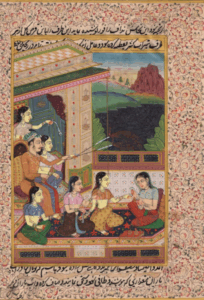
R. V. Smith, Outlook.
The festival came to be remembered as Jashn-e-Chiraghan—the Night of Illumination. Rangeela’s Diwali, as Mughal historians like Munshi Fayazuddin called it, set the tone for modern-day Diwali celebrations. It was a Diwali of survival as much as splendour, the empire’s last great blaze before the shadows fell.
Music, Desire, and the Poetics of Light
For Rangeela, Diwali was not merely celebration; it was art. He was himself a poet who wrote under the pen-name “Rangeela,” and his verses often blurred the boundaries between devotion and desire. During the festival, music and poetry filled the courtyards late into the night. Courtesans performed Kathak with diyas balanced on their heads, their ghungroos echoing the rhythm of rag Deepak, the raga of fire.
Courtier Quli Khan wrote that under Rangeela, “Delhi lived a leisurely life, every evening a sunrise of lamps.” Even as the empire faltered, beauty became a form of defiance. The emperor’s Diwali turned decay into radiance, loss into splendour.
Even ordinary people joined in. Traders opened their havelis to neighbours; sweet-sellers distributed kheel-batashe; sherbet was offered freely in earthen cups. Chandni Chowk glittered like a mirror of the heavens. Stories spread that the emperor, moved by the joy of his people, ordered himself weighed in gold and silver and distributed the metal among the poor. Whether true or not, the tale endured because it captured the spirit of his Diwali: extravagant, generous, fleeting.
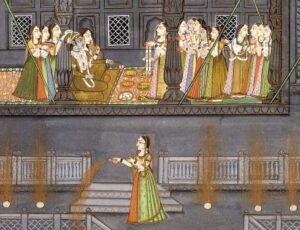
Krishna and Radha Enjoying a Feast and Fireworks [Kishangarh, early 19th century] collection of LACMA
Light and Legitimacy
Behind the splendour lay a deeper symbolism. Light, in the Mughal imagination, was inseparable from kingship. From Akbar’s concept of farr-i izadi—the unity of divine light—to the mirror-inlaid palaces of Shah Jahan, illumination signified both divine favour and imperial order. Rangeela inherited this legacy but repurposed it for an age of fragility. His Diwali transformed political weakness into aesthetic triumph.
Every lamp in the Red Fort was a declaration: that beauty could survive chaos, that the emperor’s presence still bound the city together. The blending of Hindu and Muslim rituals—the lighting of diyas, the celestial fire of Surajkrant, the distribution of alms—turned Diwali into an enactment of unity. For one night, the empire’s fractures dissolved into light.
It was also an assertion of cosmology. The Akash Diya, placed between earth and sky, embodied the emperor’s role as mediator between the two realms. To light it was to re-enact the birth of creation, to invite divine radiance into a troubled world.
Echoes of Light
History would not be kind to Muhammad Shah. Soon, Nadir Shah’s army would sack Delhi, the Peacock Throne would vanish, and the Mughal empire would fade into ceremony. Yet the memory of Rangeela’s Diwali endured. Bahadur Shah Zafar still lit lamps in the Rang Mahal a century later; Old Delhi residents continued to call the festival Jashn-e-Chiraghan, the Festival of Lamps. Even the dargah of Hazrat Nizamuddin Auliya glows with lamps on Diwali night, a tradition of roshni-e-zeest, the “light of life.” Across faiths, the city continues to speak in that same language of flame.
The Akash Diya no longer rises over Shahjahanabad, but its ghost lingers in the sky-lamps that light Delhi’s streets. The city’s diyas, mirrored on glass buildings and riverbanks, trace the same grammar of light that rangeela perfected. Every sparkler held by a child in Chandni Chowk is an echo of that imperial flame.
Rangeela’s Diwali reminds us that even in decline, beauty can be a form of power. His empire may have been fading, but his city burned brighter than ever. He turned festivity into philosophy: to illuminate, even when the world darkens. The emperor who lit the sky left behind no lasting conquests, but he left Delhi the memory of light.
And perhaps that is why, every Diwali, when the city glows, it feels as though somewhere beyond the smoke and fireworks, the ghost of Rangeela still watches from his terrace, laughing, composing verses, and whispering to the flames to burn a little longer.
References
Bhakuni, Tanuja. “Diwali Morning of Nizamuddin, 1958.”
Dash, Madhulika. “Diwali, a Festival for Delhi Sultans.” Hindustan Times, updated 23 Nov. 2015, https://www.hindustantimes.com/brunch/diwali-a-festival-for-delhi-sultans/story-hhCyHKujD3o9onYN278okL.html.
Smith, R. V. Delhi: Unknown Tales of a City. New Delhi: Lotus Collection, 2015.
Smith, R. V. “Diwali or Jashan-e-Chiraghan during Mughal Reign.” Outlook India, 28 Oct. 2019, https://www.outlookindia.com/website/story/opinion-diwali-or-jashan-e-chiraghan-during-mughal-reign/341245/amp.
Statesman News Service. “The Lure of Diwali in Delhi – Past and Present.” The Statesman, 4 Nov. 2018, https://www.thestatesman.com/features/the-lure-of-diwali-in-delhi-past-and-present-1502704787.html
Sultan, Parvez. “How the Mughals Celebrated Diwali at Red Fort, Unified Religions.” Hindustan Times, updated 30 Oct. 2016, https://www.hindustantimes.com/delhi/how-the-mughals-celebrated-diwali-at-red-fort-unified-religions/story-wJpQgcVAgWUWZKdBPV45uL.html.