
By Anusha Khan
Silence in the Texts, Life in the Shrine
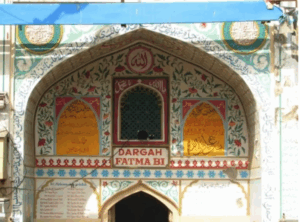
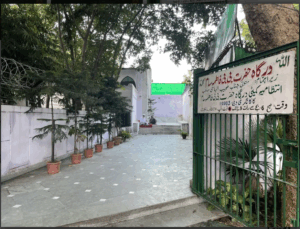
In the hustle and bustle of Delhi, where shrines and bazaars overflow with people, lies a quiet, almost forgotten grave. Tucked away in Kaka Nagar, Bibi Fatima Sam’s dargah does not announce itself with the grandeur or crowds of Nizamuddin Auliya’s dargah. Yet for centuries, people have come here to pray and to whisper their vows to a woman once revered as the “Rabia of Delhi.”
Delhi is often hailed as the city of saints. However, the saints most commemorated are predominantly men, while the women who shaped Delhi’s spiritual imagination have been pushed aside in history. Among them, Bibi Fatima Sam stands out as one of the earliest and most respected female saints of her time. A contemporary of Baba Farid and Nizamuddin Auliya, she was addressed affectionately as “Appa,” or elder sister, and sought out for her wisdom and blessings.
Her contemporary reverence is sharply contrasted by her near absence in the historical records. Amir Khurd’s Siyar al-awliya, composed in the fourteenth century, mentions her only in passing, quoting Baba Farid’s words: “Bibi Fatima Sam was not a woman, she was a man in a female appearance.” This line reveals how sainthood was imagined as masculine, and how women could only be recognised if stripped of their womanhood. Adeela Ghazanfar has shown how Chishti hagiographies consistently reduced women to domestic roles, as pious mothers, wives, or sisters. Bibi Fatima Sam is one of the very few women even named, and even then without detail. Her minimisation reflects a larger problem in historiography: the erasure of women’s intellectual and spiritual agency.
Yet her shrine and its oral traditions move against this silence and raise larger questions: what does it mean that the texts barely acknowledge her, while oral traditions preserve her as a source of blessing and intercession? What do her scattered appearances in early Chishti literature reveal about how gender shaped ideals of sainthood? And how does the continued veneration of her dargah, where women gather freely and share their vows, complicate the usual picture of Delhi’s Sufi past as a male preserve?
At her modest dargah, oral traditions of her miracles (karamat) and blessings (barakat) live on. Devotees still tell stories of the sick healed, of childless women granted children, of prayers answered in whispers at her tomb. Unlike the crowded dargahs of Delhi’s male saints, hers remains a quieter space where women enter freely. Muslim women in burqas pray beside Hindu women with sindoor in their hair, and her dargah becomes a shared space of faith.
Her story complicates the way we think about Delhi’s Sufi past. She was not an exception tucked away at the margins, but part of a spiritual world in which women shaped authority and devotion. To remember her today is to recognise the miraculous feminine that still runs through Delhi’s sacred landscape.
courtesy of sahapedia
Life and Asceticism
The details of Bibi Fatima Sam’s life are scattered and sometimes contradictory. Some traditions hold that she came from Sam, on the Iraq–Iran border, before settling in Delhi, while others insist she was from Delhi itself. All accounts, however, agree that she devoted her entire life to God and never married. She never married, devoting herself wholly to God.
She was known for her extreme asceticism. According to Fawaid al-Fuad, the malfuzat of Nizamuddin Auliya, she never let a moon pass without fasting. At sunset, a maid would place two loaves of bread and a cup of water by her prayer mat, yet she rarely ate them. The pain of seeing the poor in her neighbourhood compelled her to give away her food before she touched it.
One more anecdote illustrates her reputation for compassion. When Najibuddin Mutawakkil, with whom she had a brother-sister relationship, received bread from her, he looked up to heaven and prayed: “O Allah the Almighty! Bestow the light and intellect like this woman dervish possesses to our emperor so that he may also be aware of the condition of the poor like us.” Then he smiled and added: “Alas! The sultans do not possess that inward cleanliness by which they may be acquainted with our condition.” In this story, Fatima Sam becomes more than a saintly woman: she embodies a Sufi trope familiar across Delhi, where the spiritual authority of saints was imagined as more potent, and more just, than the temporal power of kings.
Gender and the Limits of Praise
Her sanctity was recognised by the greatest Chishti masters. Nizamuddin Auliya praised her with the words: “When the lion has come out of the forest, nobody asks if it is male or female; the children of Adam must obey and show respect, whether it is a male or female.” These lines, often repeated as signs of reverence, also expose how deeply masculinity was coded into sainthood. To acknowledge her authority, they had to recast her as male, or argue that holiness transcended gender only by analogy with animals. Her womanhood was a problem to be explained away.
In texts like Siyar al-Auliya and Akhbar al-Akhyar, she appears only briefly, reduced to a figure of piety and patience, without the details accorded to male saints. Her reverence in practice contrasts sharply with her marginalisation in writing. The paradox is clear: disciples sought her counsel, miracles were attributed to her, yet the canon of Sufi historiography struggled to accommodate her as a saint in her own right.
courtesy of sahapedia
Later Chishti Reverence
In Fawaid al-Fuad, Nizamuddin Auliya recalls not only her asceticism but also her wit: she could summon verses at the right moment, and once counselled him over a marriage proposal, only to affirm his decision to remain celibate in line with Baba Farid’s command. Here she appears not as a silent devotee but as an intellectual peer, capable of reasoning with a leading sheikh.
Akhbar al-Akhyar records her saying that feeding others with bread and water brought more blessing than countless fasts. It also preserves a dream-vision in which her soul ascended so swiftly that angels questioned her audacity. Fatima Sam refused to move until Allah himself summoned her. Even when Bibi Khadija and her daughter Fatima appeared to escort her, she prostrated at their feet but kept her oath. Only Allah’s direct call persuaded her. These narratives elevate her to the highest spiritual plane, presenting her as both humble and uncompromising, her authority validated not only by saints but by God.
Miracle stories (karamat) further underscore her stature. A childless man, after receiving her blessing and an amulet, fathered a son. Though the child was born without legs, one embrace from Bibi Fatima enabled him to walk. In another story, her blessing of bread became sustenance for the poor, embodying the Sufi principle that giving food and water to the hungry was worth more than a hundred thousand fasts.
Her memory also endured in the writings of later Chishti masters. Gesu Daraz’s Jawāmi‘ al-Kalim recalls Nizamuddin seeking solace at her tomb in times of uncertainty. The Khair al-Majālis hails her as a model for all dervishes, praising her discipline even on her deathbed. For sheikhs who followed, invoking Bibi Fatima Sam allowed them to lay claim to her spiritual heritage. As Khurshid Khan notes, this was not only reverence but also strategy: her memory let the Chishtis gesture toward the inclusion of women within their silsila, even as their genealogies largely erased them.
Her authority did not end with her death. Gesu Daraz’s Jawani al-Kalim records that Nizamuddin himself sought solace at her shrine in moments of uncertainty. The Khair al-Majalis hails her as a model for all dervishes, praising her devotion even on her deathbed. In these accounts, her figure became integrated into the spiritual capital of the Chishtis, invoked by male sheikhs to affirm their own legitimacy.
Khurshid Khan has argued that by invoking Bibi Fatima Sam, Chishti sheikhs sought to claim her spiritual heritage and expand their tariqa to include women. Even if women were marginalized in formal genealogies, figures like Bibi Fatima served as anchors, enabling the order to gesture towards inclusivity. Her memory thus played a strategic role, both spiritually and institutionally, within the Chishti silsila.
courtesy of wikipedia
The Shrine Today
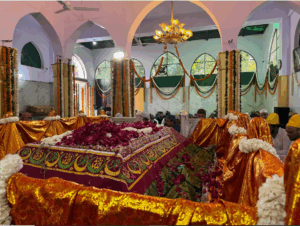
The physical site of her shrine reflects this double history: at once marginal and alive. Her tomb served as a gathering place for holy men until the 14th or 15th century. By the end of the 16th century, however, it had fallen into desolation, and only recently was the grave covered. Today, the dargah is modest, attached to a small mosque dating back to the 16th century. Its serenity contrasts with the bustle of Delhi’s major dargahs.
Its regulars are few: the caretaker Haji Baba Abdul Rashid, a flower-seller, a visually impaired acolyte. Baba Rashid, who calls himself an amil-i-jinnat (knower of spirits), insists that Bibi Fatima wished to remain veiled, revealing herself only to those she summoned. He repeats an extraordinary claim: that Baba Farid once told her, “If you had not been a woman, you would have been my first khalīfa, and not Nizamuddin.” Oral tales like this, whatever their historical basis, show how devotees continue to elevate her stature.
The dargah is also unusual in the freedom it offers women. Where Nizamuddin’s shrine restricts them to gazing through jalis, here they approach the grave directly. One devotee, Fiza, has visited weekly for five years, attributing her life’s successes to Bibi Fatima’s blessings. Others tell stories of lame visitors walking away on their own feet. Flower-sellers tell stories of lame visitors walking away healed.
During the urs, celebrated on the 17–18th of Shaban, khadims from major dargahs bring offerings, but the rituals are intimate, free of the commercial bustle of other shrines. A couplet sung at the ritual captures the reverence:
adab se chalo ise lekar,
ye bade auliya ki chadar hai,
khvaja-e-khvajgari ki chadar hai.
Walk with respect, for this is the covering of a great saint, the covering of the master of masters.
Recovering the Miraculous Feminine
Bibi Fatima Sam’s life forces us to confront the gendered silences of Islamic historiography. Annemarie Schimmel and Margaret Smith have shown that women were present from the earliest generations of Sufism, even if male-authored texts minimized them. More recently, Tara Sheemar and Khurshid Alam’s fieldwork has highlighted the “miraculous feminine” in Delhi’s Sufi shrines, where women saints continue to sustain everyday religiosity. These stories are not just folklore but counter-histories, preserving what the chronicles ignored.
The case of Bibi Fatima Sam makes this divergence clear. In the texts, she appears fleetingly, reduced to a phrase, reframed as masculine to render her sainthood legible. In practice, she was sought out for blessings, remembered for miracles, and revered by generations. She gave food to the hungry, counseled Nizamuddin, blessed the childless, and became a moral counterpoint to kings. The reverence she commanded from Baba Farid and Nizamuddin shows that her authority was undeniable, even if chroniclers tried to contain it.
Her shrine today, modest but enduring, demonstrates how memory can resist erasure. Her life and memory reveal that sainthood was never the preserve of men, and that the miraculous feminine runs through the city’s history, however faintly recorded. And as Nizamuddin himself once said, when the lion emerges from the forest, no one needs to ask whether it is male or female.
References
Dehlvi, Ghulam Rasool. “Do You Know ‘Rabia of Delhi’—Bibi Fatima Sam Popularly Known as ‘Dilli Ki Rabia’?” New Age Islam, 2014.
Dehlvi, Sadia. The Sufi Courtyard: Dargahs of Delhi. HarperCollins India, 2012.
Ghazanfar, Adeela. “Silencing of Women in Chishti Hagiographical Tradition in South Asia: A Study of Siyar al-awliyā.” Journal of Sufi Studies, vol. 3, no. 2, 2010, pp. 163–185.
Khan, Khurshid. “The Textual Memorialization of Fatima Bin Sam: A Study of a Woman Sufi Saint.” Journal of Advances and Scholarly Researches in Allied Education, vol. 14, no. 1, Oct. 2017.
Sheemar, Tara, and Khurshid Alam. “The Miraculous Feminine within Islamic Mysticism: Women’s Tomb-Shrines in Delhi.” Antrocom Online Journal of Anthropology, vol. 20, no. 2, 2024, pp. 299–320.
Tanuja Bhakuni. “Sufi Silsila-e-Dilli: Bibi Fatima and Mai Sahiba.” The Quint, 2019.