

By Saiee Katkar
Floods are among the most frequent natural disasters in India, yet their silent impact on cultural heritage often goes unnoticed. From manuscripts washed away in archives to ancient temples submerged by rising rivers, the damage is not just physical but emotional and cultural. This article explores the vulnerability of heritage to floods, focusing on the 2018 Kerala floods as a case study. It examines how priceless cultural materials were lost and how communities and professionals came together for recovery. The essay also highlights the urgent need for disaster management strategies in heritage conservation, where prevention, preparedness, and public awareness must replace reactive measures.
Introduction
When floodwaters rise, they do more than sweep through cities and villages. They also wash over centuries of memory stored in temples, manuscripts, museums, and oral traditions. Heritage, often seen as timeless, reveals its fragility in these moments.
Across India, cultural materials lie close to rivers and coasts, as ancient civilizations settled along water sources. The same rivers that once gave life now pose a threat in times of climate change and urban negligence. When floods strike, they do not only destroy homes but also erase records of who we were.
In recent decades, events in places like Bihar, Assam, and Kerala have shown how water can silently eat away at our collective memory. From the destruction of manuscripts in libraries to the collapse of centuries-old architecture, each flood writes a new story of loss, resilience, and learning.
The Silent Victims: Heritage in the Path of Floods
When we talk about flood damage, the focus usually falls on infrastructure and human loss. But cultural heritage, both tangible and intangible, often suffers in silence. Temples, manuscripts, paintings, archives, and oral traditions are all at risk.
Floods bring with them more than water; they carry mud, silt, chemicals, and bacteria that can irreversibly damage organic materials such as palm-leaf manuscripts, cloth, and wood (UNESCO, 2010). The physical loss is immediate, but the emotional and cultural loss is far greater. When a manuscript dissolves, an entire tradition of memory and learning goes with it.
In India, where heritage often exists in humid climates and fragile conditions, even a short spell of waterlogging can mean the difference between preservation and total loss. Many small libraries, temples, and local archives lack waterproof storage, humidity control, or disaster-response plans (Sharma & Joshi, 2016). Thus, when the floods come, they come as cultural as well as humanitarian disasters.
Case Study: The Kerala Floods of 2018
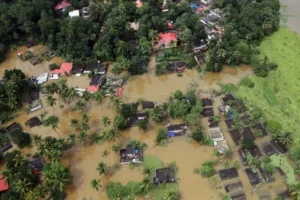
A Submerged Memory The Kerala floods of 2018 were among the worst disasters in India’s recent history. Unprecedented rainfall led to overflowing dams, landslides, and flash floods across the state. More than 400 people lost their lives, but the waters also claimed something irreplaceable: Kerala’s living heritage (Rajeevan et al., 2019). ( Image 1 )
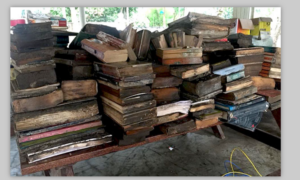
At first, rescue teams focused on saving lives and clearing debris. Only later did the full extent of cultural loss emerge. In towns like Thrissur and Pathanamthitta, ancient manuscripts stored in temple libraries, known as sarvajnapeethams, were found soaked and covered in fungus. Rare palm-leaf records, some dating back to the 17th century, were left unreadable. The waters had entered not just homes but memory itself. ( Image 2 )
One striking case came from the Sree Padmanabhaswamy Temple archives in Thiruvananthapuram. Though the main sanctum survived, the document rooms suffered heavy seepage. Volunteers and conservators rushed in, spreading manuscripts under fans and using blotting paper and dry silica gel to absorb moisture (Nair, 2019). The process was painstaking. Some texts could be saved; others had to be photographed and digitized before
disintegrating completely.
Meanwhile, museums like the Hill Palace Museum in Tripunithura faced severe humidity and mold outbreaks. Sculptures and coins had to be relocated, while textiles were frozen temporarily to halt biological decay (Kumar, 2020). The Kerala floods became not just an environmental event but a wake-up call for heritage professionals across India.
Rescuing the Past: The Restoration Efforts
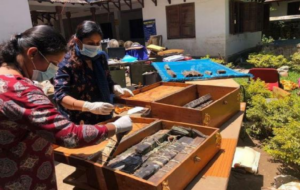
The aftermath of the 2018 Kerala floods saw the emergence of the Kerala Heritage Rescue Initiative, a collaborative effort spearheaded by young conservation professionals, with support from ICCROM and ICOMOS India. This initiative utilized a crowdmap to systematically document and assess damage to cultural heritage sites, including temples, manuscripts, and historical structures. Volunteers were trained in emergency conservation
techniques through remote First Aid to Cultural Heritage workshops, enabling them to conduct damage assessments and salvage efforts effectively. This grassroots movement not only salvaged invaluable cultural assets but also underscored the importance of community involvement in heritage preservation during crises ( Image 3 )
Damaged manuscripts were cleaned, freeze-dried, and documented. Digital restoration became a crucial tool. What could not be physically saved was scanned and preserved in digital form. Workshops were held to train local volunteers in basic conservation techniques such as handling wet paper, using natural desiccants, and avoiding further fungal damage.
For the first time, the public realized how fragile India’s heritage infrastructure truly was. Small archives, temple libraries, and museum storerooms were not designed to withstand natural calamities. The Kerala floods reshaped the national conversation on heritage. It was no longer to be seen as a static treasure but as something that needed active, ongoing protection.
The Broader Picture: Heritage at Risk Across India
Kerala’s experience was not isolated. Floods in Bihar (2008), Assam (2020), and Chennai (2015) have each left deep marks on heritage sites. In Patna, the 2008 Kosi floods submerged old temple complexes and eroded archaeological mounds (Arora, 2011). In Chennai, the Egmore Museum’s archival section suffered damage when water entered storage rooms, soaking historic manuscripts and paintings (Menon, 2016).
These events reveal a pattern. Heritage conservation in India remains reactive rather than preventive. Many archives and museums have no flood-risk assessment plans, emergency kits, or trained staff. The emphasis is often on display and renovation rather than on resilience and disaster readiness.
Globally, the situation is similar. When the River Arno flooded Florence in 1966, thousands of priceless books and artworks were destroyed. Yet that tragedy also gave rise to a new discipline of heritage disaster management and international cooperation for emergency conservation (Caple, 2010). India’s recent floods, especially Kerala’s, may be the wake-up call for a similar shift at home.
Lessons from the Waters
The floods exposed not just the vulnerability of India’s heritage but also its strength: the resilience of communities who refused to let history drown. Volunteers worked side by side with curators, archivists, and local residents. Young students from art colleges helped clean temple sculptures, while village women air-dried manuscripts in their courtyards.
This collaboration underlined an important truth. Protecting heritage is not only about institutions but also about people. When the public understands the value of heritage, they become its first responders. The post-flood recovery in Kerala became a movement of awareness, leading to new initiatives for digital documentation, museum safety audits, and disaster planning (UNESCO, 2019).
The Gaps that Remain
Despite these efforts, major gaps persist. Most heritage sites in India are not mapped for flood risk. Climate change and erratic rainfall patterns increase the likelihood of disasters, but conservation policies remain fragmented across departments. There is little coordination between the Archaeological Survey of India, the National Archives, and state disaster management authorities (Rao, 2020).
Moreover, many restoration projects stop once the visible damage is repaired, without addressing long-term structural vulnerabilities. Preventive conservation, such as proper drainage, elevated storage, waterproof cabinets, and climate control, remains underfunded and often ignored. Without systemic change, every monsoon carries the threat of repeating the same cycle.
Conclusion
Conclusion The 2018 Kerala floods stand as a reminder that heritage, like human life, is deeply vulnerable to the forces of nature. When the waters rose, temples, manuscripts, and museums became silent witnesses to loss, revealing how fragile our cultural memory truly is. The tragedy, however, also became a moment of awakening. Across Kerala, people who had never thought of themselves as conservators stepped forward to dry manuscripts, clean artifacts, and rebuild archives. Their collective effort showed that heritage protection is not only a professional duty but also a shared moral responsibility.
What emerged from the floodwaters was not just a lesson in damage, but in awareness. It became clear that India’s cultural institutions need to move beyond reactive responses and invest in preparedness. Documenting collections, digitizing manuscripts, and training local communities are no longer optional measures; they are lifelines for the past. The Kerala experience also underlined that traditional knowledge and local participation can strengthen modern conservation frameworks, especially in regions prone to natural disasters.
The story of Kerala is, therefore, one of both loss and resilience. It reminds us that the preservation of heritage is not simply about stone, paper, or pigment, but about continuity of knowledge, of memory, and of identity. Each rescued manuscript, each restored sculpture, reaffirms our connection to the past and our responsibility to the future. The task ahead is not only to rebuild what was lost but to ensure that when the next flood comes, our heritage can stand stronger against the tide.
References
● Arora, P. (2011). Floods and Cultural Heritage: The Case of Bihar. Indian Archaeology Journal, 54(2), 101–118.
● Caple, C. (2010). Conservation Skills: Judgement, Method and Decision Making. Routledge.
● INTACH. (2018). Kerala Heritage Rescue Report. Indian National Trust for Art and Cultural Heritage.
● Kumar, S. (2020). Cultural Heritage and Natural Disasters in Kerala: Post-2018 Recovery Efforts. Indian Conservation Review, 8(3), 45–62.
● Menon, D. (2016). When the Archives Drown: Chennai Floods and the Loss of Memory. The Hindu, December 2016.
● Nair, M. (2019). Kerala Floods and the Fate of Heritage Collections. Economic and Political Weekly, 54(7), 22–26.
● Rao, V. (2020). Disaster Management and Heritage: Policy Gaps in India. Journal of South Asian Studies, 12(1), 77–95.
● Sharma, R., & Joshi, P. (2016). Preserving the Fragile Past: Heritage Risk in India’s Climate Zones. Indian Museum Bulletin, 7(1), 31–46.
● UNESCO. (2010). Managing Disaster Risks for World Heritage. UNESCO World Heritage Centre.
● UNESCO. (2019). Post-Disaster Recovery of Heritage in Kerala: Lessons and Practices. New Delhi Office.
● Rajeevan, M., et al. (2019). The 2018 Kerala Floods: Causes, Impacts, and Lessons. Ministry of Earth Sciences, Government of India.
Image references
● Image 1
An aerial view of partially submerged houses and heritage sites in Kerala during the 2018 floods, highlighting the widespread devastation.Source: Al Jazeera, August 31, 2018
● Image 2
Damaged manuscripts and books awaiting conservation post-Kerala floods. Image credit: ICCROM / Kerala Heritage Rescue Initiative
● Image 3
Movable Heritage: Retrieving artefacts (palm leaf scriptures called Thaliyolas) at Paliyam Dutch Palace Museum.
Image credit: ICCROM / Kerala Heritage Rescue Initiative