
P. Sanjay
Turmeric – “The Golden Spice” is a treasure that’s accessible by all, yet very rich in its cultural significance and healing property. Because of its brilliant yellow colour, it is also known as “Indian Saffron”. It has different names in different languages, but its sacredness is revered throughout the country. In Sanskrit it is mentioned as Haridra; it is known as Kurkum to Arabs and as Haldi and Halada to Hindi, Bengali, Maharashtrian and Gujarati regions and as Manjal to Tamils, Pasupu to Telugus and as Arishina to Kannada people.
Its countless uses makes it present in every possible form. From the kitchen, using it as a spice to the medicine cabinet as a healing agent to the wounds. From being a daily skincare product in the facial kits to its uses in rituals symbolizing its sanctity. It is an unavoidable ingredient in Indian cuisine and it is applied on wounds in every household during the absence of an antiseptic cream. It is also considered an auspicious spice, especially in Hindu tradition. The Haldi ceremony, a pre-wedding ritual, during which turmeric paste is smeared over the bride and groom, for brighter, lighter and even out skin tone before the big day. The Mangalsutra (nuptial thread) is also dyed with turmeric for the wedding ceremony. (Neelam A. Vashi, MD, 2018)
Many different traditional healing systems, such as Ayurveda, Sidha, Unani, and Tibetan, have incorporated the use of turmeric in their practices (Ravindran et al., 2007). In Ayurvedic practices, turmeric is thought to have many medicinal properties including strengthening the overall energy of the body, relieving gas, dispelling worms, improving digestion, regulating menstruation, dissolving gallstones, and relieving arthritis.

Turmeric paste on a bride’s hands and feet during the prenuptial Hindu Haldi ceremony. Source : (Susruthi Rajanala, BA; Neelam A. Vashi, MD)
India, a land of staggering diversity, a living tapestry woven with vibrant cultures, ancient knowledge systems and a rich biodiversity. The knowledge system of India remains very crucial as it not only gives a sense of pride but gives the country a reservoir of cultural and ecological wealth. The traditions that are infused in the day to day life of the people which are usually ignored, contain a strong relevance in the global context. The inferiority of the Third World countries against the developed nations poses a threat to the Indigenous Traditional Knowledge systems and its misuse for the creation of wealth rather than helping people out from its benefits – exactly how turmeric used in our homes has been stolen by the US.
The tale of turmeric – that we are going to see today starts on the 28th March of 1995, when two US based Indians namely Suman K Das and Harihar P Cohly assigned to the University of Mississippi Medical Centre, were granted a US patent – US’504. Getting a patent on an innovation is a highly appreciable work, but what was the patent granted for? The patent was granted for the healing properties of turmeric. The patent consisted of six claims – in summary, it claims that turmeric can be used for promoting wound healing. It can be applied orally, topically, or both and it can also be applied to surgical wounds and body ulcers. These claims, however, do not constitute novel inventions, as the use of turmeric has been a well established traditional practice in India and some other South Asian countries.
However, the granting of a patent related to turmeric to the US was unknown to Indians as there was a great lack of information and alertness among them. It was after a year, that on 02 July 1996, when Dr. Saha, Director, Patent Facility Cell, Dept. of Science and Technology, who accidentally while surfing the internet came across the information. The information was soon covered in a newspaper article based on Delhi. The very next day, it came to the notice of Dr. Raghunath Mashelkar, Director General of Council of Scientific and Industrial Research (CSIR).
Raghunath Mashelkar, is also given the title as the Haldi Ghati warrior, who fought against the western appropriation of the traditional Indian knowledge. Mashelkar was shocked on hearing the information and also shared a story of his personal life in an interview (By Alexi Horowitz-Ghazi, Erika Bera, Molly Messick, Willa Rubin) that , when a bird was unable to fly and fell down with its wings badly injured. What his mother first did after seeing it, was to apply the paste of turmeric over the wound of the bird. This defines the consciousness of turmeric to be a natural healing agent has been imbibed in the minds of Indians and that no one can claim rights on it.
As the use of turmeric in the form of powder, paste and other forms is an age-old practice in India. Its prior art was well – documented in social, religious and scientific literature in different languages in the country. This motivated CSIR to plunge into action. The then director Mashelkar, exactly acting as the leader of the army, led the research work of the CSIR. CSIR collected the maximum number of documents to ask the US Patent and Trademark Office (USPTO) for the re – examination of the patent. The documents and references that were found in various sources were translated to English, documents that were published before the date of patent were also collected. On 13th August 1997, USPTO looked into the case and rejected all the six claims of the patent.
The traditional knowledge of turmeric has contributed globally to the pharmaceutical applications of Turmeric and continues to garner interest in the scientific community , with ongoing research on the versatile characteristics of turmeric. Its properties contribute to a better and healthier lifestyle. Although turmeric originated in India, its benefits are enjoyed globally, beyond the constraints of borders. The struggle for the rejection of the patent was not only to cut down the monetary benefit to the patent holders but rather a larger goal of providing our grandmothers’ treatment of healing through turmeric to the world.
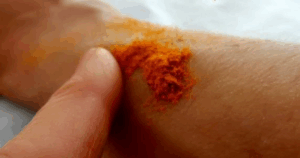
Turmeric applying on wound, Source: (Google: Wipo)
Conclusion
The misappropriation of the traditional knowledge system by the west didn’t start from the case of turmeric and will not stop with turmeric. The patents of Basmati rice and Neem which are culturally embedded with the people’s lives of India are also owned by other countries for which the Indian scientists’ fight continues. The turmeric case has remained a lesson for Indians which drove scientists and people to document the traditional knowledge from being stolen. This led to the efforts in India to establish a Traditional Knowledge Digital Library (TKDL), which is easily accessible. A lot of focus has been given to turmeric from setting up turmeric boards and research institutes for studying the medicinal properties and conserving the various species.
References
Jayaraman, K. S. “US patent office withdraws patent on Indian herb.” Nature 389.6646 (1997): 6-6.
Kumar, Sanjay. “India wins battle with USA over turmeric patent.” The Lancet 350.9079 (1997): 724.
Gupta, R. K., and L. Balasubrahmanyam. “The turmeric effect.” World Patent Information 20.3-4 (1998): 185-191.
Nagpal, T. D. “Keeping Vigil Against Bio-piracy: Lessons From the Turmeric Patent Case.” KURUKSHETRA-NEW DELHI- 46 (1997): 37-38.
Mashelkar, Raghunath How one man fought a patent war over turmeric. Interview By Alexi Horowitz-Ghazi, Erika Bera, Molly Messick, Willa Rubin, NPR, 1 Sep. 2023, https://www.npr.org/2023/09/01/1197321273/turmeric-india-biopiracy-patent-tkdl
Rajanala, Susruthi, and Neelam A. Vashi. “Haldi ceremony—Historical use of turmeric.” JAMA dermatology 154.5 (2018): 543-543.