

By- Arpita Jain
At sunrise, two versions of heritage stand face to face. In modern India, a 16th century UNESCO world heritage site functions at once as a tourist destination, a legal dispute and a religious claim, contained behind fences and ticket counters. Yet beyond these boundaries, surrounding communities continue to live heritage daily through shared incense and memory.
This article explores the contested ownership of heritage in contemporary India by examining the competing claims of the state, local communities, and emerging private stakeholders. By connecting preservation policies with living traditions, and issues pertaining to access, livelihood, and interpretation, it argues that India’s past cannot be owned in a singular legal sense. Instead, it must be understood as a shared yet deeply political cultural resource.
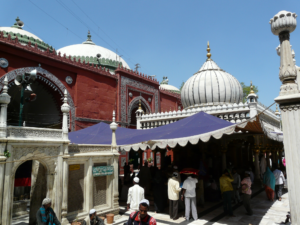
Hazrat Nizamuddin Dargah, Delhi. Source- Wikipedia
Stretching across palaces and rising through domes and temples, India’s highly visible past has produced an urgent modern question: who truly owns heritage in a contemporary nation? At first glance, monuments and heritage sites appear to belong to the state and its institutions. Yet a temple is not merely a monument but also a living religious space. A fort is not only an architecture but a foundation of local identity and pride. A dargah is as much an ongoing spiritual centre as it is a historical arena.
THE AUTHORIZED WALLS
The modern Indian state approaches heritage largely through the law. The most significant legal framework is the Ancient Monuments and Archaeological Sites and Remains Act (AMASR), 1958, which empowers the state to declare monuments as protected and place them under the control of the Archaeological Survey of India. Established in 1861 during colonial rule, ASI remains the central authority responsible for conserving and maintaining many of India’s major monuments today.
The ASI oversees 3,697 monuments and archaeological sites declared of national importance. Packaging history into an accessible experience, it provides pathways, signage, benches, disability access, souvenir stores, and sound-and-light shows. Typologically, its portfolio includes over 1,471 religious monuments, 749 archaeological sites, 490 forts and palaces, and 437 memorial buildings, alongside gardens, water systems, and civic structures, with state-protected monuments mirroring a similar distribution. Despite this, however many monuments remain neglected and in decay with over 90,000 historically significant buildings remaining largely unprotected.
Following the 2010 amendment to the AMASR Act, this approach became even stricter with the creation of two key zones around protected monuments: a 100-metre prohibited area where construction is banned, and a 200-metre regulated area where building activity requires permission.
STATE, COMMUNITY, AND PRIVATE CLAIMS
Often seen as the primary guardian of India’s monuments, it has a long institutional history, as the government’s attention toward systematic repair and conservation did not arise naturally but was prompted under colonial rule. The Duke of Argyll, Secretary of State, advised the Government of India to establish a central archaeological department and emphasised that it was the government’s duty ‘to prevent its own servants from wantonly accelerating the decay’ of monuments. Hence, ASI itself was established originally serving the colonial objectives of military reconnaissance and administrative oversight, tasked with a complete survey of the country and a systematic record of architectural remains remarkable for antiquity, beauty, or historical interest. For instance, Alexander Cunningham was entrusted with developing a scheme of systematic enquiry, summarising previous work, and guiding future research.
Beginning as an exercise of colonial governance—cataloguing, classifying, and controlling the past, the post-independence Indian state inherited this apparatus and expanded it, not only through the ASI but also through cultural institutions like the Sangeet Natak Akademi, Sahitya Akademi, Lalit Kala Akademi, the National School of Drama, and the National Gallery of Modern Art, recognising culture as essential to nation-building.
Yet state ownership often slips into state monopoly. When the government defines what is “national importance,” it also defines what is worth remembering. When it renovates, it also decides what counts as restoration and what becomes erasure.
For instance, in January 2024, Outlook reported that monuments such as Gol Gumbaz, Safdarjung’s Tomb, and Sikander Lodi’s Tomb were covered in sand, cement, and paint in a hurried attempt at beautification. In the process, delicate carvings and details were allegedly erased, with plaster and paint flattening centuries of craftsmanship. Even when crores are spent, the damage done by poor restoration can be irreversible, raising a critical question that if the state owns the monument, does it also own the right to alter it beyond recognition.
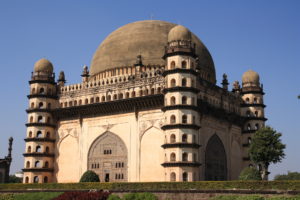
Gol Gumbaz, Delhi. Source- Wikipedia
The modern heritage landscape has introduced a third claimant: the private sector. In 2017, the ‘Adopt a Heritage’ scheme allowed corporations to develop and maintain tourism infrastructure at 105 monuments and heritage sites. Increasingly being treated as assets, companies were tasked with toilets, drinking water, signage, audio guides, ticketing, and cleanliness, while receiving brand visibility in return.
On paper, while this seems beneficial, corporate involvement raises fears of commercialisation and narrative manipulation. When the Dalmia Bharat Group adopted the Red Fort in a multi-million dollar deal, historians strongly opposed the decision, warning that corporate involvement could encourage false or unverified interpretations of history, shaped less by scholarship than by the demands of tourism and branding. The tension between state and community becomes most visible when a monument is also a religious space, and in such a politically polarised nation, heritage interpretation can quickly become ideological propaganda.
A monument does not only represent history, rather it produces history through the way it is explained. Whoever controls interpretation controls memory. In a country where history is deeply layered and contemporary politics often fuels religious majoritarianism, any sweeping alteration of heritage sites without careful review and public accountability is bound to provoke resistance. For instance, in regions such as Assam, where feelings of marginalisation from mainland narratives persist, preservation projects carried out without sensitivity to local culture risk deepening alienation rather than fostering inclusion.
THE PEOPLE AROUND HERITAGE
If monuments are one form of heritage, living traditions are another, and arguably more fragile one. Heritage conservation isn’t just restoring old sites. People, culture need to be protected too.
UNESCO acknowledged this dimension through the Convention for the Safeguarding of Intangible Cultural Heritage (2003), which recognizes oral traditions, performing arts, rituals, and craftsmanship as heritage. For instance, India’s intangible heritage list includes practices such as Kutiyattam (traditional Sanskrit theatre in Kerala), Kalbelia dance and songs, Yoga, or the Kumbh Mela, which is one of the largest recurring gatherings in the world.
Heritage is not always something you visit, but also something you do like oral storytelling traditions like Pabuji ki Phad in Rajasthan. The heritage here is not preserved in a museum but carried in memory and performance, with the performer’s voice itself becoming the living archive. Similarly, the Thatheras of Jandiala Guru continue to craft brass and copper utensils using age-old techniques passed orally from father to son. Embedded in natural materials, their work blends utility with ritual and shapes identity and community status in Punjab, representing ownership of heritage not to the state but to the people who embody it.
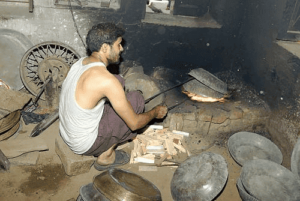
The Thatheras of Jandiala Guru, Punjab. Source- Ministry of Culture
Likewise, practices like langar in Sikh gurdwaras represent heritage that is repeated daily, intrinsically tied to Sikh history and identity. Surviving through communities, it makes the people not just a stakeholder but the primary carrier of the past.
“It is about being alive and giving continuity to life.”
Andrea Anastasio, director of the Italian Cultural Institute, says conservation is not merely protection; rather it is being alive which requires understanding roots. Not only architectural roots but cultural ones, heritage then is ‘not a dead object preserved behind railings, but becomes a living relationship between people and place.’
Sites such as Humayun’s Tomb and the Nizamuddin Basti nearby are not simply collections of historic buildings, rather they are inhabited landscapes where generations of families have lived, worked, and shaped their identities around spaces like the Hazrat Nizamuddin Dargah. While the tomb is monumental, protected, and visited, the basti is lived. And hence, their traditions of prayer, food, and memory becomes a form of an archive that no museum can fully capture.
India once had over 150,000 varieties of rice, a vast cultural biodiversity shaped by agriculture, climate knowledge, and community identity. Today only a handful dominate the market. While some communities still protect 600–700 varieties, much has already been erased. Similarly, oral traditions such as the chanting of the Vedas, composed over 3,500 years ago represent one of the world’s oldest surviving cultural systems. Now declining, the loss of such practices cannot be repaired with cement or funding; it requires cultural participation and intergenerational continuity.
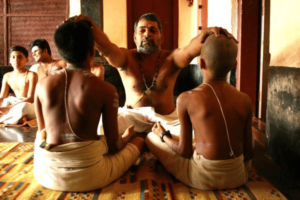
Vedic Chanting. Source- Ministry of Culture
SO, WHO OWNS INDIA’S PAST?
While on one hand, monuments decay under neglect and urban pressure, on the other hand political voices demand the demolition of Mughal tombs, arguing that certain histories do not deserve preservation. Dr. Sheeba Chandar notes that this selective approach treats heritage not as collective inheritance but as a battlefield for identity politics. If history is only worth protecting when it glorifies one community or absolves one narrative, then heritage becomes propaganda, not memory.
Shaped through legislation, fought over by communities, and repackaged for tourism, India’s heritage is as contested as it is inherited. India’s past is not a commodity to be fenced, ticketed, or branded. While the state has legal authority and administrative responsibility, communities hold lived cultural meaning. As a shared cultural resource, while it is politically charged, emotionally rooted, and constantly contested, the real question is not merely who owns it, but who has the power to preserve it, profit from it, and shape its narrative.
Our past survives not only in tombs and pillars, but in songs passed down and routes retraced. While the state may fence monuments, heritage cannot be reduced to property alone. It must be understood as a shared responsibility. As ultimately, restoration can repair, but heritage survives through people and memory.
For when the visitors leave and silence returns, the lamp continues to burn and the past keeps on belonging to those who inherit it and keep it alive.
REFERENCES
https://thediplomat.com/2018/05/the-privatization-of-heritage-why-corporate-funding-to-restore-monuments-worries-india/
https://www.theswaddle.com/why-delhis-central-vista-project-has-sparked-debate-about-development-heritage
https://culture.gov.in/intangible-cultural-heritage
https://asi.nic.in/HQ/history-view
https://theprint.in/feature/around-town/heritage-conservation-isnt-restoring-old-sites-people-culture-need-protected-too/2580553/
https://theprint.in/ground-reports/a-heritage-law-left-homeowners-at-asis-mercy-now-modi-govt-plans-to-ease-it/2697741/
https://iimun.in/blog/others/indias-cultural-heritage-a-collective-failure-to-protect-and-preserve/