

By Shreya Kamboj
Sai Paranjpye’s Chashme Baddoor (1981) is often celebrated for its slice-of-life charm, witty characters, and quietly progressive gender politics. But beyond its humour and romance, the film stands out for how it quietly documents a city in transition. Without overt nostalgia, Sai Paranjpye offers a portrait of Delhi that feels almost unrecognizable today: slow-paced, breathable, and emotionally porous. The Delhi she films isn’t the landmarks or historical grandeur – it’s built out of everyday spaces like modest barsaatis, parks with working cafés, empty streets lined with trees, and paan shops that double as sites of social exchange.
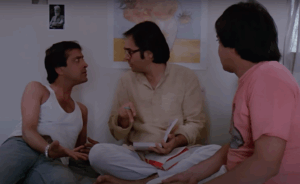
Within this everyday cityscape, the story follows three college friends – Siddharth, Omi, and Jai – who share a modest barsaati and an easy camaraderie. While Omi and Jai spend their days concocting schemes to flirt with women, Siddharth remains earnest and quietly focused. When Neha, a Chamko detergent salesgirl, visits their neighbourhood, all three encounter her separately. Omi and Jai try, unsuccessfully and absurdly, to woo her. Siddharth, however, through a simple and sincere interaction, forms a real connection. As their relationship deepens, the other two, envious of his success, fabricate stories to break the couple apart. What follows is a brief rupture, a series of comic interferences, and eventually, a redemption arc that includes a botched fake kidnapping turning into a real one. The plot is light, but its emotional currents run through the daily routines of student life, idle gossip, romantic anxiety, and casual betrayal.
The city here is not merely a backdrop, but a living part of the narrative, and if I may say so, a character in itself. The city determines how people meet, how long they can linger, and where they can miscommunicate or reconcile; these interactions, in turn, shape the emotional topography of the city. In this sense, the film reflects what Henri Lefebvre, a French philosopher and sociologist, called the “social morphology” of space: space is not merely a form, but is shaped by lived experience. Through this subtle attention to space and its rhythms, Chashme Baddoor becomes a quiet archive of how cities once felt and what they once allowed.
Framing Space as Character in Cinema
“In the fusion of place and soul, the soul is as much of a container of place as place is a container of soul.” (Harrison R.P., 2008)
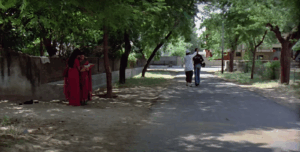
There exists a profound reciprocity between characters and their spatial environment in cinema. A city on screen is not merely geography – it is memory, emotion, and identity. At the same time, as the Finnish architect and theorist Pallasmaa (2012) asserts, the city is a phenomenon that cannot be easily described, represented, or recorded because it is ‘felt’ in the experiences. Paranjpye’s film, then, is one of the very few pieces that capture probably as much of the city as is possible through lens and dialogues. A street in the film does not simply end at the edge of the screen; it spills outward, invoking an imagined network of streets, buildings, and life situations around the viewer. This is precisely what we observe in Chashme Baddoor: even though we only see fragments of streets, glimpses of modest houses, garden paths, or buffaloes bathing in a canal, the film invites us to perceive the texture of the entire city. It enables the viewer to imagine what Delhi might have looked and felt like at that particular moment in history, even without ever having been there.
Paranjpye’s film joins a small but significant set of urban cinema, like Woody Allen’s Manhattan, where the city is not just a backdrop but essential to the narrative arc. As Pallasmaa argues, spaces and characters co-create meaning: spatial settings shape emotions, while emotions give lasting weight to those settings. The memory of specific spaces – rooftops, cafés, tea stalls – becomes intricately woven into the emotional lives of the characters. For example, the barsaati shared by the three male protagonists becomes the site where friendships are formed, jokes are exchanged, and romantic hopes are whispered. Similarly, the paan shop and corner café are not incidental; they serve as emotional anchor points, holding together the lived geography of the film’s Delhi and the interior worlds of its characters.
Everyday Architecture and Social Geography in Chashme Baddoor
Sai Paranjpye’s Chashme Baddoor doesn’t focus on Delhi’s iconic landmarks; instead, it lovingly maps the city’s lesser-known but emotionally rich spaces that are imbued with lived history.
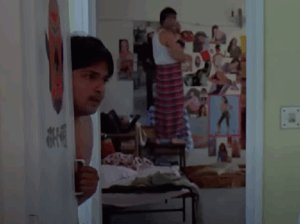
The barsaati, a modest rooftop room perched atop Delhi’s residential buildings, has long been an understated yet iconic element of the city’s architectural and cultural landscape. In Chashme Baddoor, the trio’s Defence Colony barsaati quietly shapes their shared world with its reaky wooden floors and timeworn walls. The scenes of spontaneous poetry recitations by Omi and Jai’s unfiltered chatter unfold within these walls. Etymologically, barsaati is drawn from the Hindi word barsaat, meaning rain – aptly so, as these rooms bear the full brunt of Delhi’s dramatic monsoons, exposed as they are on the terrace. Historically, barsaatis were associated with post-Partition refugee homes and were often assigned to those on the fringes of the household: a distant cousin or the family’s live-in help. But by the late 1960s, their perception began to shift. They became affordable places for students and young professionals that Delhi quietly attracted. By the 1980s, barsaatis came to reflect a kind of romantic urban struggle, where material comfort was limited but creativity thrived. They became homes to writers, artists, and dreamers who made these rooftops their own.
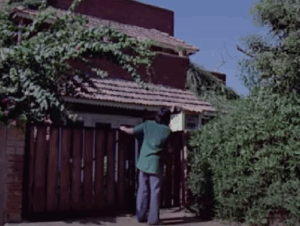
Though Neha is shown to live within walking distance from the three men, Paranjpye takes certain spatial liberties. Neha’s house, described by the filmmaker in her autobiography as a “neat little doll’s house, complete with a garden”, was actually located in Vasant Vihar, which is around 11 km from Defence Colony. Neha’s home, with its quaint garden and lived-in warmth, becomes an emblem of domestic order, which provides an aesthetic and spatial contrast to the chaotic masculine energy of the barsaati.
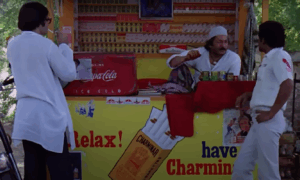
The local paan shop run by Lallan Mian, where the three young men frequently stop to buy cigarettes on credit, stands out as a vital everyday setting in Chashme Baddoor. More than just a shop, it functions as a key social node – what urban sociologist Ray Oldenburg famously terms a “third place”: not home, not work, but an informal, accessible space where community life naturally unfolds. Reflecting on the disappearance of such spaces, Oldenburg notes, “What suburbia cries for are the means for people to gather easily, inexpensively, regularly, and pleasurably — a ‘place on the corner,’ real life alternatives to television.” For the boys, Lallan Mian’s paan shop offers just that: a social anchor where they can flirt, brag, withdraw, or simply listen in. Over time, Lallan Mian himself becomes something of a paternal presence. It reminds us of a Delhi that belonged to its people, before the rise of concrete overpasses and market-driven development pushed intimacy to the margins.
The location of the paan shop holds no less significance: Nizamuddin started as a humble town outside the imperial city, which was renamed Nizamuddin following the death of the Sufi saint Hazrat Nizamuddin Auliya in the 14th century. (Snyder 2010) His mausoleum – later complemented by Amir Khusrau’s tomb and Humayun’s Tomb – became a revered pilgrimage site. After his death, his tomb catalyzed the growth of the surrounding basti, initially housing shrine caretakers and later Muslim migrants.
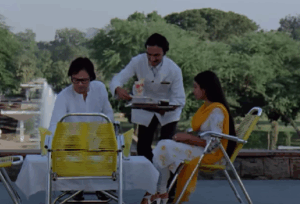
Siddharth and Neha enjoy carefree motorcycle rides across the city. These leisurely scenes wind through the calm, tree-lined stretches of Lutyens’ Delhi, which emerged after the 1911 decision to move India’s capital from Calcutta to Delhi. It introduced expansive avenues, monumental classical-style government buildings, and lush garden-city planning centering on Rashtrapati Bhavan atop Raisina Hill. Among the notable places they visit is the café in Talkatora Garden, an eighteenth-century royal pleasure garden. Neha’s predictable choice of Tutti Frutti and Siddharth’s preference for plain coffee become small rituals of their budding romance. In the calm of the garden, the couple talks about their future, reflecting the modest romantic ideals typical of Delhi’s middle-class life.
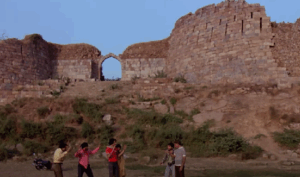
One of the film’s most memorable climaxes unfolds at Tughlaqabad Fort, where a fake Bollywood-style kidnapping spirals into real confusion. Jai and Omi’s plan for Siddharth to heroically rescue Neha unravels when she actually goes missing. The ensuing chase with intense background music, tyre close-ups, and toy guns mimics action tropes only to mock them. The fort’s majestic ruins provide a dramatic contrast to the farcical events, turning a historic site into a playground for satire. Paranjpye parodies the exaggerated theatrics of mainstream cinema. However, instead of glorifying the lone male hero, Paranjpye disperses agency across multiple characters, undermining the machismo of typical cinematic resolutions and re-centers the narrative on collective effort and community humour. (Tholia & Singh 2022) This mockery of the typical Bollywood tropes is also visible in the scene where the duo, despite their critique of Bollywood song clichés, break into song and dance around bushes. Unlike typical abrupt cuts in Hindi films, Sai Paranjpye lets the scene play out, revealing a crowd gathered in the park watching and mocking them. (Tholia & Singh 2022)
Gender and Mobility

In The Shape of Life, Bakshi examines an interesting angle: how Chashme Baddoor subtly challenges Delhi’s patriarchal spatial order through Neha’s confident movement across domestic, semi-public, and public spaces. As a Chamko detergent saleswoman, Neha’s door-to-door mobility places her within a terrain where visibility often codes women as ‘available’ or morally suspect. This has been shown by Paranjpye through Omi and Jai, who, according to Bakshi, exhibit “hegemonic masculine traits”. They perceive women on the streets as ‘available’ or in their own terms “shikaar” or prey, and exhibit predatory behaviour. Critiquing this, Bakshi shows how the spatial practices of these men normalize the objectification of women in public life. Elizabeth Wilson (2001) historicizes this anxiety, arguing that “the very presence of unattended – unowned – women constituted a threat both to male power and a temptation to male ‘frailty’.” Similarly, Debashree Mukherjee notes that the modern woman in the city was mobile, visible, and ambiguous which collapsed distinctions between a journalist, a worker, and a sex worker, inciting discomfort in patriarchal imaginaries (Mukherjee 2020, p.29). Paranjpye places Neha within this tension but refuses to frame her as a threat or a victim. Instead, her mobility is mundane yet radical.
Conclusion
Seen alongside Sparsh or Katha, Chashme Baddoor reinforces what has always marked Sai Paranjpye’s cinema: an attentiveness to the small, the quiet, and the off-centre. Her films rarely hinge on high drama or resolution; instead, they are structured around the everyday mechanics of care, misunderstanding, humour, and vulnerability. If Katha plays out in the congested gullies of Mumbai’s chawls, then Chashme Baddoor unfolds in the barsaati of Delhi. In doing so, Paranjpye offers a model of storytelling where space matters not because of what it symbolizes, but because of how it functions in the background of ordinary lives.
References
1. Bakshi, S. (2023). The Shape of Life: Reading Space in Sai Paranjpye’s Cinema.
2. Bakhuni, T. (2021). Delhi, Summers & Hindi Cinema: Chashme Buddoor (1981). zikredilli.com. Retrieved July 05 2025. https://zikredilli.com/f/delhi-summers-hindi-cinema-chashme-buddoor-1981
3. Chhabra, A. (2021). In Sai Paranjpye’s Chashme Baddoor, a love letter to the Delhi of my memories. www.firstpost.com. Retrieved July 05 2025. https://www.firstpost.com/entertainment/in-sai-paranjpyes-chashme-baddoor-a-love-letter-to-the-delhi-of-my-memories-9826011.html
4. Embankment at Talkatora Garden. archaeology.delhi.gov.in. Retrieved July 06 2025. https://archaeology.delhi.gov.in/archaeology/embankment-talkatora-garden
5. Harrison, J.P. (2008). “Sympathetic Miracles” in Gardens: An Essay on the Human Condition, The University of Chicago Press, Chicago and London, 2008, p. 130.
6. Joshi, R. (2005). BARSAATI BLUES – An upwardly mobile guide to surviving the Delhi summers. www.telegraphindia.com. Retrieved July 05 2025. https://www.telegraphindia.com/opinion/barsaati-blues-an-upwardly-mobile-guide-to-surviving-the-delhi-summers/cid/1023227
7. Kayatekin, C. (2025). Historic Preservation, Complexity, and the Shadow of Monumentality: The Case of Lutyens’ Delhi. ARCHive-SR, 9(1), 38-48. 8. Lefebvre, H. (1991). ‘The production of space’ (D. Nicholson-Smith, Trans.). Oxford: Blackwell. (Original work published 1974)
9. Oldenburg, R. (1997). Our vanishing third places. Planning commissioners journal, 25(4), 6-10.
10. Pallasmaa, J. (2012). The existential image: Lived space in cinema and architecture. Phainomenon, 25(1), 157-174.
11. Snyder, M. (2010). Where Delhi is Still Quite Far: Hazrat Nizamuddin Auliya and the Making of Nizamuddin Basti. Columbia Undergrad J South Asian Stud, 1-29.
12. Tholia, S. & Singh, A. (2022). Recontextualizing the Cinematic Code: The “Female Gaze” of Sai Paranjpye in Sparsh, Chashme Baddoor, and Katha. Open Cultural Studies, 6(1), 113-126.