

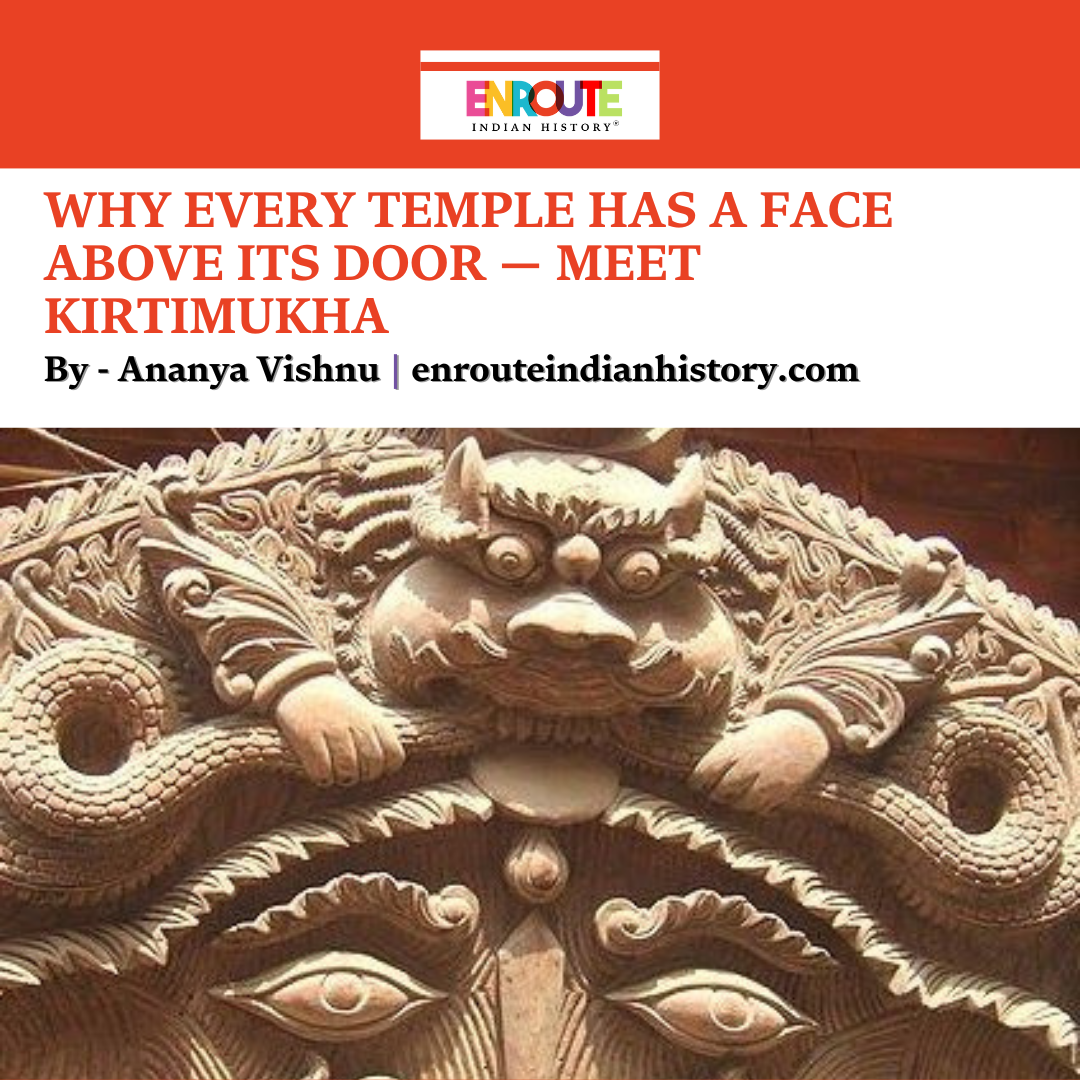
By Ananya Vishnu
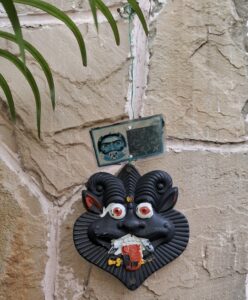
Kirtimukha motif photographed by the author.
It greets you at doorsteps, stares from above truck windshields, and swings from yarn tassels on buses, yet few pause to notice it. The fierce, grinning face often seen above Indian homes or on the front of trucks, especially in Punjab, is more than just a decorative or superstitious symbol. Known widely today as a Nazar Battu to ward off the evil eye, this motif traces its roots deep into ancient Indian mythology and temple architecture.
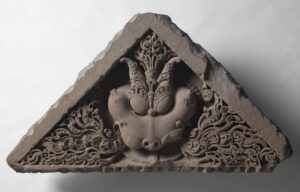
Pediment with the Face of Glory, c.1000s, Northern India
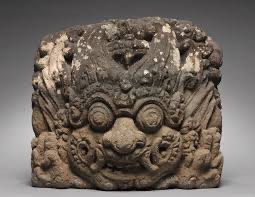
Kala-mukha, c. 12 -14th century CE
Unmasking the mask: What is Kirtimukha?
Kirtimukha is commonly translated as the “Face of Glory,” combining kirti (meaning glory or reputation) with mukha(meaning face). However, the term kirti carries multiple renditions across Sanskrit and Pali literature. In texts like the Chandogya Upanishad and Digha Nikaya, it denotes fame or achievement, where a great being’s kirti—their eminence—precedes them into both worldly and spiritual realms. In other texts such as the Mahabharata, kirti is associated with sound or atmospheric presence, suggesting a more abstract or cosmic quality. Kirti can also refer to tangible, often sacred, structures—such as Buddhist cave temples. In this architectural sense, V.S. Agrawala proposed that kirti once signified an excavated chaitya-hall, and then a temple or the palace, while kirtimukha referred specifically to the entrance or opening through which the excavation began, earliest use in this sense is supported by a copper plate inscription found in Kanheri 493 CE. This early meaning likely evolved over time into the symbolic guardian face we see today (Sarker, 2020).
Mention of the mukha can be found in a wide array of Indian literature. The first graphic representation of the Kirtimukha appears in the Skanda Purana. This ancient text, along with the Shiva Purana, provides various legendary accounts of its creation. Beyond these, texts like the Pampa Bharat by the 10th century Kannada poet Adikavi Pampa and the 12th century Ramachandra Charita Puranam of the Jain Poet, Nagachandra Kavi too refer to the grotesque mask (Uddin, 2019).
Tales of Origin
In Shaivite traditions, the motif originated from a moment of divine wrath. When a powerful demon demanded Shiva’s consort, the god responded by releasing a blazing energy from his third eye, which manifested into a lion-headed, hunger-driven being. As the demon sought mercy from Shiva, the god was obliged to protect him, leaving the monstrous entity without a prey. To resolve this, Shiva ordered it to feed on itself. The creature obeyed, devouring its own body until only its face remained.
Impressed by this act of submission and self-sacrifice, Shiva named it Kirtimukha and ordained that it would eternally guard the entrances to his temples as a symbol of divine power, self-control, and protection.
A tale from the Chandogya Upanishad tells of a benevolent king whose fame shone so brightly that even birds flying at night felt as if it were day. This story links kirti to fame, light, sound, and divine recognition. Kirti is said to precede a person into the afterlife, announcing their merit to the gods (Jain, 2018).
Early Appearances
Among the earliest archaeological examples of the Kirtimukha, is a carving on the Bodhgaya railing from around the 3rd century CE. This depiction showcases a circular, grinning face with eyebrows and a mustache resembling foliage, a motif that has remained an essential characteristic. The Kirtimukha’s presence became widespread and common from the Gupta period onwards, demonstrating its continuous adoption across India. In Chalukya temples, it often crowns the images of deities (Srinivasan, 2019). Its repeated appearance in the Ajanta and Ellora caves and numerous examples of temple architecture in South India, such as the Badami caves, solidified its role as a pervasive decorative and symbolic motif.
Pan-India Guardian
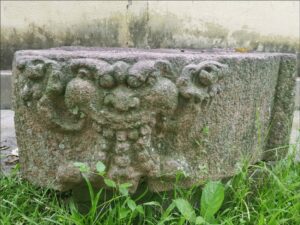
Kirtimukha on an architectural component of a temple, Rajbari, 11th century CE.
Grotesque, jawless, and perpetually hangry— not a very convincing persona, yet the motif spread across the subcontinent, adapting regionally and acquiring diverse names. In Gujarat, it’s called Grassmukha, with rows of these faces on temple base mouldings known as Grasspattika, seen in early Solanki temples. It’s also recognized as Vanaspati in Assam, linking it to nature and fertility. In Assam’s Kapili-Jamuna valley, remains discovered from sites like Rajbari, Na-Nath, Mikrati, Shivpur and Doboka show that it was frequently carved in low relief on massive stone blocks of temple śikhara and other sculptures. Evidently, here the motif commonly adorned the apex of steles depicting deities such as Shiva, Vishnu, Surya, and Ganesha , from the 9th to 12th centuries CE (Saikia & Das, 2021). Other renditions include Rahu-Mukharmala or Bho in Odisha and Pancha-vaktra in Bihar and West Bengal.
Beyond the Borders
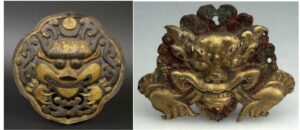
Kirtimukha, gilt metal, c.19th century CE, Tibet
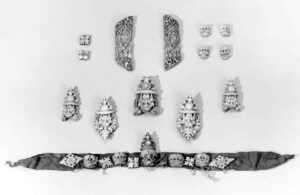
Plaque from a Tantric Ritual Apron, 17th century,Tibet
The motif of Kirtimukha originated in India and subsequently traveled to Southeast Asia and beyond, appearing in various contexts including Hindu, Buddhist, and Jain art. Evidence of Kirtimukha has been found in Bangladesh through terracotta plaques, salvaged from Paharpur Mahavihara, Naogaon. Tibetan art integrates Zeeba/ Tsipa into sacred and martial contexts. In temples, it often features jewelled friezes descending from its upper jaw, and it serves as a heraldic or protective symbol in military and spiritual iconography. Its use however, is not confined to architectural elements like lintels and cornices as the motif also appears on helmets, shields, weapons. Among the Newars of Nepal,it is known as Chepu. According to local legend, Chepu was the elder brother of Garuda and destined to be the bravest celestial being. However, due to his mother’s impatience, he was born prematurely, with only his head and hands fully formed. Post 7th century CE, the foliage spin in Chhepu gradually transformed into a horizontal crescent on the lion’s head. In Sri Lanka, a related form called Kibini is seen on temple structures.
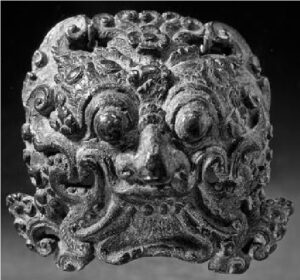
Bronze Kala Head, c. 12th century or earlier , Indonesia
In Southeast Asia, Kirtimukha plays a prominent role in sculptures. In Cambodia, especially in Angkor Wat, Kirtimukha motifs appear extensively on temple lintels and are embedded in Khmer art. In Vietnam, particularly seen at Cham sites, the masks adorn red-brick Hindu temples, often positioned to face the rising sun. In Thailand, the motif appears as Pha Rahu.
The motif is also evident in Indonesian art, where it is known as Kala-Makara in Java (Srinivasan, 2019) and Karanga-Boma in Bali (Wirawibawa et al., 2022). In Java , it acquires gigantic proportions and serves as a keystone in architecture. It is also employed in the Ramayana panels at Tjandi Panataran to separate episodes. The Balinese architectural style includes it atop the ulap-ulap above the main entrance. Here, the Kirtimukha evolved from a leonine image into a witch-like giant face as can be seen on the entrance of the 11th century hermitage of Goa Gajah at Bedu. In Japan, an iconic parallel appears as Oni and in roof architecture as Onigawara (decorative ridge-end tiles). The Korean counterpart, Gamyeon, appears in temple architecture from around 700 CE.
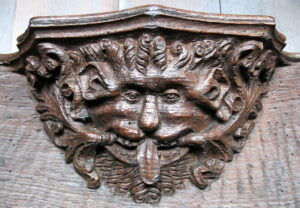
Green Man, 1390 CE, St. Botolph Church, England
Across the Western world, Kirtimukha finds visual resonance in strikingly similar forms. These include Medusa’s Mask to the Greeks and Romans, Ouroboros to the Sumerians, Green-man to the English church architecture. The Chacgod of Mayan civilization also shows similarities (Priya & Tiwary, 2020).
The Green Man iconography, a demonic face/mask with sinister features often without a lower jaw, is believed by some scholars, to have been exported to Europe by the Vikings. This theory is supported by the discovery of two full-faced heads on artifacts from Norwegian 9th century ship burials. One is on a wooden sleigh shaft from a burial at Borre, and the second appears on a rowlock from one of the small boats belonging to the Gokstad ship. Additionally, items hinting at oriental connections were found in the Oseberg ship, such as a wooden pail known as the “Buddha bucket” due to its cross-legged figure resembling a Buddha and its decoration with swastikas, a widely used Hindu symbol. Even if the Vikings did not extensively use the motif themselves, they could possibly have played a role in introducing it to the West as merchandise from the East (McDermott, 2008).
Concluding Thoughts: Cultural Appreciation or Appropriation?
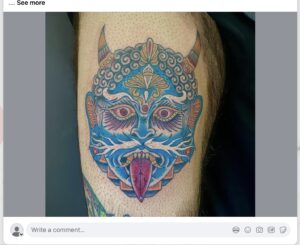
A social media post featuring the mukh.
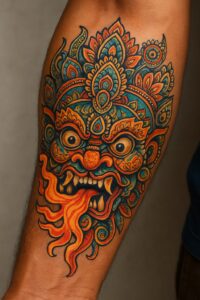
In recent years, Kirtimukha has quietly found new life not on architecture but on skin.
The motif has made its debut into the tattoo industry , often detached from its cultural and religious significance. On social media, one can come across posts featuring individuals—often with no known connection to South Asia—displaying the iconic face inked onto arms, backs, or even legs. Presented as a fierce or “cool” design, Kirtimukha is admired for its bold and intimidating presence, yet the deeper story behind the symbol—its mythic origin, spiritual role, and protective power—is rarely mentioned, let alone understood. Divorced from its sacred and symbolic origins, it is reduced to its mere aesthetic value – a conveniently planned and selective erasure of the cultural roots or just innocent appreciation?
This kind of casual adoption speaks to a larger pattern of cultural amnesia. South Asian iconography, like many other non-Western traditions, is increasingly consumed in fragments, reduced to visuals that can be worn, posted, repackaged and branded, without context or care. In such moments, we must ask: How much of our cultural heritage are we willing to let go before someone else decides what it means?
References
1. Wirawibawa, I.B.G., Putra, I.D.G.A.D. and Aritama, A.A.N., 2022. Exploring Socio-Cultural Identity: Characteristics of the Architectural Design of Kori Agung Bangli. Journal of Social and Political Sciences, 5(1), pp.50–59. doi: 10.31014/aior.1991.05.01.335.
2. Saikia, M. and Das, P., 2021. Kīrtimukha in the Art of the Kapili-Jamuna Valley of Assam: An Artistic Survey. Ancient Asia, 12(2), pp.1–15.
3. Sarker, A., 2020. The Kirtimukha in Ancient Indian Art and its Association with the ‘Grotesque’. The Chitrolekha Journal on Art and Design, 4(2), pp.1–12. doi: https://dx.doi.org/10.21659/cjad.41.v4n203.
4. Jain, A., 2018. Significance of Kirtimukha Symbol in South Asia, South-East Asia, Artistic Narration. Vol. IX(2), pp.28–33.
5. Uddin, M.S., 2019. Kirtimukha Represented in Pre-Medieval Terracotta Plaques of Bangladesh. Pratnatattva: Journal of the Department of Archaeology, Jahangirnagar University, 25, pp.139–142.
6. Swart, P., n.d. A Legacy of Cham Royal Worship: The Đà Nẵng Museum of Cham Sculpture.
7. Srinivasan, S., 2019. Analyzing the Impact of Indian Architecture on the Architecture of Cambodia, Thailand and Indonesia. International Journal of Architectural and Environmental Engineering, 13(5).
8. MacDermott, M., 2008. Explore Green Men. 2nd ed. Photographs by Ruth Wylie. Heart of Albion Press. ISBN: 978-1-872883-946.
9. Franklin, G.L., 2020. Patterns of Home: Religious Art and Traditional Design in Punjabi and American Truck Decoration. XXIII Generative Art Conference – GA2020.
10. Priya, N. and Tiwary, S.K., 2020. Tracing the Origin and Antiquity of Kirtimukha Motif: Finding Iconic Parallels. Heritage: Journal of Multidisciplinary Studies in Archaeology, 8(2), pp.1030–1040.
Images:
1. Sarker, A., 2020. The kīrtimukha in ancient Indian art and its association with the ‘grotesque’. The Chitrolekha Journal on Art and Design, 4(2). doi: 10.21659/CJAD.41.V4N203.
2. Cleveland Museum of Art, 1100s–1300s. Architectural Sculpture: Face of Time (Kala-mukha). Available at: https://www.clevelandart.org/art/1975.104 [Accessed 3 July 2025].
3. Cleveland Museum of Art, c. 1000s. Pediment with the Face of Glory (Kirti-mukha). Available at: https://www.clevelandart.org/art/1988.102 [Accessed 3 July 2025].
4. The Metropolitan Museum of Art, n.d. Architectural Ornament with Face of Glory (Kīrtimukha). Available at: https://www.metmuseum.org/art/collection/search/44645 [Accessed 3 July 2025].
5. Tiwary, S.K. and Priya, N., 2020. Image of Kirtimukha motif , in: Tracing the Origin and Antiquity of Kirtimukha Motif: Finding Iconic Parallels. Heritage: Journal of Multidisciplinary Studies in Archaeology, 8(2), p.1036. Available at: https://www.heritageuniversityofkerala.com/JournalPDF/Volume8.2/63.pdf [Accessed 3 July 2025].
6. Saikia, M. and Das, P., 2021. Kīrtimukha on architectural component of a temple, Rajbari, c.11th century CE, in: Kīrtimukha in the Art of the Kapili-Jamuna Valley of Assam: An Artistic Survey. Scientific figure on ResearchGate. Available at: https://www.researchgate.net/figure/Kirtimukha-on-architectural-component-of-a-temple-Rajbari-c11-th-century-CE_fig1_350073945 [Accessed 3 July 2025].
7. Norton Simon Museum, n.d. Architectural Element with Face of Glory (Kirtimukha). Available at: https://www.nortonsimon.org/art/detail/P.2000.07.2 [Accessed 3 July 2025].
8. Black Poison Tattoos, n.d. Kirtimukha Tattoo Meaning, Symbolism & Tattoo Art. Available at: https://blackpoisontattoos.com/kirtimukha-tattoo-meaning-symbolism-tattoo-art/ [Accessed 3 July 2025].