
By Prishnika Mazumdar
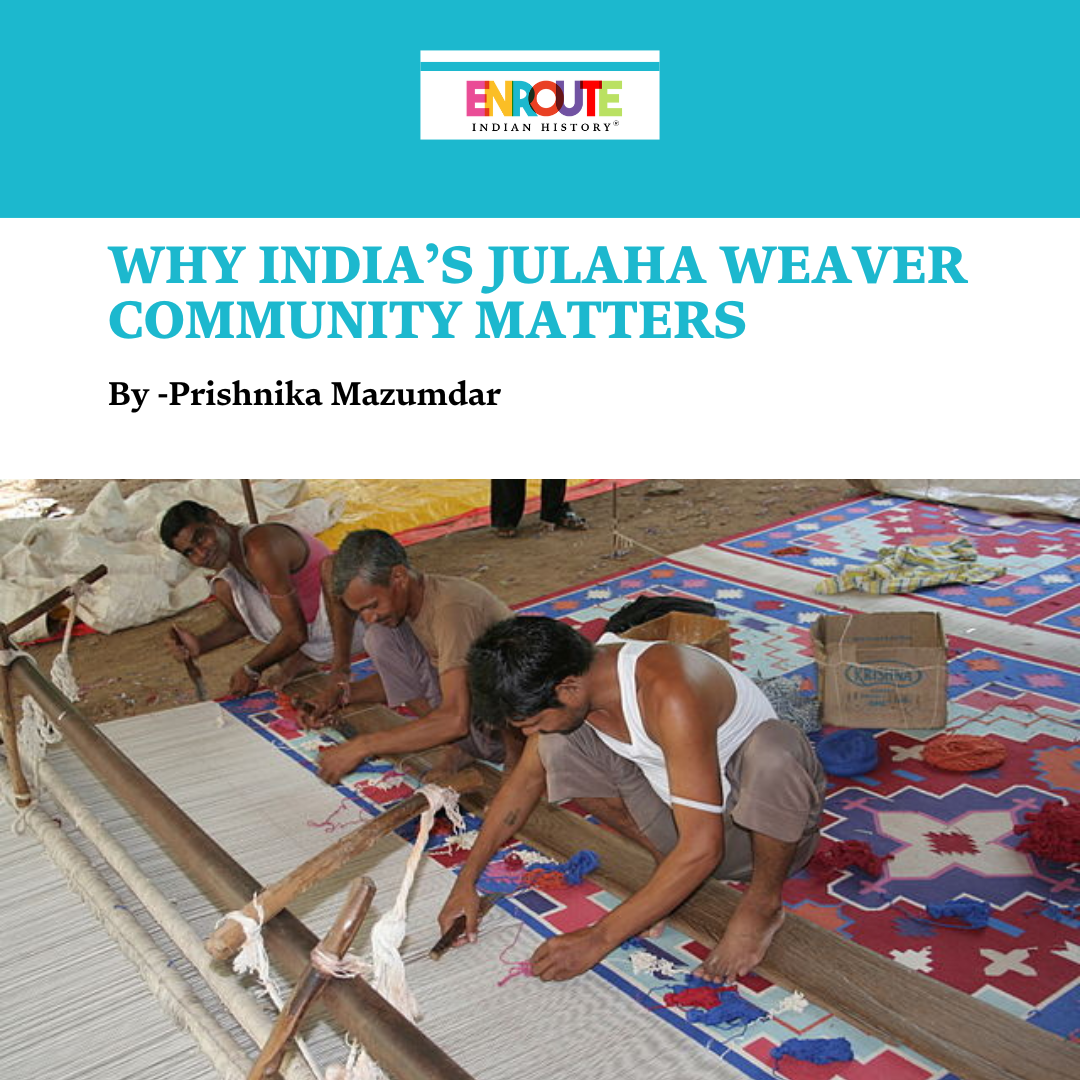
The weaving communities of India constitute the backbone of its historically rich textile industry, with communities such as the Julahas, Padmashalis, and Devangs among many others sustaining local economies through handloom work. Among these, the Julahas, primarily Muslim weavers concentrated in North India, have long been associated with cotton weaving, often facing marginalisation due to the low caste status traditionally assigned to artisanal occupations (Bayly, 1999). In this article, we will focus on the identity formation of the Julahas. Herein, we will observe the perceptions that developed about them, their self-identification and the complications that emerge from such perceptions. For us, it is important to understand the Julahas because identity, discrimination and recognition continue to shape the political and social realities of our times as well.
Who are the Julahas?
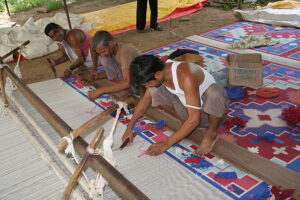
The word Julaha is likely to be of Persian origin, in Persian, Julah means ‘weaver,’ which in turn comes from jula or a ‘ball of thread’ (Pandey, 1983). This community is mostly found in Punjab, Haryana and Delhi, some are spread across other states as well, including Rajasthan, Uttar Pradesh, Uttarakhand, Himachal Pradesh, Jharkhand, Bihar, Jammu and Kashmir, and Maharashtra. The word Julaha, in fact, is often used as an umbrella term for weavers at large (Lamba, 2018). As a by-product of the Julahas being spread over a vast area, there developed immense diversity among them. There were Koli-Julahas, Chamar-Julahas, Mochi-Julahas, Ramdasi-Julahas and many more. It is likely that after a few generations, the members of this community dropped the prefix which suggested their low origins to become Julahas, short and simple (Rose, Ibbetson and Maclagan, 1911).
Caste hierarchies were an important part of the equation for both Hindu and Muslim Julahas. The Persian word julah, a ball of thread, finds its Hindi equivalent in the term Tánti, which is the highest occupation generally open to the outcast section of the Hindu community (Rose, Ibbetson and Maclagan, 1911).
Differences among Muslims become apparent in terms of status and occupational groups. This is visible in the differences between and within two groups; the first group of “forward castes” includes the titles of Sayyid, Shaikh, Mugal, and Pathan, and the second set of Muslims is described as biradaris (brotherhood, kinsfolk, or community). Julahas are situated in the latter category (Gottschalk, 2005).
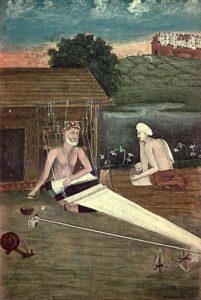
Most of us are familiar with Sant Kabir, the mystic poet of the 15th century. Kabir is said to belong to this community of weavers. Over time, most of the Hindu Julahas professed to follow him and called themselves Kabirbansis or descendants of Kabir (Rose, Ibbetson and Maclagan, 1911).
Stereotypes associated with the Julahas
In 19th-century India, stereotypes sought to attach the name to the Arabic Juhala, meaning the ‘ignorant class’, with the Julahas. This would bring them in line with popular ideas about weavers’ stupidity. Such ideas of intellectual inferiority developed for reasons of devaluation of manual labour and broader stereotypes encouraged by caste prejudice and colonialism (Pandey, 1983).
Julahas themselves argued that the word came from jal, meaning net, or jils, meaning decorated or ujla, that is ‘lighted up,’ or ‘white.’ Perhaps from here, the word nurbaf or ‘weavers of light’ emerged, which many of the weavers used for themselves (Pandey, 1983) .
Historian Gyanendra Pandey suggests that by the end of the 19th century, the idea of the bigoted Julaha had been firmly established. Writing in 1896, William Crooke in his Tribes and Castes of North Western Provinces and Oudh Vol 1 declared, “The Julaha generally bears the character of being cowardly, pretentious, factious and bigoted.” Such a reputation for bigotry was fuelled by their participation in sectarian strife that disturbed different parts of the subcontinent in the 19th century. Take, for example, Banaras and Ayodhya, where the bloodiest riots materialised in 1809 and 1856, respectively. In these places, the Julahas (of the Muslim community) were actively involved on the Muslim side (Pandey, 1983).
These disturbances were related to the tensions generated by the rapid and unpredictable shifts that were taking place in the social, economic and political conditions of the time. Power was being appropriated by the colonial authority, and there was social and economic dislocation as a result of colonial penetration. This stress contributed to the widespread agitation among the weavers. For example, during the ‘cotton famine’ of the early 1860s, many weavers in parts of northern and central India had to leave their looms in large numbers. They were forced to work with pickaxes and shovels or move to distant places and cities to find jobs (Pandey, 1983).
Besides, as a result of economic distress, there was migration to the industrial belt of the eastern and later the western regions. This, however, was forced migration of largely individual men. Such migration had a temporary character in most cases and brought tremendous stress to the local communities. It is in this context of strain that their participation in communal tensions materialised (Pandey, 1983).
While we note the complications of Julaha identity, we should remind ourselves that similar stereotypes extend to other communities. In addition to the bigoted Julaha, there was the martial Rajput, the industrious Jat, the criminal Pasi and the turbulent Ahir among others. This is related to the Orientalist vision of an Indian whose primitive religiosity bound him to superstition and instinct. This is also related to the idea of the Orient being languid and unchanging at large. Such perceptions rob places and people of their history and reduce them to ‘essential types.’ Qualities of being corrupt and unprincipled were attributed to an overwhelming majority of Oriental peoples. Such ideas of essential fanaticism of the Indian people were then used to explain imperialist presence (Pandey, 1983).
Road to Recognition
To improve their social standing, many Julahas changed their titles. They abandoned the title Julaha for Ansari and Momin. The former comes from Ansar, Prophet Muhammad’s name for the believers, the first community to adopt Islam outside his native Mecca. The latter has a similar meaning and is used to refer to faithful believers in the Quran (Gottschalk, 2005).
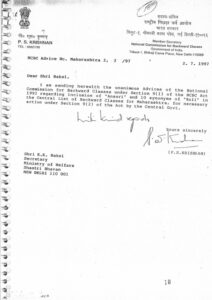
After independence, the situation began to change. To undo the historical injustice suffered by the Julaha community, they were placed in the Central List of Backward Classes. Initially, however, the list failed to recognise those Julaha groups which had changed their titles. Therefore, requests for inclusion began to emerge (National Commission for Backward Classes, 1997).
One such case was placed before the Maharashtra Bench of the National Commission for Backward Classes in 1997. This case arose from the request of the Ansari Welfare Society, 3/11, Noorani Chawl, 107-C M. Azad Road in Mumbai for the inclusion of ‘Ansari’ as a synonym of ‘Julaha’ and ‘Momin.’ In the hearings, it was realised that the Ansaris were indeed a subcaste of the Julaha community who took up the title of Ansaris to escape contempt, hatred and disrespect. They were then added to the Central List of Backward Classes for Maharashtra (National Commission for Backward Classes, 1997). Other than Maharashtra, states such as Uttar Pradesh, Gujarat, and Madhya Pradesh include the Ansaris in their respective lists.
The Julahas, from their association with the handloom industry to the burdens of caste-based and colonial stereotypes that labelled them as backward or bigoted, their identity came to be shaped by their resistance against stereotypical perceptions and internal adaptations. Economic crises like the ‘cotton famine’ pushed them into distress migration and exacerbated their vulnerabilities, which in turn influenced their participation in the social and communal tensions of the time. Yet, despite historical disadvantages, the Julahas, under various titles like Ansari and Momin, have strived to reclaim their dignity and recognition. Their inclusion in the list of Backward Classes in many states has enabled a shift towards the acknowledgement and correction of systemic injustice. The fight for recognition of the Julahas is far from over, as many still face forms of social discrimination tied to their occupational and caste identity. In several states, groups like the Ansaris and Momins continue to be excluded from official lists of Backward Castes (Press Information Bureau, 2010).
References
Pandey, G. (1983) The Bigoted Julaha. Economic and Political Weekly, 18(5), pp. PE19–PE28. Available at: JSTOR (Accessed: 12 June 2025).
Lamba, N. (2018) ‘The handloom communities of India’, The Statesman, 7 August. Available at: The Statesman (Accessed: 12 June 2025).
National Commission for Backward Classes (n.d.). National Commission for Backward Classes. [PDF] Archived on 19 August 2019. Available at: https://web.archive.org/…/addmh2.pdf (Accessed: 14 June 2025).
Gottschalk, P. (2005) Beyond Hindu and Muslim: Multiple Identity in Narratives from Village India. Oxford: Oxford University Press. ISBN 9780199760527.
Rose, H. A., Ibbetson, D. C. J. & Maclagan, E. D. (1911) A Glossary of the Tribes and Castes of the Punjab and North‑West Frontier Province. Based on the Census Report for the Punjab, 1883 and 1892. Lahore: Government Printing Press.
Bayly, S. (1999). Caste, society and politics in India from the eighteenth century to the modern age. Cambridge: Cambridge University Press.
Press Information Bureau (2010). OBC reservation to Muslim minorities. Press Information Bureau, Government of India, 24 August. Available at: https://www.pib.gov.in/newsite/PrintRelease.aspx?relid=76106 (Accessed: 16 June 2025).
Image Sources
Wikimedia Commons (2014) Representative image of Weavers of India. Available at: https://commons.wikimedia.org/w/index.php?search=weavers+of+india&title=Special%3AMediaSearch&type=image (Accessed: 16 June 2025).
Wikimedia Commons (2011) 1825 Painting of Sant Kabir with a Disciple. Available at: https://commons.wikimedia.org/wiki/File:Kabir004.jpg (Accessed: 16 June 2025).
National Commission for Backward Classes (n.d.) First page of National Commission for Backward Classes Recommendation. Available at: http://ncbc.nic.in/Writereaddata/addmh2.pdf (Accessed: 16 June 2025).