
By Ananya Vishnu
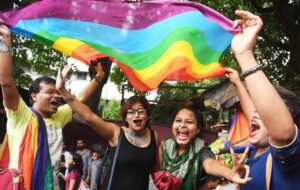
The Indian Supreme Court’s decision to strike down a law criminalizing same-sex conduct brings a wave of happiness.
For generations, India’s LGBTQIA+ community has navigated a landscape marked by systemic injustice, social invisibility, and state-sanctioned persecution. While landmark legal victories in recent years – notably the decriminalisation of consensual same-sex relations and the recognition of a “third gender”– offer hope, the deep roots of this oppression lie firmly in India’s colonial past (Malik & Dabral,2024). The pervasive discrimination faced by queer Indians today is not an indigenous development but a direct consequence of laws and moral codes imposed by the British Empire,that systematically undermined the subcontinent’s historically fluid conceptions of gender and sexuality.
India possesses a rich tapestry of traditions that acknowledged and often revered non-binary and alternative gender identities long before colonial contact. The enduring cultural and social presence of Hijra communities, often associated with ritual blessings, mythological figures like Shikhandi in the Mahabharata, and Ardhanarishvara (the half-male, half-female form of Shiva),generous patronage of eunuchs byMughal Empire in the 15th to 19th centuries, attest to a pre-colonial framework where gender and sexuality existed on a spectrum. The British Raj, however, arrived armed with a rigid Victorian worldview that demanded conformity. This imported morality, steeped in Christian theology and emerging pseudo-scientific classifications of “deviance”, sought nothing less than the moral re-engineering of Indian society. Gender variance and same-sex love were recast not as facets of human diversity but as criminal acts, moral failings, and threats to the social order. This ideological assault was institutionalised through two particularly pernicious laws: Section 377 of the Indian Penal Code (1861) and the Criminal Tribes Act (1871).
The Imposition of Victorian Morality: Section 377
The criminalisation of homosexuality under Section 377 cannot be divorced from its Western origins. British law drew heavily from Christian doctrine, particularly the condemnations found in the Book of Leviticus, which labelled same-sex acts as abominations (Sanders, 2009). This theological foundation manifested legally in England as early as the Buggery Act of 1533, criminalising “the detestable and abominable Vice of Buggery”. This framework viewed certain sexual behaviours especially homosexuality as synonymous with heresy and sin, demanding severe punishment (Hepple, 2012).
By the 19th century, Victorian England had elevated sexual regulation to an obsession. Sexuality was confined strictly to the purpose of reproduction within heterosexual marriage. Any deviation was pathologised, categorised as “unnatural” and “deviant” (Han & O’Mahoney 2014). This era saw the rise of “scientia sexualis,” where medicine and law colluded to define and control sexual behaviour. It was within this suffocating atmosphere that Lord Macaulay drafted Section 377 for the Indian Penal Code in 1861. The law, prohibiting “carnal intercourse against the order of nature,” cloaked in the language of morality, served as an instrument of quiet domination. Crucially, its primary target became consensual same-sex relations between adults.
Section 377 was a foreign imposition. It found no resonance in India’s diverse pre-colonial legal or cultural traditions. While specific practices varied regionally, the blanket criminalisation of homosexuality was alien. Even the Napoleonic Code in France, decriminalised private homosexual acts between consenting adults, unlike the British colonial policy which actively exported and entrenched punitive laws across its empire. Section 377 became more than just a statute; it was a powerful symbol of state-sanctioned stigma, legitimising societal prejudice and enabling constant surveillance and harassment of queer individuals. It declared their very existence, their capacity for love and intimacy, as inherently criminal.
Targeting Tradition: The Criminal Tribes Act and Hijras
The colonial assault extended beyond same-sex relations to encompass gender non-conformity itself. Hijra communities, with their long-standing socio-religious roles in blessing newborns and newlyweds, found themselves specifically targeted by the Criminal Tribes Act of 1871. This draconian legislation labelled entire communities, including Hijras, as “habitually criminal” by birth. The Act mandated the registration of Hijras, restricted their freedom of movement, banned their traditional performances and means of livelihood, and severed vital kinship structures by prohibiting adoption and inheritance (Ghosh, 2022).
The colonial gaze viewed Hijras through a lens of profound misunderstanding and revulsion. Their visible presence in public life, integral to their cultural identity and social function, was wilfully misinterpreted as sexual solicitation and a corrupting influence on public morality. British administrators ignored centuries of indigenous acceptance and the Hijras’ own complex social structures and spiritual significance. Instead, they reduced them to caricatures of criminality and sexual deviance, systematically dismantling their social standing and economic survival. The The Criminal Tribes Act was more than a legal instrument—it was a calculated assault on identity. By branding entire communities as inherently deviant, it transformed cultural difference into criminality, turning centuries-old ways of life into evidence of.
“Oriental Vice” and the Tools of Control
The criminalisation of queer identities served a broader colonial purpose beyond mere moral policing. British officials and writers, like Richard Burton and George MacMunn, propagated lurid narratives depicting South Asia as a hotbed of “oriental vice”, particularly sodomy (Ghosh,2022). Homosexuality, which existed naturally within various pre-colonial Indian contexts – from royal courts to Sufi circles – was deliberately reframed as evidence of inherent moral degeneracy and effeminacy among the colonised population. This racist rhetoric served a dual purpose: it justified the brutal suppression of queer lives under the guise of civilising a ‘backward’ society, and it reinforced the supposed racial and moral superiority of the British rulers. The imposition of Victorian sexual norms was, therefore, a calculated tool of political domination and racial control, integral to the colonial project of subjugation.
The struggle for LGBTQIA+ rights in India is fundamentally a struggle against cultural alienation in the precise sense articulated by Ngũgĩ wa Thiong’o. Colonialism violently imposed a dual alienation: first, it forced Indians into psychological distance from their own socio-cultural reality—erasing traditions like the status of Hijras, the fluid deities of Hindu-Buddhist iconography, and the documented presence of same-sex relationships in pre-colonial literature. Second, it engineered identification with externally imposed constructs, embedding Victorian sexual morality so deeply that generations of Indians internalised the lie that queerness was a ‘Western perversion’ rather than a suppressed facet of their own heritage. Section 377 was not just a law; it was a tool of epistemicide, making Indians strangers to their own historical truths.
The Long Shadow: Post-Colonial Legality and Lingering Stigma
Tragically, the shackles forged by colonialism outlasted the Raj. Independent India retained Section 377 for over seven decades. Its repeal was not a swift act of decolonisation but a hard-fought battle waged by generations of activists. The watershed moment arrived in 2014 the NALSA judgment, where the Supreme Court recognised transgender persons as a legal “third gender,” affirming their right to self-identify without medical intervention. This judgment represented a significant rupture from the rigid colonial binary system, offering legal recognition to the fluidity and diversity of gender identity inherent in Indian tradition, particularly embodied by the Hijra community.
This victory was succeeded by another crucial step, with the Supreme Court’s landmark judgment in Navtej Singh Johar v. Union of India. The Court, in a powerful affirmation of constitutional values, declared the application of Section 377 to consensual same-sex relations between adults unconstitutional, recognising it as a gross violation of the fundamental rights to equality, dignity, privacy, and freedom of expression (Mignot, 2022).
Despite these legal advancements, the colonial legacy endures with stubborn tenacity. Deep-seated prejudice, fuelled by the decades-long association of queerness with criminality and immorality, continues to permeate Indian society. LGBTQIA+ individuals face widespread discrimination, social ostracisation, family rejection, violence, and blackmail.
The legal recognition of relationships remains a critical frontier. Same-sex marriage is still unrecognised, denying couples fundamental rights related to inheritance, adoption, insurance, and next-of-kin status (Ailawadi, 2014). Transgender persons continue to battle bureaucratic obstacles and societal hostility in accessing basic rights and services. The colonial project succeeded not only in imposing oppressive laws but also in severing the connection to indigenous knowledge systems that once embraced gender and sexual diversity. The damage was cultural as much as legal.


Collection by organisation Naz as part of the Men Who Have Sex With Men Program.
Conclusion: Towards Decolonisation and Dignity
Understanding the colonial genesis of LGBTQIA+ criminalisation in India is not merely an academic exercise; it is a political necessity. The repeal of Section 377 and the recognition of transgender rights are vital milestones, but they are only the beginning of a much deeper process: the decolonisation of Indian society. This means dismantling the persistent colonial mindset that equates queerness with deviance, actively challenging discrimination in all spheres of life, and reforming laws that perpetuate inequality, such as the current marriage statutes. Echoing postcolonial expert Ngũgĩ wa Thiong’o’s imperative to “decolonise the mind”, who argued that colonialism’s deepest violence was the cultural and linguistic alienation that severed Africans from their own histories and identities, British rule in India imposed a Victorian moral framework that violently disrupted indigenous conceptions of gender and sexuality.
True liberation for India’s LGBTQIA+ community requires more than just the absence of criminalisation; it demands the positive affirmation of their identities and relationships within the fabric of the nation. This necessitates sustained social transformation driven by inclusive education, authentic representation in media and public life, and unwavering activism. The journey from criminalisation to celebration is long, but recognising the colonial roots of the injustice is the essential first step towards genuine freedom.
References
1. Han, E. & O’Mahoney, J. 2014, ‘British Colonialism and the Criminalization of Homosexuality’, Cambridge Review of International Affairs, vol. 27, no. 2, pp. 268–288.
2. Ailawadi, D. 2014, ‘Legislating (Lesbian) Sexuality: Colonial Law and Post-Colonial Impact’, Annual Review of Critical Psychology, vol. 11.
3. Ghosh, A. 2022, ‘British Policies towards Homosexuals and the Hijras in Colonial India: An Assessment’, Athena, vol. VI, pp. 60–70.
4. Malik, P. & Dabral, S. 2024, ‘The Unheard Cries of Gender Neutrality’, Indian Journal of Law and Legal Research, vol. 2, no. 7.
5. Mignot, J. 2022, ‘Decriminalizing Homosexuality: A Global Overview Since the 18th Century’, Annales de Démographie Historique, vol. 1, pp. 115–133.
6. Sanders, D.E. 2009, ‘377 and the Unnatural Afterlife of British Colonialism in Asia’, Asian Journal of Comparative Law, vol. 4, no. 1.
7. Harvard University 2024, The Third Gender and Hijras, Religion and Public Life Project, https://rpl.hds.harvard.edu/religion-context/case-studies/gender/third-gender-and-hijras.
8. Hepple, J. 2012, ‘Will Sexual Minorities Ever Be Equal? The Repercussions of British Colonial “Sodomy” Laws’, Equal Rights Review, vol. 8.
Images:
1. Trayler-Smith, A. 2009, Men are able to be themselves at a Naz drop-in centre in South Delhi, as part of the men who have sex with men program, JSTOR, [Accessed : 18 Jun.2025]
https://jstor.org/stable/community.12146173.
2. Sarkar, D. 2018, [Celebrating Pride], AFP/Getty Images. [Accessed : 18 Jun.2025]