


By Shreya Kamboj

Unlike other monuments in Delhi, the Jantar Mantar is neither a tomb nor a temple; neither crowned with domes nor decorated in intricate jaali work. It seems architecturally detached from the architectural history of the subcontinent because it lacks the ornamentation of Mughal aesthetics or the sacred iconography of Hindu temples. This monument, painted in red lime plaster, is geometric in its form and precise in its function. At first glance, it appears almost anachronistic, more Bauhaus than Baroque, more modernist than medieval. It is perhaps this architectural otherness that led Anisha Shekhar Mukherji, architect and conservationist, to describe the Delhi Jantar Mantar as an “extraordinary” form that “defies any categorisation”. (Perlus 2020)
Yet the structure begins to make sense when placed within the historical currents of the early 18th century, where political ambition, scientific interests, and epistemic contestations intersected. This Jantar Mantar in Delhi was the first of five observatories eventually constructed by Sawai Jai Singh II, the Rajput ruler of Amber, across Jaipur, Ujjain, Varanasi, and Mathura. Its construction was finished in 1724 and was located just to the south of Shahjahanabad as an intended gift to the reigning Emperor.
Over the centuries, multiple interpretive frameworks have emerged around the monument: some position it firmly within the framework of indigenous Indian astronomy; others trace its lineage to Islamic observational sciences by identifying its resemblance to the instruments and methodologies of Samarkand; and still others highlight European influences. But to isolate one influence over the others is to miss the point. This article explores questions that haunt both historians and casual visitors alike: Why here? Why then? What inspired Jai Singh to translate astronomy into stone? Why did he choose Delhi, the seat of a fading Mughal power, as the site for the first observational experiment? And crucially, how did this structure emerge as something so unprecedented in both Indian architecture and the global history of science?
Nomenclature: From Jantra to Jantar Mantar
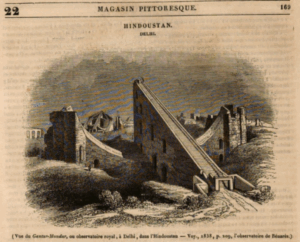
Although all five of Jai Singh’s observatories are today popularly referred to as Jantar Mantar, this name does not appear in the official records of the Jaipur state. According to V.N. Sharma, the author of Sawai Jai Singh and His Astronomy, the term consistently used in archival sources is Jantra, a Sanskrit-derived word referring to mystical diagrams or astronomical instruments. The more commonly used Jantar appears to be a colloquial variation of Jantra or Yantra, while Mantar may have been added either as a rhyming suffix, a common feature in Hindustani, or as a reference to Mantra, meaning a sacred incantation or magical words (Sharma 1995, MacDougall 1996).
Interestingly, the earliest known usage of the term Jantar Mantar for the Delhi observatory dates back over two centuries. Major William Thorn, who visited the site in 1803, records the name in his account. Based on this, it seems plausible that the phrase Jantar Mantar may have first emerged as a local term in Delhi. Over time, this local usage might have extended to the other observatories in Jaipur, Ujjain, Mathura, and Varanasi, eventually becoming the popular name for the entire set.
Historical and Political Context: Why was the Jantar Mantar at Delhi Constructed?
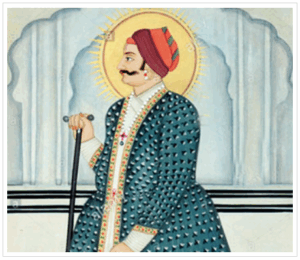
The construction of the Delhi observatory can be traced back to a ‘heated disagreement’ in the Mughal court in 1719, where the Hindu and Muslim astrologers failed to reconcile over an auspicious date for the Emperor Muhammad Shah to embark on an expedition. At the centre of this episode was Sawai Jai Singh II, who was himself deeply invested in astronomy and mathematics. He reasoned that the small size of the instruments produced inaccurate readings. And thus, the idea of building an observatory dawned on Jai Singh, who then requested Emperor Muhammad Shah to allow him to undertake the responsibility of correcting the astrological tables. (Vellu, et al. 2003)
However, what prompted the Emperor to let his subordinate build such elaborate observatories right in the imperial capital remains another interesting aspect. Jahangir saw the building plans of Jai Singh’s forbearers as a challenge to his authority. (MacDoughall 1996) Moreover, Jai Singh’s great-grandfather, Maharaja Ram Singh, had to spend almost his entire reign on duty in outposts in Assam and Afghanistan because he had antagonized the Emperor Aurangzeb, who wanted him kept out of Delhi. (MacDoughall 1996) Jai Singh’s plan for the observatory in Delhi, then, was an attempt to make himself known beyond his borders without directly contesting the Mughal authority under the cloak of science. It is also likely that the emperor also had political motives behind its approval – in a subcontinent so infused with superstitious beliefs, important events were to be strictly carried out on auspicious days. As such, with the longevity of the Empire said to depend on sacrificial rites and ceremonies, the accuracy of planetary positions became a topmost priority. (Vellu, et al. 2003) Jai Singh, in his later published work Zij Muhammad Shahi, which included a new and accurate star catalogue of 1018 stars, illustrated this point:
‘Seeing that very important affairs, both regarding religion and the administration of the Empire, depend upon these……. he represented the matter to his Majesty of dignity and power,……. the shadow of God, the victorious king Muhammad Shah. May he ever be triumphant in battle.’
This statement reveals a dual purpose: the project was meant to serve religious and administrative needs, but also provided Jai Singh with a platform to display his knowledge, discipline, and capacity to contribute to imperial stability. As a member of the solar race of Kacchawa Rajputs, Jai Singh traced his lineage to the sun god and was a descendant of Lord Rama. Thus, it was no coincidence that the man who traced his lineage to the sun god designed his most iconic instrument around its movement. The design and function of the Samrat Yantra (a massive sundial) allowed Jai Singh to link his scientific endeavour to his political identity and project himself as a ruler attuned to cosmic order, which in turn reinforced his authority both within and beyond his regional domain.
The Indigenous Framework: Siddhantas, Cosmology, and the Naked Eye
V.N. Sharma notes that Jai Singh was trained in Sanskrit treatises and mathematical works from a young age. Thus, Jai Singh’s astronomical vision was inspired by classical Indian traditions like the Surya Siddhanta and Vedanga Jyotisha, not merely in terms of the nomenclature of the instruments, but also in terms of their functions. These texts offered mathematical models for tracking celestial movements and drew on metaphysical concepts like kāla (cosmic time) and ākāśa (space). Jai Singh saw his work not as a departure from tradition, but as its refinement through empirical observation.
He was advised by Hindu astronomers like Jagannatha Samrat, Kevalarama, and Nayanasukha Upadhyaya (Sharma, 1995). His own Zij-i Muhammad Shahi begins by stressing that Jai Singh undertook the construction of these observatories with the aim of improving the accuracy of the Indian calendrical system, ensuring more reliable astronomical data to guide both religious rituals and agricultural practices that depended on exact celestial observations (Varadarajan, 2003).
The Samrat Yantra or the “Supreme Instrument” was essentially a scaled-up version of the traditional sundial forms used in India and other parts of the world to allow precise timekeeping. Though built for observation, instruments like the Ram Yantra and Jai Prakash reflect the geometry of Vedic altars. B.G. MacDougall, an architectural historian, notes that their forms have elements of Hindu fire sacrifices – like circles, squares, and semicircles symbolising earth, heaven, and space (MacDougall 1996). These design choices suggest Jai Singh subtly wove ritual symbolism into his scientific vision.
Islamicate Influences: Samarkand, Zij Tables, and Cross-cultural Precision
Jai Singh’s astronomical programme also appears to have drawn significantly from the Islamicate tradition, particularly the legacy of large-scale masonry observatories at Samarkand and Maragha, and the use of Zij-i Sultani. At least two instruments at the Delhi Jantar Mantar, the Ram Yantra and the Samrat Yantra, bear a strong resemblance to those found at the Samarkand observatory, particularly in their overall conceptual design and observational purpose. While there are differences in scale, internal structure, and surface treatment, the fundamental principles of construction align closely. (Vellu, et al. 2003) However, this has been contested by Mukherji, who argues that while these observatories are frequently cited as precedents, they did not exist in a functional state by the time of Jai Singh. (Perlus 2020) The use of zijes, tables containing planetary and trigonometric data, was consulted during the planning of Jai Singh’s observatories. Sharma confirms that Arabic and Persian treatises were translated and compared at his court. (Sharma, 1995) Overall, the Islamicate influences remained more technical rather than ideological.
European Dialogues: Jesuits, Ephemerides, and Selective Adoption
Jai Singh’s most complex engagement was with European astronomical knowledge, mediated primarily through Jesuit missionaries active in the Mughal court. One of the more prominent figures, Father Emmanuel de Figueiredo, played a key role in advising Jai Singh on mathematical and astronomical matters. Under Jai Singh’s authority, Figueiredo even led a legation to Lisbon to acquire the latest astronomical data. In exchange, Jai Singh permitted the establishment of a church for missionary activity in his territory. By 1734, French Jesuits had taken over the role, followed later by German priests who continued assisting in technical matters (Vellu et al. 2003, p. 16).
Jai Singh did not accept European knowledge uncritically. He conducted comparative studies between Indian, Islamic, and European ephemerides and identified discrepancies in the latter. Despite having access to telescopes, Jai Singh chose not to adopt them. As noted by him in Zij-i Muhammad Shahi, he based his ‘rules of computation for naked eye observations only, which, in turn, are based on earlier texts’ because ‘the telescope is not readily available to an average man’. Ultimately, the influence of Jesuits was primarily mathematical, not instrumental. While European geometry informed some design calculations, the physical forms and observational methods remained rooted in Indian and Islamic precedents
Structure of the Delhi Jantar Mantar: Materials, Construction, and Instruments
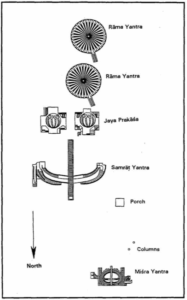
The Delhi Jantar Mantar was constructed using brick rubble masonry and surfaced with red lime plaster, a material commonly used in 18th-century Rajput construction. In parts where precision was necessary, such as along gnomons, quadrants, and scale divisions, marble was used to ensure stability and legibility. Jai Singh’s team employed traditional surveying tools such as plumb lines, water levels, and calibrated rods for levelling and alignment of the instruments. (MacDoughall 1996)
According to records by Jagannātha Samrat, Jai Singh’s chief assistant, and contemporary visitors, the Delhi observatory originally housed seven instruments. These included the Samrat Yantra, a massive triangular sundial used to calculate solar time and declination; the Jaya Prakāśa, two concave hemispherical structures for determining the altitude and azimuth of celestial bodies; the Rāma Yantra, open cylindrical structures that also measured altitude and azimuth; the Ṣaṣṭhāṁśa Yantra, which functioned like a sextant; the Dakṣiṇottara Bhitti, a vertical meridian wall aligned to track the sun’s passage at local noon; the Miśra Yantra, a composite instrument unique to Delhi that could tell local time at multiple geographic locations; and the Agrā Yantra or horizontal sundial.
Conclusion
The construction of the Jantar Mantar demanded close coordination between astronomers, mathematicians, and skilled masons. This collaboration across disciplines allowed the instruments to retain their precision and structural integrity over centuries, even after earthquakes, renovations, and the application of modern materials like sandstone relaying and cement-based paints. (Perlus 2020) But this convergence was not just logistical – it was also conceptual. The very impulse behind the observatory lay in bringing together diverse systems of knowledge. Jai Singh’s project drew from Indic cosmology, Islamic mathematical astronomy, and European computational methods, integrating them into a coherent scientific vision.
Today, the structure stands not only as a scientific site but also as a cultural monument. Its designation as a UNESCO World Heritage Site affirms its place within India’s intellectual and architectural legacy. (Shinde 2012) While it once served a practical function in calibrating calendars and determining auspicious timings, it now operates as a space for historical reflection, drawing scholars, educators, and tourists alike.
Bibliography
1. MacDougall, B.G. (1996) ‘Jantar Mantar: Architecture, Astronomy, and Solar Kingship in Princely India’. The Cornell Journal of Architecture. Pp. 16-33
2. Perlus, B. (2020) ‘Celestial Mirror The Astronomical Observatories of Jai Singh II.’ New Haven & London: Yale University Press.
3. Sharma, V.N. (1995). ‘Sawai Jai Singh and His Astronomy’. Delhi: Motilal Banarsidass Publishers Private Limited
4. Shinde, S. (2012). ‘The Astronomical Legacy of Jaipur: Analyzing the Scientific and Cultural Significance of Jantar Mantar’. International Journal of Humanities and Social Science Invention (IJHSSI), Vol 01, Issue 1. Pp. 105-108
5. Varadarajan, L. (2003). ‘Observational Astronomy in Jaipur: A Study of Jantar Mantar.’ Asian Historical Review, 15(1), pp. 44-61.
6. Vellu, I. et al. (2003). ‘Jantar Mantar: The Science of Indian Conjecture’
7. Verma, N. (2009). ‘The importance of Jantar Mantar as a UNESCO World Heritage site’. Heritage Studies Journal, 7(2), pp. 33-47.