
By Ananya Vishnu
Textiles and clothing serve as powerful registers of memory, echoing the stories of people and their origins. From 3000 BC until the 1750’s, only the indigenous Arboreum and Herbaceum plants were used to grow cotton in India. Samples found from Mohen-jo-daro were made from these plants, establishing a deep rooted legacy. Among the four species of cotton found globally, two are indigenous to Asia and Africa, collectively known as ‘old world’ or desi cottons (Desor, 2015). Within this ancient lineage, Kala cotton, a strain native to India, has recently resurfaced, capturing attention across various designer collections and sparking a profound curiosity about its re-emergence. Far from being a recent discovery, Kala cotton was once a significant component of India’s cotton export trade to Britain during the era of colonization. Its coarse, short-staple fibers, characteristic of desi varieties, were a staple. This raises compelling questions: why did such a resilient and historically important crop disappear from the industry’s radar, and what forces are driving its remarkable comeback today? This article aims to provide insight into the rise, fall, and potential resurgence of this unique and sustainable domestic cotton strain.
What is Kala Cotton?
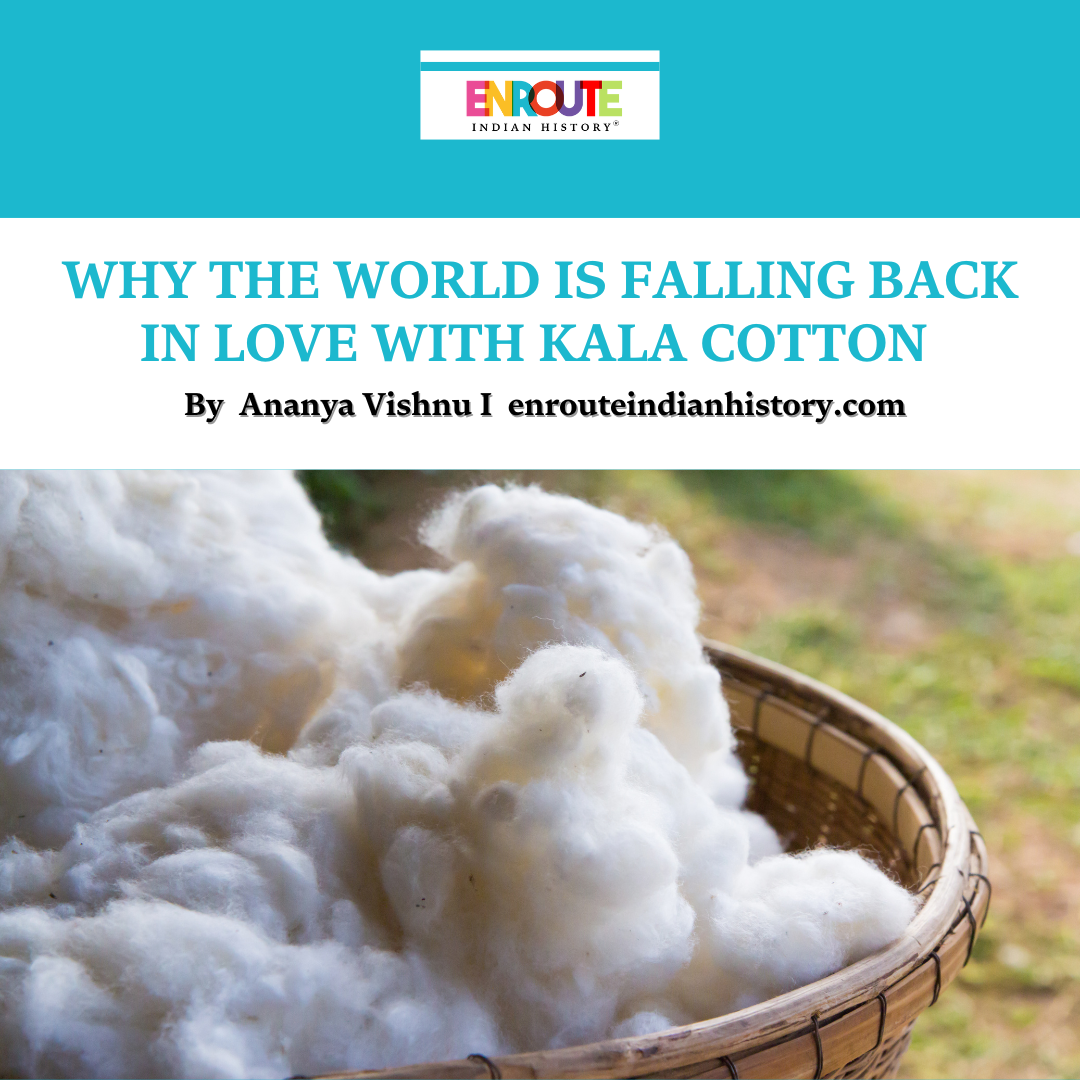
Kala cotton is an exceptionally energy-efficient and carbon-neutral crop, distinguished by its remarkable resilience, even under harsh weather conditions. It is entirely rain-fed, thriving naturally in the arid and drought-prone areas of Kutch. The name “Kala,” meaning ‘black’ in some Indian languages, often leads to a common misconception that the cotton fiber itself is black. However, this term actually refers to the empty boll left behind after the cotton fiber has been extracted. This particular strain possesses specific characteristics that have made it historically valuable and environmentally pertinent. Beyond its climatic adaptability, Kala cotton requires minimal external inputs, growing without the need for irrigation, chemical fertilizers, or pesticides. This inherent low-input demand significantly reduces its ecological footprint, making it a compelling choice for sustainable agriculture, particularly in water-stressed regions like India. Its robust nature also grants it strong resistance to disease and pests, further solidifying its status as an ecologically sound crop. Known as Rammol, or “the divine crop,” by locals, due to its ability to flourish with less than 300 mm of rainfall, Kala cotton represents a paradigm of natural sustainability in cotton cultivation (Jha, 2018).
A Legacy Interrupted:Cultivation and Decline
The cultivation of Kala cotton was once widespread across various regions of Kutch. Farmers from the Adesar region, in a meeting in 2012, recounted its historical prevalence, noting its ease of growth with minimal attention and additional cost. They traditionally stocked entire rooms with harvested cotton, using it as a vital insurance against difficult times, and the Pratharia Ahir community often sold their harvest just before baisakh ki teras, a significant day for fixing marriages. However, this extensive cultivation has now shrunk, largely restricted to certain villages in Rapar and Bhachau (Desor, 2015).
The British colonial rule in India profoundly reshaped the nation’s textile industry, effectively sowing the seeds for the ruination of the desi cotton sector. From the early 1600s until Independence in 1947, the British actively encouraged and, at times, coerced Indian farmers to cultivate long-staple cotton varieties, primarily for mass production and profit to feed their industrial mills. This directive severely disrupted the intricate and self-sustaining value chain that had existed for centuries between domestic cotton producers, local weavers, natural dyers, and traditional markets. As a direct consequence, Kala cotton output was nearly wiped out, leading to the catastrophic collapse of the homespun sector across India. Even after India gained independence in 1947, despite its inherent sturdiness, resilience, and pest resistance, Kala cotton was unjustly branded as ‘inferior’ when compared to the long-staple American and other hybrid species promoted during the colonial era. Today, roughly 96% of India’s cotton cultivation is dominated by Monsanto’s transgenic Bacillus thuringiensis (Bt) cotton, a G. Hirsutum species, while desi cotton now constitutes less than 1 percent of the national yield (Tyagi,2022).
The Vankar Community and the Cultural Tapestry of Kutch
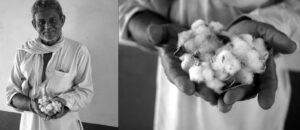
Artisan proudly shows Kala Cotton.
Kutch, serves as a stark yet vibrant backdrop for some of India’s most exquisite textiles, enriched by a broad yet syncretic community mix. Among these communities, the Vankars of Bhujodi, hold a prominent place. The Vankars in Kutch largely comprise the Marwada ethnic group, with some Maheshwaris and Gurjars, who migrated from the Meghwal community of Rajasthan approximately 500 to 600 years ago. These landless Marwadas settled alongside local pastoral communities such as the Rabari, as well as the Ahirs, Darbars, and Patels, establishing intricate relationships of economic exchange passed down through generations. While handloom weaving was initially one of several occupations, it gained increasing prominence over time as other communities came to rely on the Vankars for their clothing needs.
For generations, farming and weaving were the twin pillars of livelihood for the inhabitants of villages like Bhujodi, each practiced for half the year. However, the increasing inconsistency in monsoon patterns rendered farming unreliable, prompting a significant shift towards weaving as the primary source of sustainable income. Bhujodi, in particular, underwent a remarkable transformation. After the devastating 2001 earthquake, the resilient inhabitants of this village, home to the Vankar community, initiated ambitious revival projects. A shining example is Vankar Shamji Vishram Valji, who proudly continues the legacy of his father, Vankar Vishram Valji, recipient of the National Award in 1974 for his exemplary work in Dhabla weaving. Shamji bhai emerged as an early champion of Kala cotton and oversees Vankar Vishram Valji Weaving, a multi-generational craft initiative dedicated to the weaving and dyeing of fabrics, shawls, stoles, furnishings, and rugs using cotton and indigenous wool, providing employment to approximately ninety families. Over the past two decades, Shamji bhai has transformed this venture into a thriving business with clients both in India and abroad. His participation in international projects, such as the 2014 ‘Hand Made’ exhibit in Japan and the 2015 ‘Cotton Exchange: A Material Response’ project comparing cotton manufacture between England and India using handspun Kala cotton, significantly amplified global awareness of Kala cotton’s potential. A recipient of numerous accolades, Shamji bhai embodies a holistic approach to the preservation of heritage, skill, ecology, identity, and traditional knowledge (Kalpavriksh and Khamir, 2024).
Reviving a Heritage: Collaborative Efforts and Modern Adoption
In recent years, a concerted effort by various stakeholders has begun to reverse the tide of Kala cotton’s decline, smoothly transitioning from its historical marginalization to a significant re-emergence. The integrated endeavors of the Vankar community of Bhujodi village, its adoption by visionary fashion designers, and the tireless work of non-governmental organizations and fashion event organizers have collectively contributed to a substantial increase in awareness about Kala cotton. The consolidated impact of these initiatives has resulted in the resuscitation of a languishing cotton crop as a viable and sustainable alternative to the dominant Bt cotton.
At the forefront of this revival is Khamir, an organization deeply committed to the support and sustenance of traditional handicrafts, practices, culture, community, and local environments. Established in 2005 as a joint initiative of Kutch Nav Nirman Abhiyan and the Nehru Foundation for Development, Khamir’s genesis was a direct response to the critical situation that emerged after the devastating 2001 earthquake in Bhuj. The subsequent rebuilding efforts brought industrialization and mill employment but often at the expense of traditional cultural livelihoods. Recognizing that industrialized textile production, geared towards export markets, had caused traditional weaving practices and local partnerships to disappear, along with the cultivation of Kala cotton, Khamir initiated a three-stage strategy: initial explorations, development of a local value chain, and subsequent scaling up with financial and technical support. For this purpose, Khamir launched the Kala Cotton Initiative in collaboration with Satvik and Setu Resource and Support Centre, providing sustained support for indigenous cotton farming followed by handloom cotton weaving. The organization prioritized raw material grown locally, environmentally benign, and valuable to the community. After prolonged experimentation with spinning and weaving, the first Kala cotton products were proudly launched in 2010.
A tangible outcome of its initiative in promoting indigenous cotton is the significant increase in scale: farmers now receive a premium price, encouraging them to cultivate indigenous cotton. Higher wages and robust market support have also contributed to an increase in the number of weavers engaging with Kala cotton. However, challenges persist for large-scale revival, including the threat of inconsistent demand, plagiarism from the powerloom sector, and the substitution by cheaper non-organic cotton.
Beyond Khamir, various designers and organizations have embraced Kala cotton. Designers like Rashmi Varma, Anavila Misra amplify its appeal. International labels like Stitch by Stitch broaden its reach.Critically, India’s first Kala cotton spinning mill in Paddhar village, Kutch signals infrastructural renewal.

Kala Cotton features in high-fashion collections of Anavila Misra.
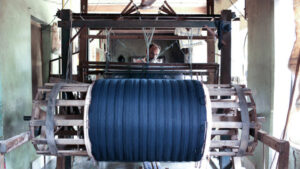
Jagdishbhai Weaver, weaving khadi denim engineered by 11.11/eleven eleven.
The Imperative for Revival: Benefits and Superiority
The compelling reasons for Kala cotton’s revival are manifold, encompassing environmental sustainability, the preservation of livelihoods, and the enrichment of India’s textile heritage. Its inherent characteristics make it an excellent organic crop for farmers to cultivate: it is entirely rain-fed, eliminating the need for irrigation, and requires no pesticides or fertilizers, making it easily sustainable and organic. This ecological advantage is particularly crucial in the present context of water scarcity in India. Farmers in Gujarat, for instance, often choose to plant Kala cotton during seasons of less rain because it thrives solely on the available rainfall and exhibits remarkable resistance to disease and pests. Beyond its cultivation, Kala cotton farmers demonstrate remarkable resourcefulness by efficiently utilizing all parts of the plant: leaves are used as livestock feed, the cotton for yarn, and stems as fuel. The inherent strength of the Kala cotton boll, which naturally nests and protects the lint from pests, further reduces the need for chemical intervention.
A comparative study in collaboration by Khamir and Kalpavrikha (an environmental action group), clearly demonstrates Kala cotton’s superior environmental footprint over genetically modified Bt cotton, revealing that Kala cotton’s footprint is nearly half that of Bt cotton. Although the short fibers are yet to be fully adapted to mill technology, hand-spun and hand-woven Kala cotton textiles boast an astonishing 93% less carbon emissions than their mill-made counterparts, effectively reversing the ecological impact of the fabric. Ultimately, Kala cotton offers a blueprint for other strains of desi cotton across the country, where nascent efforts towards their reappearance have already begun.
Conclusion
The journey of Kala cotton, from its ancient origins and crucial role in pre-colonial India to its near eradication by colonial economic policies and subsequent marginalization, represents a profound narrative of resilience and resurgence. Once the cornerstone of livelihoods for communities like the Vankars of Kutch, its decline mirrored the broader disruption of India’s indigenous textile heritage. Yet, through the dedicated efforts of organizations like Khamir and Satvik, the visionary application by conscious designers, and the unwavering commitment of traditional artisans, Kala cotton is experiencing a remarkable comeback. High-profile endorsements, such as the Prime Minister of India wearing a Kala cotton stole at Textiles India 2017 in Gandhinagar, signal a growing national and international awareness of its significance. Kala cotton’s revival serves as a beacon, illuminating the path towards a textile industry that honors both people and the planet.
References
1. Desor, S., 2014. Strengthening Local Livelihoods with Ecological Considerations in Kutch, Gujarat. Pune, Maharashtra: Kalpavriksh.
2. Indian Institute of Crafts & Design, 2017. A treatise on Recent Trends and Sustainability in Crafts & Design. Jaipur: Indian Institute of Crafts & Design.
3. Jha, B., 2018. Kala Cotton: A Sustainable Alternative. National Institute of Fashion Technology, India. In: The Asian Conference on Sustainability, Energy & the Environment 2018. Official Conference Proceedings.
4. Kalpavriksh and Khamir, 2024. Sandhani: Transformation Among Handloom Weavers of Kutch, India. London: Pluto Press.
5. Kothari, A., Venkataswamy, D., Laheru, G., Dixit, A., Trivedi, K. and Mulay, R., 2019. Sandhani: Weaving Transformations in Kutch, India: The Full Report. Pune: Kalpavriksh; Bhuj: Khamir and the Vankars of Kutch.
6. Tyagi, B., 2022. Kala Cotton: India’s old world organic cotton. Indian Textile Journal, 24 May. Available at: https://indiantextilejournal.com/kala-cotton-indias-old-world-organic-cotton/ [Accessed 09 Jun. 2025].
7. Desor, S., 2015. Reweaving an Old World Cotton. Vikalp Sangam, 3 March.Available at: https://vikalpsangam.org/article/reweaving-an-old-world-cotton/ [Accessed 10 Jun. 2025].
Images:
1. Khamir, n.d. Kala Cotton. Available at: https://www.khamir.org/crafts/kala-cotton [Accessed 12 Jun. 2025].
2. Anavila, n.d. Hello Spring. Available at: https://anavila.com/hello-spring/ [Accessed 12 Jun. 2025].
3. 11.11 / eleven eleven, 2025. Handspun Denim. Available at: https://11-11.in/blogs/meet-the-makers-of-tangaliya-textiles/handspun-denim [Accessed 12 Jun. 2025].