
P. Sanjay
Golconda is synonymous with “a source of wealth, advantages, or happiness” as it is inferred in the Oxford Dictionary. It explains how Golconda is associated with immense wealth and richness. Diamond, the depiction of royal wealth, the kings and rulers feels themselves to be the superior beings through their possession of these precious stones. Since ages, India has been the world’s primary source of diamond, especially the diamonds from the Deccan. It is the land of oldest civilizations, which has the honour of producing authentic diamonds. Its contribution globally for the trade practices played a crucial role in the economy. The mining of diamonds also promoted its related industries like cutting and polishing, which got the worldwide recognition for Golconda diamonds.
Though diamonds were so popular throughout the world, diamonds in India occur only over three main regions: the Krishna – Godavari basin, area between the Pennar and Son rivers, and the Chottanagpur plateau along with parts of Madhya Pradesh. The diamond mines were given much attention by the foreign travellers during their visit to medieval India(Ishrat Aslam, 1998). Duarte Barbosa, Fernano Nuniz, Jan Huyghen Van Lincoshten and many more gave a lot of information on the diamond mines. Pieter de Lange’s detailed report helps in mapping out the mining sites of the medieval times and even Jean Baptiste Travernier, visited Golconda in the mid 17th century. Many of these travellers, who were merchants too, with a keen interest in gems and jewelleries, wanted these oriental luxuries to sell them in the west(Karin Hofmeester, 2012).
The kingdom of Golconda because of its worldwide popularity of diamonds, it was also known by various names such as “country of diamonds” and “diamond capital of the past”. During the reign of Qutb Shahi dynasty of Golconda and the Adil Shahi dynasty of Bijapur, diamond mining, cutting and polishing was thriving and a large workforce was employed in order to carry out various activities. Gujarat and Marwadi traders along with merchants from other areas stayed and carried out trade in diamonds and other semi-precious stones(Karin Hofmeester, 2012).
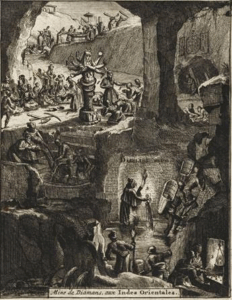
Diamond mine in the Golconda region 1725 CE from the collection of Pieter van der Aa—a Dutch publisher known for preparing maps and atlases. (Source: Wikimedia Commons)
All the famous Indian stones and diamonds were mined from the south, for which Golconda was the main market. The mining was at its peak in the 17th century and produced the world famous diamonds like The Great Mogul, The Koh-i-Noor, The Orloff, The Regent or Pitt, The Hope, The Nizam, The Great Table, The Dariya-i-Noor and The Shah. Each of these diamonds carries its own story of travel, displacement and luxury(Philip Scalisi, 1992 )
The demand for diamonds increased with time because of major developments in the cutting and polishing industries. What is most awespiring about diamonds is their luminescence and the perfect symmetrical radiating patterns that they display, almost as if they hold light within themselves. This quality was not present in their natural state but emerged only after the invention of cutting and polishing techniques. With the establishment of these industries close to mine sites, the practice grew steadily and began shaping diamonds into the forms admired today.
The earliest mention of the diamond-cutting process was given by a Jewish traveller in 1403, who described his knowledge of how the procedure was carried out. This account is significant, as it shows the process had already found a place in human understanding, though it was still far from perfected. In their raw form, diamonds appear quite plain and unattractive, resembling ordinary stones with little to set them apart. It was only through human effort that their hidden brilliance could be revealed.
In earlier times, India had developed basic polishing methods, but these were limited in their effect. The extreme hardness of diamonds made them notoriously difficult to work on, preventing their wider use. Without scientific methods of cutting, the true sparkle and brilliancy of the stones could not be enhanced. Thus, while they were valued, they were not yet transformed into the dazzling gems they would later become.
A true shift came in 1465, when Louis de Berquem of Bruges recut the Beau Sancy diamond. This act is regarded as the beginning of modern cutting, where symmetry, balance, and proportion became the focus. From then on, diamonds were not only rare stones but carefully crafted treasures, their beauty magnified by art as much as nature.
The technique of polishing included the wheel and bort (diamond dust). The basics of the designs starts from the “table-cut”, where the top of the octahedron was flattened. As slowly the complexities of the designs of diamonds increased, the demand also grew. The koh-i-noor was cut in a style called the rose cut. Today, diamond is valued and its worth is decided on the basis of its cuts, colour, clarity and carat. It was the same even in the 17th century. The cuts of diamonds were in vogue during the candlelit evening parties. These diamonds became an important perfect ornament for European courtiers, nobility and bourgeoisie.
Golconda diamonds were used extensively in jewellery because they have a high degree of transparency, it is so transparent that the light passes through it, making them luminous. It is described as having whiteness, limpidity and clarity. Coloured diamonds were also mined from the mines of Golconda. The Hope diamond, Great Table, the Dresden Green were the great examples of coloured diamonds. The colours of the diamonds are the truest of colours, naturally present in the environment not the one that is induced in the modern days.
In the late 1720s, the discovery of large deposits of alluvial diamonds in the Brazillian mines, there was an increase in the supply from there. Soon, the Portuguese ruler took control of the resources, and India no longer remained the sole supplier of rough diamonds. As the supply of diamonds increased into Europe, there was a decline in the prices. The centuries of extraction of diamonds from Golconda led to the exhaustion. The mining of these mystique, sparkling gems has now stopped, but India remains the hub for cutting and polishing.
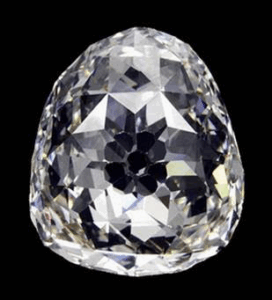
Beau Sancy, An example of the Rose cut diamond. (Source: Wikimedia Commons)
References
Alam, Ishrat. “Diamond mining and trade in south India in the 17th century.” Proceedings of the Indian History Congress. Vol. 59. Indian History Congress, 1998.
Hofmeester, Karin. “Working for Diamonds from the 16th to the 20th Century.” Working on labor: essays in honor of Jan Lucassen (2012): 19-46.
Scalisi, Philip. “The diamonds of india.” Bridgewater Review 10.1 (1992): 3-7.
Satyanarayana, S. V., and H. K. Gupta. “Diamonds in the Deccan: an overview.” Deccan Heritage (2000): 135-156.