

By Prishnika Mazumdar
Our present imagination surrounding the separation of powers informs us that there is a legislature that makes laws, an executive that implements these laws, and a judiciary that ensures such laws are obeyed. Often, we forget the novelty of such a conception. Often, we also tend to forget that in reality, systems do not always work within our imaginations of neat compartments. There are cases of political interference, partisan appointments, or institutional overreach that blur the boundaries created by imaginary concepts. In this essay, we will try to understand such a reality of blurred boundaries in the context of medieval India, particularly concerning ourselves with the 13th and 14th centuries when the jurisdiction of the Sufi Shaikh encroached into that of the Sultan, the resulting concords and discords have given us some of the most interesting stories of the time.
THE POLITICAL AND THE SPIRITUAL REALM
The Delhi Sultanate was at the peak of its power during the fourteenth century. It’s Sufi Shaikh at the time was Nizamuddin Auliya (1238-1325), who had been declared the Sultan-al-Mashaikh, which meant the Sultan of Shaikhs. This was expanded upon by Amir Khusro’s poem:
An emperor in a faqir’s cell,
A “Refuge of the World” for the heart of the world,
A King of Kings without throne or crown,
With kings in need of the Power of a Prophecy
This overlap of titles translates to an overlap of jurisdictions. The Sufi Shaikhs were believed to possess spiritual authority or wilayat that could directly influence the material fate of kingdoms. This spiritual authority that was believed to protect or doom realms presented a symbolic and ideological threat to the Sultan’s claims over territorial control (Digby, 1986). Each in his own way claimed that he was responsible for maintaining moral order. If we allow ourselves the readings of literature written about the two figures, it would appear as though Delhi had two Sultans ruling simultaneously (Kumar, 2000).
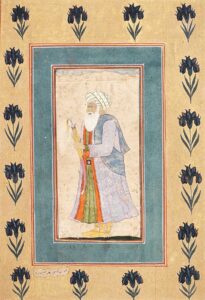
An anecdote from Siyar al-Auliya by Amir Khwurd surrounding the life of Nizamuddin Auliya says that when Shaikh Nizamuddin refused to visit Sultan Alauddin Khalji (r. 1296-1316), the Sultan declared his intentions of visiting the Shaikh himself. The Sufi Shaikh then pronounced:
“The house of this weak one has two doors. If the Sultan enters by one door, I will go out by the other.”
This hostility continued with the son and successor of Alauddin Khalji, Sultan Qutb-ud-din Mubarak Shah (r. 1316-1320). This was for two reasons. Firstly, because the Sultan had built a congregational mosque at Siri, where he summoned all the shaikhs and the ulama to offer prayers. Shaikh Nizamuddin refused, stating that there was a mosque closer to him and that it would be appropriate for him to offer his prayers there. The second reason is that all men of religion used to assemble on the first day of the month to offer their greetings to the Sultan. Shaikh Nizamuddin refused again, this time sending his servant instead. The Sultan was enraged, and he declared that if the Shaikh did not come by himself, he would be brought forcibly. As the first of the next month approached, the followers of Nizamuddin grew anxious. On the last night before the beginning of the new month, Khusro Khan, the favourite of Sultan Qutb-ud-din Mubarak Shah, decapitated him. The Sultan’s body was thrown off the roof, and his head was displayed on a lance (Digby, 1986).
The multiple refusals of gifts, invitations, and courtly presence inform us about a deliberate distance maintained by the Sufi Shaikh from state corruption, which in turn added to his spiritual credibility. This enabled the Sufi Shaikh to create a moral world that was separate from the logic of the state, this was an assertion of independence that was despised by the Sultans. To the Sultan, such aloofness represented a challenge to his supremacy (Kumar, 2000).
The Sultan claimed legitimacy through conquest, control of wealth, and the language of kingship, while the Sufi Shaikh asserted spiritual sovereignty by occupying sacred space, refusing patronage, and maintaining a distance from royal authority.
SUFI PROPHECY AND THE SULTAN’S FATE
Perhaps the most popular story surrounding Shaikh Nizamuddin Auliya is about the death of Sultan Ghiyasuddin Tughlaq (r. 1320-1325) and the birth of a proverb that is attributed to the Sufi Shaikh saying, “Hanoz Dilli Door Ast” meaning Delhi is far away. Sultan Ghiyasuddin was killed by the collapse of a pavilion after a victorious campaign, while being only one stage away from Delhi. This pavilion was erected by his son and successor, Sultan Muhammad Bin Tughlaq (r. 1325-1351), many believe that its collapse was not accidental (Digby, 1986).
It is interesting that Ibn Battuta, who was in Delhi just a decade after the event, attributes the statement to astrologers while acknowledging that the Sufi Shaikh had already conferred the kingdom on Muhammad Bin Tughlaq. The earliest and clearest reference to the Shaikh uttering the statement came from Sirhindi, who wrote over a century later (Digby, 1986).
The belief remained that an offense against a Sufi Shaikh would lead to the downfall of a ruler. Such a Shaikh could also foresee the attainment of the throne, meaning that they could bestow kingship upon men they encountered. Scholar, translator, and writer Simon Digby argues that such beliefs prevail in a society without strong traditions of succession, such as primogeniture, where usurpations of power are common (Digby, 1990).
There remain many instances of bestowal of kingship and good fortune by the Sufis. This good fortune was less impressive if it was bestowed upon a likely heir, such as a prince who could claim to be the legitimate successor, and more impressive if it was on an unlikely candidate, such as a slave (Digby, 1986). This is attested by the many stories surrounding prophecies about Shamsuddin Iltutmish (r. 1210-1235).
As a young slave at Bukhara, he was sent to purchase grapes. While on his way, he lost the money and began crying. Just then, a faqir bought him some grapes and asked him to take care of the holy folks on attaining power. Another story says that when the future Sultan entered the khanqah and offered broken pieces of precious metal from his waistband, Shaikh Sihab al-Din Suhrawardi said, “I see the light of the Sultanate shining in the face of this fellow.”
While on the one hand, such prophecies (often retrospectively pronounced) legitimised the kingship of the Sultan, they also enhanced the credibility of the Sufi Shaikh (Digby, 1986).
The jurisdictions of the Sultan and the Sufi Shaikh overlapped in space, imagination, and influence. For both, the construction of authority was based on symbolic and discursive ways, as suggested by historian Sunil Kumar (Kumar, 2000). Although confrontation was mostly avoided, these constructions of authority implicitly competed with one another. Authority in the Delhi Sultanate was administrative as well as spiritual. Sufi Shaikhs such as Nizamuddin Auliya created an almost autonomous moral sphere that sometimes directly, and sometimes subtly, contested the Sultan’s authority. In the meanwhile, stories of prophecy and retribution elevated the Sufi Shaikh’s wilayat to a level where even Sultans feared to offend him. Far from functioning in separate domains, the jurisdictions of the Sultan and the Shaikh were entangled, while sometimes adversarial, sometimes they were mutually reinforcing. Such coexistence should remind us that power, in any society, is rarely confined to neat categories. It flows, overlaps, and is constantly negotiated in the minds of rulers, saints, and subjects alike. This was true for the Delhi Sultanate, and this is true for us, only on a lesser scale today than before.
REFERENCES
Digby, S. (1986). ‘The Sufi Shaikh as a source of authority in mediaeval India.’ In: Appadurai, A. (ed.), The Social Life of Things: Commodities in Cultural Perspective, 1st ed. Paris: Éditions de l’École des Hautes Études en Sciences Sociales (Purusartha IV), pp.55–77.
Digby, S. (1990). ‘The Sufi Shaikh and the Sultan: A conflict of claims to authority in medieval India.’ Iran, 28, pp.71–81.
Kumar, S. (2000). ‘Assertions of authority: A study of the discursive statements of two Sultans of Delhi – ‘Ala al-Din Khalaji and Nizam al-Din Auliya.’ In: Muqarnas: An Annual on the Visual Culture of the Islamic World, Leiden: Brill.
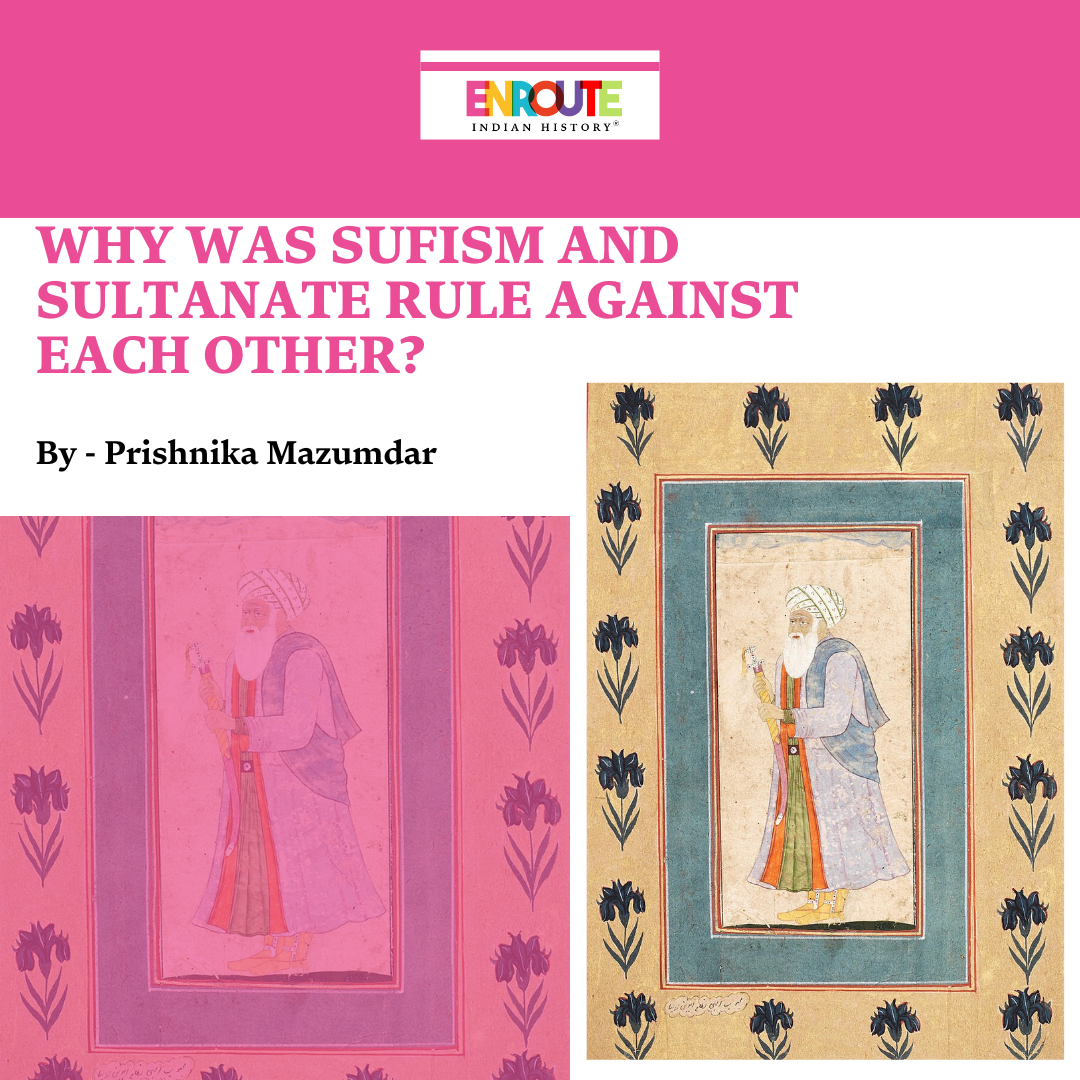
Image source: Wikimedia Commons (2022). A Painting of Nizamuddin Auliya grasping a sword. Available at: https://commons.wikimedia.org/w/index.phpsearch=Nizamuddin+Auliya&title=Special:MediaSearch&type=image [Accessed 24 May 2025].
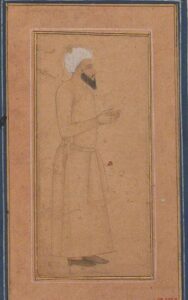
Image source: Wikimedia Commons (2014). Portrait of Alaudding Khalji (17th century). Available at: https://commons.wikimedia.org/wiki/File:Portrait_of_Sultan_%27Ala-ud-Din,_Padshah_of_Delhi.jpg [Accessed 24 May 2025].