
By Anukriti Upreti
Garima Martoliya, a PhD scholar at Kumaun University and a resident of Pithoragarh started learning this precious art of dan making from her mother during the time of Covid- Lockdown. Her mother, Nirmala Devi, a resident of Munsyari Village, has been making dan since childhood. She remembers the days when they used to collect sheep wool and make different wool articles, but now the situation has changed, and they buy wool from the market. “The process is tiring and requires patience, in this era of machines and industries they face declining demands for their articles,” she says. However, the articles still hold a symbolic meaning, and these dans are still gifted to the bride during the time of marriage as a symbol of love, care, and diligence.
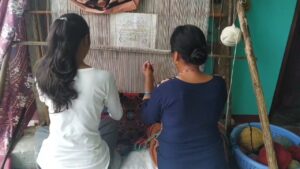
Garima, learning the art of Dann from her mother. Photo clicked during the field visit.
Bhotiya, a name derived from Bhot,Tibet, comprises a semi-nomadic community living at the Indo-Tibet border in Uttarakhand, particularly in the districts of Pithoragarh, Chamoli, and Utarkashi. Throughout history, they have played a significant role in the functioning of the economy and society through their practice of transhumance. In summers, they lived at high altitudes like Harsil Valley, a town located near the sacred town Gangotri, where women and elders used to stay and rear sheep, while men used to travel across the ‘modern’ borders of Tibet and carried Tibetan articles to the lower regions of Uttarakhand. In winter, they would come to lower valleys like Dhunda and make wool articles, mostly for their personal use. Their transhumance was crucial not only for their own survival but also for the sharing of culture between Tibet and Uttarakhand.
However, the Indo-China war of 1962 changed their livelihood completely as the regulations after the war put an end to their trade with Tibet and they shifted to ‘modern’ professions. However, there are some communities such as Shaukas, Rungs, Tolchhas, Marchhas, and Jadhs, who still make these articles and have kept the tradition alive. They make different articles called Dann, a rectangular carpet with geometrical designs used for bed covering or on the floor; the asan, a square mat used for prayers and sitting on the floor; pankhi, a twill shawl mostly in white or gray color, and blankets such as Chukta and Thulma.
Process of making wool articles
The weaving process starts with the procurement of wool. [earlier] “The wool was collected from the sheep reared by them and processed through scouring, carding, spinning, and dyeing with traditional indigenous techniques” (Srivastava and Goel, 2018). Before the 1962 war, they preferred a Tibetan variety of wool, but it has now been replaced with Ludhiana wool. The process begins with the tedious and time-consuming task of removing hair from the animal’s body, called shearing. This is followed by grading wool according to its quality, and then the most important part of scouring, removal of impurities from the wool, is performed. For scouring, the wool was soaked in luke-warm water and reetha (Sapindus mukorosii) or pangar (Himalayan horse-chestnut, Aesculus indica) solution was added to remove the soil, grease, and stain from the wool.
The wool was manually carded and spun into a Bageshwari Charkha or Takli , a treadle-operated spinning wheel. Different types of looms are used to make different articles, the Dann and asan are woven on a vertical or high-warp loom (locally called dann raanch or khara ranch) (MAP Academy, 2025) The wool is hand knotted over a plain weave and each row of the knotted pile is then pushed down with comb or mallet. In my conversation with Garima, she said “we use a stencil to make different designs from the wool. The process is difficult, but I really enjoy it.” For simple articles such as Thulma and Pnakhi, a pit loom (khadda raanch) or waist loom is used. These articles are given a soft texture by plucking wool through the brush.
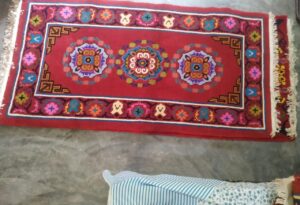
Dann, made by Garima’s mother, Nirmala Devi. Photo clicked during the field visit.
The geometrical patterns are especially found in the Danns, along with images of mythical birds such as Jira and dak of Tibet and the Chinese dragon called Jug in Tibet. Today, we find large floral motifs at the center, surrounded by designs and geometrical patterns drawn symmetrically to make the carpet attractive. Earlier these Dann were exchanged with other food articles through fairs like Uttarayni in Bageshwar, now after the handicraft got GI tag in 2021, the Uttarakhand Handloom and Handicraft Development Council (UHHDC) is working for their online retail.
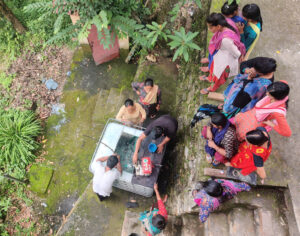
Members of Avani working on natural dyes. Image Courtesy Avani-kumaun.org.
A significant aspect of the traditional wool weaving of Bhotiyas is the use of natural dyes. The plants used mainly as dye sources were jangli palak (Rumex nepalensis), bagmaru (Eupatorium), kilmora (Berberis asiatica), akhrot (Juglans regia, dolu (Rheum aystrale), tea leaves, kaphal (Myrica esculenta), haldi (Curcuma longa), tantric (Rheum moorcroftianum), darim (Punica grantum), burans (Rhodendron araborium) and harda (Terminlia chebula) (Sharda and Rastogi, 2013). This was eco friendly and had a vibrant texture on the textile. However, this practice declined as cheaper and more feasible synthetic dyes were introduced into the market. “Now, nobody has that much time to look for the natural dyes or procure wool directly so we use the dyed wool available in the market.” Garima says.
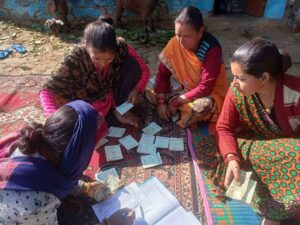
Women as managers, step towards women empowerment, and revival of traditional art by Avani Kumaun. Image courtesy: Avani-Kumaun. org.
However, there is a group of volunteers working to revive the traditional dyeing practices of Bhotiyas. A non-profit organization, AVANI, is working with locals to preserve this art and make it more attractive for the modern market. Through its project Earthcraft, an artisans’ and farmers’ cooperative, it generates livelihoods for vulnerable women and girls by cultivating Indigo in the Tripuradevi region of Pithoragarh district, Uttarakhand. This has helped to diversify the shades of natural colors used in Bhotiya textiles. Rajesh Kumar Joshi, one of the locals working with Avani told me about the details of the work and how they carry out the process of collection, processing and marketing in the same place in order to maintain the quality of the product. This is a great step towards protecting the age-old knowledge of natural dying used by the Bhotiyas. Such initiatives give us new hope for the future development of traditional artisanal practices in new ways.
References:
1. Rawat, H., Rani, A. and Goel, A. (2019). Sustainable traditional dyeing of wool by Bhotia tribe in Himalayan region: A case study. Journal of Applied and Natural Science, 11(2), pp.379–383. doi:https://doi.org/10.31018/jans.v11i2.2068.
2. MAP Academy. (2025). Bhotia Wool Weaving – MAP Academy. [online] Available at: https://mapacademy.io/article/bhotia-wool-weaving/ [Accessed 16 Nov. 2025].
3. https://avani-kumaon.org/
4. Sapna, Dhar A. (2025). Handicraft of Bhotiya Tribes in Uttarakhand Transition of Traditional to Modern Touch in Making Process. 10.13140/RG.2.2.31244.63364
5. Personal conversations with the weavers.