


P. Sanjay
One of the most important crops in India is rice. It constitutes 41.58% of the total food grain production in India (PIB). As rice is rich in genetic diversity, with thousands of varieties grown throughout the world, India provides a large number of rice varieties of almost 60,000 varieties, at present. Originally, India had more than 1,11,000 varieties of rice until 1970, which were lost during the Green Revolution with its emphasis on monoculture and hybrid crops. Let’s go back in time thousands of years to trace the whispered origins of rice, where grain first met the soil.
The term Neolithic refers to the New Stone Age, a label introduced by Sir John Lubbock in 1865, who categorized historical eras based on tool use. However, the Neolithic period encompasses significant innovations and cultural transformations that distinguish it from others. It brought about crucial developments in human life, particularly in terms of settling in one place, farming crops, and taming animals. One of the key benefits of agriculture is that it offers a steady and foreseeable supply of food, enabling populations to establish permanent settlements and begin altering local plant and animal life for their benefit, which further promotes the domestication of both flora and fauna.
The greatest events come to pass without any
Design; chance make blunders goof…. The
Important events of the word are not
deliberately brought about : they occur
– George C Lichttenburg
The start of the Neolithic is very debatable in the Indian context. The striking characteristics of agricultural revolution is that It happened independently in different regions of the world. Even in India the Neolithic tools in different regions have been found which belong to different time periods. “Agriculture” and “cultivation” are not the same terms. They are two different terms. Agriculture involves human efforts to modify the environments of plants and animals to increase their productivity and usefulness. On the other hand cultivation refers to the growing of plants from seeds, bulbs, shoots and so on. Agriculture usually involves the use of domesticated seeds and plants, which have been knowingly or unknowingly been manipulated by the action of humans. These domesticated plants are more productive than the wild ones.
The oldest records of pottery in China and Japan are believed to be from 21,000 to 18,000 BCE. The initial signs of agriculture originate from locations such as Yuchanyan in Hunan Province and Xianrendong in Jiangxi Province, dating back more than 10,000 years to when rice agriculture began. The Yangtze Valley in China provides evidence that Asia is the birthplace of rice. In the Neolithic layers of eastern and central India, evidence of domesticated rice and pottery has been found at Koldihawa and Mahagara, which date back to the Neolithic period. Radiocarbon dating places Koldihawa at around 9,000 to 8,000 years ago and Mahagara at approximately 8,080 ± 115 BCE.
The oldest known evidence of rice usage is from 8359 BP at Lahuradewa located in the Middle Ganges. The finding of four spikelet bases in the oldest layer of Lahuradewa is believed to be of a domesticated variety, but these show immature spikelets and characteristics that are not typical of domesticated rice. Phytoliths discovered in the lake core at Lahuradewa revealed a combination of wild varieties in the earliest sections of the core along with domesticated ones. Lahuradewa is recognized as the starting point of a lengthy process of domestication, representing a significant chapter in the history of rice.
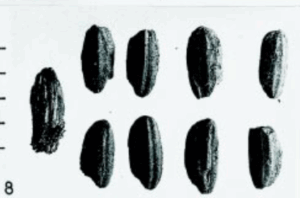
A grain of domesticated rice from the deepest layer in a trench in Lahuradewa, (Source: K M Saraswat)
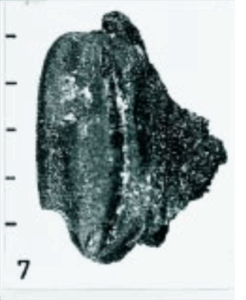
Domesticated rice (Oryza sativa) grains, (Source : K S Saraswat)
The debate surrounding the domestication of rice and its early social and economic effects is still very much alive. The modern cultivated Asian rice, known as Oryza sativa, has a complicated past due to numerous instances of hybridization. The Proto indica hypothesis debate highlights concepts related to rice hybridization in India. Oryza nivara represents the native wild variant of rice found in India. Cultivation of Oryza japonica took root in the Yangtze Valley around 9000 BC, according to botanical evidence. The hybridization between O. japonica and the South Asian variety O. indica accounts for the rice we have today. One hypothesis suggests there existed a semi-domesticated rice tradition in North India, with fully domesticated rice emerging only after the O. japonica variety arrived from the East around 2000-1500 BC. Recently, it has been proposed that two independently domesticated rice crops have shared genetic material. It remains uncertain how the initial exploration of rice differed from its later exploitation post-domestication, as there is a notable gap in archaeological records from the 7th millennium BC to the 2nd millennium BC.
The story of rice remains interesting as we see how Japonica rice would have travelled all the way from China .What ways and through which route would they have travelled? The tale of the meeting of two varieties of rice. There have been hypotheses on the advent of O. japonica variety to the Indian subcontinent. The particular entry points of O. japonica in India will help to refine models of rice domestication and diffusion by applying the spread of Proto – Indica. These models evaluate the acknowledged data much better.
The South Route Hypothesis – East Asia is very well connected to Northeastern India. The Neolithic culture of Northeast almost resembles the East Asian Neolithic culture starting from tools to their pottery. Presuming that the origin of rice was the influence of Yangtze Valley in China and that Northeast India lies between China and Ganga Valley. The lack of evidence from the Northeast apart from a few exceptions from little archaeological remains of grain from Myanmar and Assam.
The Inner Asian Mountain Corridor Hypothesis of which archaeological data fits better. The introduction of rice from the same corridor that went around the Tibetan plateau. The evidence of the millets passing through the same route westwards might have brought the O. japonica variety of rice in the Indian subcontinent. Further archaeological remains from Mahagara and Pirak also support this hypothesis. In Mahagara, hybridized, non-shattering remains of rice have been found containing similar genetic characters of the O. japonica variety and in Pirak which produced grains that were argued to look like O. japonica on the basis of the morphometrics of the grain. As both the hypotheses have their own evidence supporting their claims, the current evidence shows a multidirectional approach to the entry of rice. As new archaeobotanical sites are being excavated, new finds can even rewrite the narrative.
The story of rice in the Indian subcontinent is the story of agricultural revolution that intertwines with a broader narrative of evolution, adoption and cross-cultural interaction. The constant manipulation of the environment by humans leads to the modification and changes leading to new inventions more beneficial to humans. As new sites are excavated, evidence collected, new analytical methods advances and further studies will provide deeper understanding and inturn increase the scope of the field . The story of rice is far from complete. Every grain unearthed and every new question asked, the story modifies as the rice modified itself.
References
Bates, Jennifer. “The fits and starts of Indian rice domestication: How the movement of rice across northwest India impacted domestication pathways and agricultural stories.” Frontiers in Ecology and Evolution, vol. 10, 5 July 2022, https://doi.org/10.3389/fevo.2022.924977.
Hazarika, Manjil. “Neolithic culture of Northeast India: A recent perspective on the origins of pottery and Agriculture.” Ancient Asia, vol. 1, 1 Dec. 2006, p. 25, https://doi.org/10.5334/aa.06104.
Allchin, Bridget, and F. Raymond Allchin. Origins of a Civilization: The Prehistory and Early Archaeology of South Asia, Viking, New Delhi, 1997, pp. 94–100.
Wenke, Robert J., and Deborah Olszewski. Patterns in Prehistory: Humankind’s First Three Million Years. Oxford University Press, 2007, pp. 228-235
Silva, Fabio, et al. “A tale of two rice varieties: Modelling the prehistoric dispersals of japonica and proto-indica rices.” The Holocene, vol. 28, no. 11, 7 Aug. 2018, pp. 1745–1758, https://doi.org/10.1177/0959683618788634.