

By Aryan Singh
In the courts of the Mughal Empire, where Persian poets, Rajput nobles, and European powers competed for influence, the story of a remarkable woman has long been overlooked in history. Born in Goa in 1645, Juliana Dias de Costa, a Portuguese Catholic, emerged from humble beginnings to hold the rare position of advisor and close confidante within the Mughal harem. Serving under emperors like Aurangzeb and Bahadur Shah I, she skilfully balanced faith, politics, and power during a time when few women—especially foreigners—could claim such authority. The final trace of Juliana Dias de Costa’s legacy can be found in Delhi’s Okhla area, where the locality of Sarai Julena gaon still carries her name. Originally established in the 18th century as a Sarai—a rest stop for weary travellers—the site has transformed over time and is now occupied by modern DDA residential flats. (Indian Express, 2019)
This article will delve into the story of Juliana Dias de Costa, her background, and her influence in the Mughal Court.

Source: Indian Express, Sarai Julena Gaon signboard in Okhla, Delhi
Portuguese explorers arrived in India in 1498 under Vasco da Gama, spreading their influence across the country. By 1510, they had taken control of Goa from the sultan of Bijapur and began expanding their presence in India. The story of Juliana and the Mughal Kings can be found in Bruit’s account, which recounts that King Jahangir faced a rebellion from his son, Prince Khurram, who later took the title of Shah Jahan. According to Bruit, after the rebellion, Jahangir died of grief, and his sister went on a pilgrimage to Mecca. On the way, the Portuguese attacked her ship, seized her belongings, and imprisoned her in Goa. This outraged the emperor, who decided to attack Goa and punish the foreigners. Shah Jahan blockaded Goa and attacked Hugli in 1632, resulting in a victorious army returning with around 4500 prisoners, including Juliana, a young girl at the time, and her mother, as mentioned by Bruit.
He also mentions that Juliana & her mother were given to a begum in the Mughal palace as slaves. After the death of the begum, they came under the care of Pedro Antón Magallán, who arranged Juliana’s marriage to an unnamed Portuguese man after her mother died. According to Divya Sethu, Juliana displayed remarkable wisdom and a deep understanding of medicine from an early age. Her skills eventually led her to serve the wife of Emperor Aurangzeb. When one of Aurangzeb’s sons rose in rebellion and was consequently confined under house arrest, Juliana’s loyalty never wavered. She remained by his side throughout, even at great personal risk, ensuring his comfort by secretly bringing him gifts and essentials for nearly seven years.
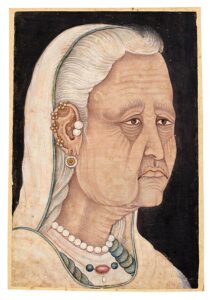
Source: Wikipedia Commons, Mughal era painting of Juliana
Bruit writes that after seeing the loyalty of Juliana, the prince promised her that when he became the king, he would give her a rank higher than all the nobility. Jean Baptiste Joseph Gentil also stated that Juliana even predicted that Bahadur Shah would win. When it happened, the king granted her wealth and the palace of Dara Shikoh. She became closest to the king and was ranked higher than all nobles in the imperial court. Her level was such that when she visited anywhere, she would be accompanied by 6-7 thousand soldiers. Author Jean Baptiste Joseph Gentil’s sketch of Juliana also depicts her riding beside the king on an elephant. Divya Sethu further notes that Juliana took charge of educating several royal children, a role that gave her access to the inner workings of the court, including its secrets, affairs, and wealth. She also acted as a physician to the royal women, oversaw the management of the harem, and simultaneously represented Portuguese interests as both a diplomat and ambassador. Bruit also narrates how Juliana spent his whole day. In the morning, she first takes a bath and then spends 4 hours praying in Ibadat Khana, and then joins the other women of the harem. After that, she would spend another 4 hours cooking food for the king, especially the King’s favourite dish, rice with lentils, and sewing. After that, she would put on her formal clothes (Libas-i-darbari) and attend to the tasks of the court. Authors of Juliana Nama also mention that her influence was such that other people of whatever stature would always seek her counsel, and if she intercedes on their behalf, then their wishes would be fulfilled.
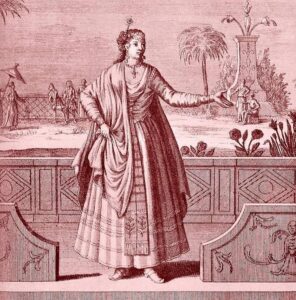
Source: WordPress.com, Juliana Dias d Costa
Divya Sethu writes that Juliana had so much influence on the young prince that she nearly converted him to Christianity to such an extent that he would kneel before Jesus in prayer and send blessings to the church just short of baptism. The authors of Juliana Nama also mention that her influence favoured the Portuguese to such an extent that Surat was declared a duty-free port for them, and her intervention in the rulings helped the Portuguese to gain several benefits.
The Jesuit sources portray Juliana as a proxy for a spiritual mission in India, while Portuguese accounts depict her as a proxy for their political aspirations when their own influence was in decline in the 18th century. Juliana also once wrote a letter in Persian in 1711, in which she prays for the glory of the Portuguese king and acknowledges the exchange of gifts between the Mughals and Portuguese. (Luis Dias, 2014) When Shah Alam ascended the throne in 1707 and decided to raise a naval fleet under a French general, the Portuguese grew insecure, and the Juliana convinced the emperor against collaborating with the French. (TOI, 2017)
Her loyalty to the Mughal court continued even after the passing of Bahadur Shah I and served his sons and successors, Jahandar Shah (1713), his nephew Farrukhsiyar, and later Muhammad Shah Rangeela. Bruit also mentions that once, the mother of Muhammad Shah was very terrified about her son’s safety from his brothers, who might kill him, so she asked Juliana to pray to her saints. Juliana changed the name of the prince to Muhammad Yahya and placed her under the guidance of John the Baptist.
When Juliana became old, she even sought permission from the Mughals to retire to Santa Monica Convent in Goa, but was persuaded to remain in court on account of usefulness in diplomacy. But during her last days, she was allowed to spend her time in Santa Monica and died in 1734. (Luis Dias, 2014)
References
1. Zaman, Taymiya R. “Visions of Juliana: A Portuguese Woman at the Court of the Mughals.” Journal of World History, vol. 23, no. 4, 2012, pp. 761–791, https://doi.org/10.1353/jwh.2012.0136. Accessed 9th September 2025.
2. Dias, Luis. “The Many Worlds Inhabited by the Enigmatic Dona Juliana Dias Da Costa.” Luis Dias, 9 June 2024, luisdias.wordpress.com/2024/06/09/the-many-worlds-inhabited-by-the-enigmatic-dona-juliana-dias-da-costa/. Accessed 9 Sept. 2025.
3. Divya Sethu. “When a Portuguese Woman Intrigued with an Emperor in the Mughal Empire.” The Better India, 9 Dec. 2021, thebetterindia.com/268217/juliana-dias-da-costa-mughal-empire-bahadur-shah-forgotten-portuguese-history/.
4. Lakhani, Somya. “All That Remains Is a Village in Juliana’s Name.” The Indian Express, 25 Apr. 2019, indianexpress.com/article/cities/delhi/all-that-remains-is-a-village-in-julianas-name-5695221/. Accessed 9 Sept. 2025.
5. Gauree Malkarnekar. “A Love Affair That Saved the Portuguese from Mughals.” The Times of India, Times Of India, 22 July 2017, timesofindia.indiatimes.com/city/goa/a-love-affair-that-saved-portuguese-from-mughals/articleshow/59719523.cms. Accessed 9 Sept. 2025.