
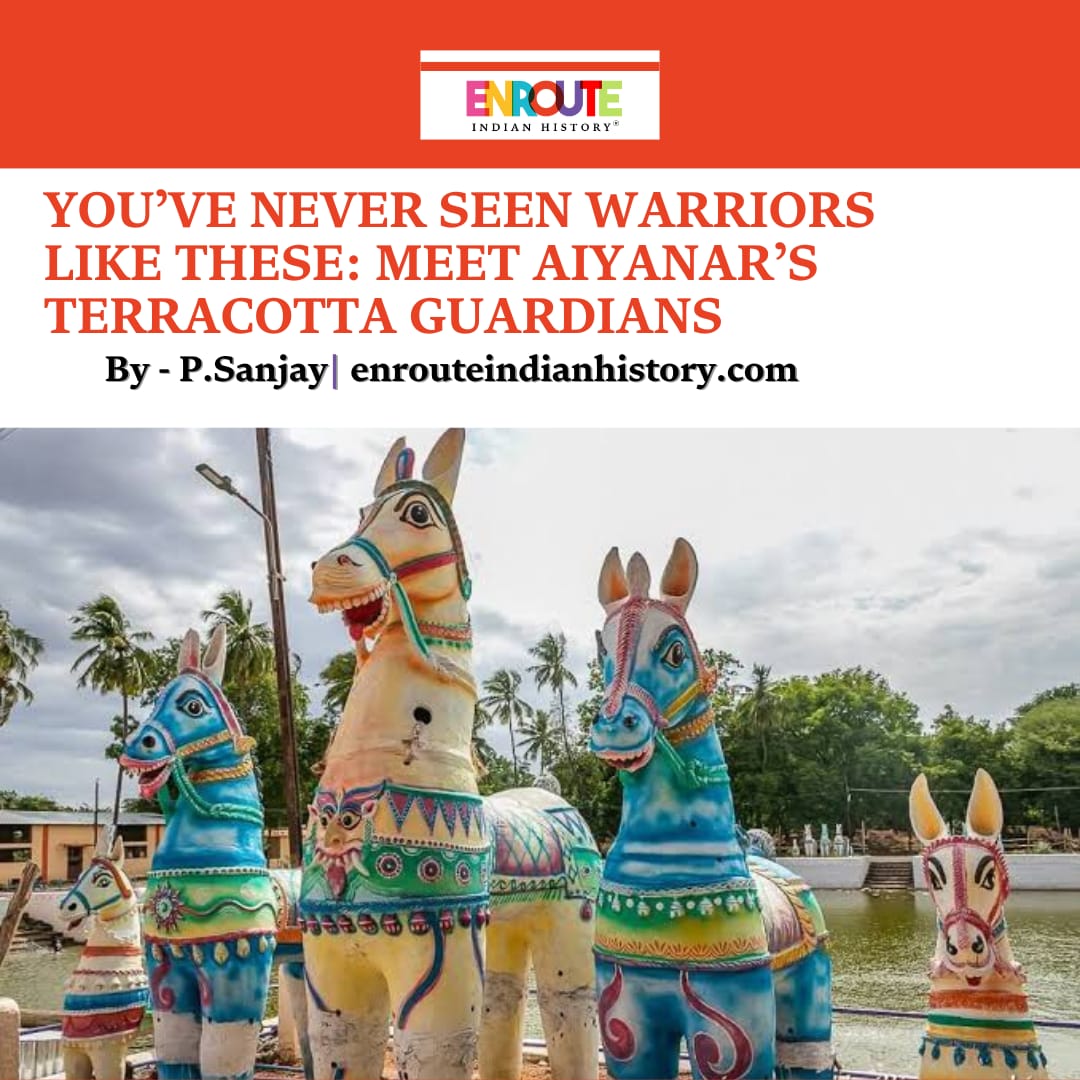
You’ve Never Seen Warriors Like These: Meet Aiyanar’s Terracotta Guardians
- October 15, 2025
P. Sanjay
On the outskirts of villages in Tamilnadu, usually resides a Guardian deity. These guardian deities vary accordingly from village to village, but the interesting thing is that the deities perform the major duty of protecting the village and its people. These are guardian deities like Aiyanar, Muniyandi, Karuppar, Maduraiveeran, Sudalaimadan, Irulappan, and so on. The list goes on but these deities remain the chief god or attendant gods in many of the temples. Each of these deities exhibit different characteristics and are unique in all cases. They are iconographically depicted with ferocious facial expressions, swords in their hand, large moustaches and usually as seated on horses.
Aiyanar is one of the prominent guardian deities. He is usually found in the outskirts of the village, where one can easily identify the temple with large terracotta horses, stucco sculptures of Aiyanar and his attendant gods and a mix of intact and broken terracotta objects. The size of the temple depends upon the economic conditions of the village and its devotees. A temple complex of Aiyanar, is not solely dedicated to himself rather with a range of attendant gods and goddesses. The attendant gods are usually fixed as Maduaraiveeran, Muniyandi or Karuppar (with some minor regional differences) and the goddesses are independent of the other gods and are worshipped accordingly by the villagers. It is interesting to note that Aiyanar is also the lineage god or clan deity (kuladeivam) for many of the families.
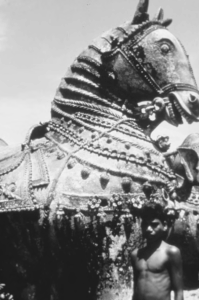
A twelve – foot – high statue of an Ayyanar Horse in Tamil Nadu. Photograph by Stephen B. Huyler
The origin of Aiyanar remains a debate as scholars consider him to be a local deity who was later absorbed into the larger Brahmanical traditions and some consider it to be introduced during the Bhakti wave. Aiyanar is considered to be the son of Siva and Mohini ( female incarnation of Vishnu) thus also known by the name, Hariharaputra. He is accompanied with his two consorts namely Puranai & Puskalai. We all must be aware of Lord Ayyappa of Sabarimala, who is also considered to be another form of Hariharaputra similar to Aiyanar.
But why are these people having a range of burnt clay horses, seated with a veeran (hero or a warrior) as if going to a war. When we visit a temple, we usually offer fruits and flowers to the deity as a form of devotion. The devotees engage in rituals such as lighting lamps, chanting prayers and seeking blessing, where people also ask their personal wishes and aspirations from the god. Devotees of the Aiyanar temple donate terracotta sculptures as offerings once their wishes are fulfilled by the deity. That is why the temple stands as an immense collection of these objects.
The tradition of making the terracotta horses is still carried by the traditional families which have been doing this job for centuries. They are usually potters known officially by the caste name Kulalar and colloquially as Kusavan. More specific caste titles are used in particular regions and among people with whom they interact frequently, as well as among themselves (SR Inglis, 2001). Potters have a special connection with Aiyanar as they are also the priests of the temple. The priests perform various rituals and manage the temple’s functions. They also connect with the divine by entering a trance-like state, during which they are believed to be possessed by the deity. Devotees seek blessings and ask questions, hoping to receive answers directly from the god through the priest. (Huyler, 1991)
The process of making the terracotta horse takes at least 15 days, and that completely depends on the size of the horse which is commissioned by the devotee. Even though generations have passed, the Kuyavan still uses the old simple tools like the wooden mallet (Marattattu) and a handstone anvil (kal). A wooden stick is used to etch out the details in the sculptures.(Udaya Kumar, 2025). The wooden mallet and anvil are applied to enlarge and smoothen the surface of the horse. The process of making the terracotta horse starts with a special puja of Aiyanar, as it is believed that the deity stays with them in supporting them in the process. The rituals also include the sacrifice of a rooster, offering liquor and then the process of crafting the statue. But in some regions where the deity is considered to be a vegetarian, strict fastings and only vegetarian foods are consumed.
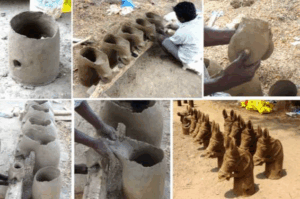
All the parts of a small terracotta horse, (Source: Udaya Kumar S)
The major raw materials for the construction of terracotta horse are clay mixed with riverbed sand and nicely chopped rice straw. These are mixed together to make it stronger and the rice straw binds the soil together. The small size to terracotta sculpture of approximately up to 5 feet height but large ones are also commissioned by the people. The process starts with removing all the impurities using their legs to knead it more efficiently. Starting from the hooves of the horse, usually making four hollow cylindrical pipes with the clay in case of a small one. In the case of a ten feet horse, the legs are supported by a pole which is wrapped with rice straw and then the clay is applied.
Drying is an essential part of the manufacturing process and must be carried out after every level progressively to avoid cracks, tensions and deformation. Once the legs are dried, they work on the body of the horse. The body of a small horse is made separately, and then it is attached to the legs. It is first given a rough shape and the mallet and anvil are used to give it shape. The anvil is used to smoothen the inner side and the mallet – the outer side of the body. A hole is also left in the middle bottom of the horse to hold and lift the body parts at different sections of the process. But in the case of the large horse, the body is built above the legs by giving it support of wooden poles, arranged horizontally over the legs, connecting the front and rear legs. A rectangular clay slab support is also given to the body of the horse, between the front and rear legs.
Once the structure is dried it is then ready for the next step: the neck, head and tail are made ready, which remain as the last parts to be assembled. The artist works on the symbols and ornamentation of the horse. Now comes the most interesting and fascinating part of the process: firing. The whole structure is covered with coconut husk, cow dung cake, and rice straws stuffed into the gaps so that the immense structure burns evenly. The potter ignites the fire at all the four corners of the setup and also checks the fire and controls it with water, sand and ash. During this process, the structure loses the remaining moisture and the clay loses its plasticity. Thus, firing at the right temperature and for appropriate duration is required.
As the ash and dirt are removed after firing, it is for one last time checked for cracks and damages. This artist is an expert in handling the damages, he seals the cracks and plasters the damaged part. The artist then paints the body of the horse with the body as white, and other details with vibrant yellow, red and blue. But the eyes are left to be painted at the time of ritual as it is believed that the horse only gets life as the eyes are painted. Every year during the Annual Festival, an elaborate ritual takes place before the installation of the horse.
Though the terracotta horse remains the classical sculpture, elephants, thottilam pillaiyum or cradle child, human figures and other animals are also donated to the deity. The special ritual involves the procession of the statues and ritual singing from the priest in Tamil –
You have given us a life, you have shown us your mercy;
We bring to you our gift;
For the life you have given, we give you this horse;
We are given earth; we are of earth; we return earth;
Accept our gift.” – recorded by Huyler, Stephen P, 2001
When reflecting on the contemporary world, we see that the terracotta objects have long been discarded by people. The daily use objects made of terracotta like pots, hearths, vessels have been replaced by aluminium and steel ones. The changing world has limited their opportunities and their profession has now been reduced to a seasonal job. Even at some places, the terracotta horses are being replaced by the cemented stucco horses, but the tradition of donation and devotion still continues. Aiyanar and his horses are still believed as the guardians, who roam around the village at night and protect his subjects from evils, spirits and thieves.
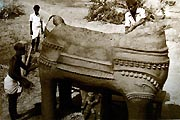
Making of a large terracotta horse, Incomplete – without the head and tail, (Source: Ron du Bois, 1980 )
REFERENCES
Jarzombek, Mark. “Horse Shrines in Tamil India: Reflections on Modernity.” Future Anterior: Journal of Historic Preservation, History, Theory, and Criticism, vol. 6, no. 1, 2009, pp. 18–36. JSTOR, http://www.jstor.org/stable/25835049.
Udaya Kumar, S. “A Current Wisdom and Heritage of Making Terracotta Horses in Konthagai Village, Sivagangai District, Tamil Nadu.” Heritage: Journal of Multidisciplinary Studies in Archaeology 10 (2025): 129-147.
Huyler, Stephen P. The production and use of ritual terracottas in India, University of London, School of Oriental and African Studies (United Kingdom), England, 1991. ProQuest, https://www.proquest.com/dissertations-theses/production-use-ritual-terracottas-india/docview/1976961641/se-2.
du Bois, Ron. “Larger than Life: The Terracotta Sculptures of India.” Ceramics Today, http://www. ceramicstoday. com/articles/clay_horses. Htm.
Inglis, Stephen R. “Making and Breaking: Craft and Ritual in South Asia.” Revelations: Bi-millenial Papers from the Canadian Museum of Civilization 75 (2001): 71.
Beaudry, Marilyn, J. Mark Kenoyer, and Rita P. Wright. “Traditional Potters of India.” Expedition 29.3 (1987): 55.
https://frontline.thehindu.com/arts-and-culture/horses-of-a-little-tradition/article9655984.ece?utm_source=frontline_search&utm_medium=organic&utm_campaign=search_results&utm_term=ayyanar