
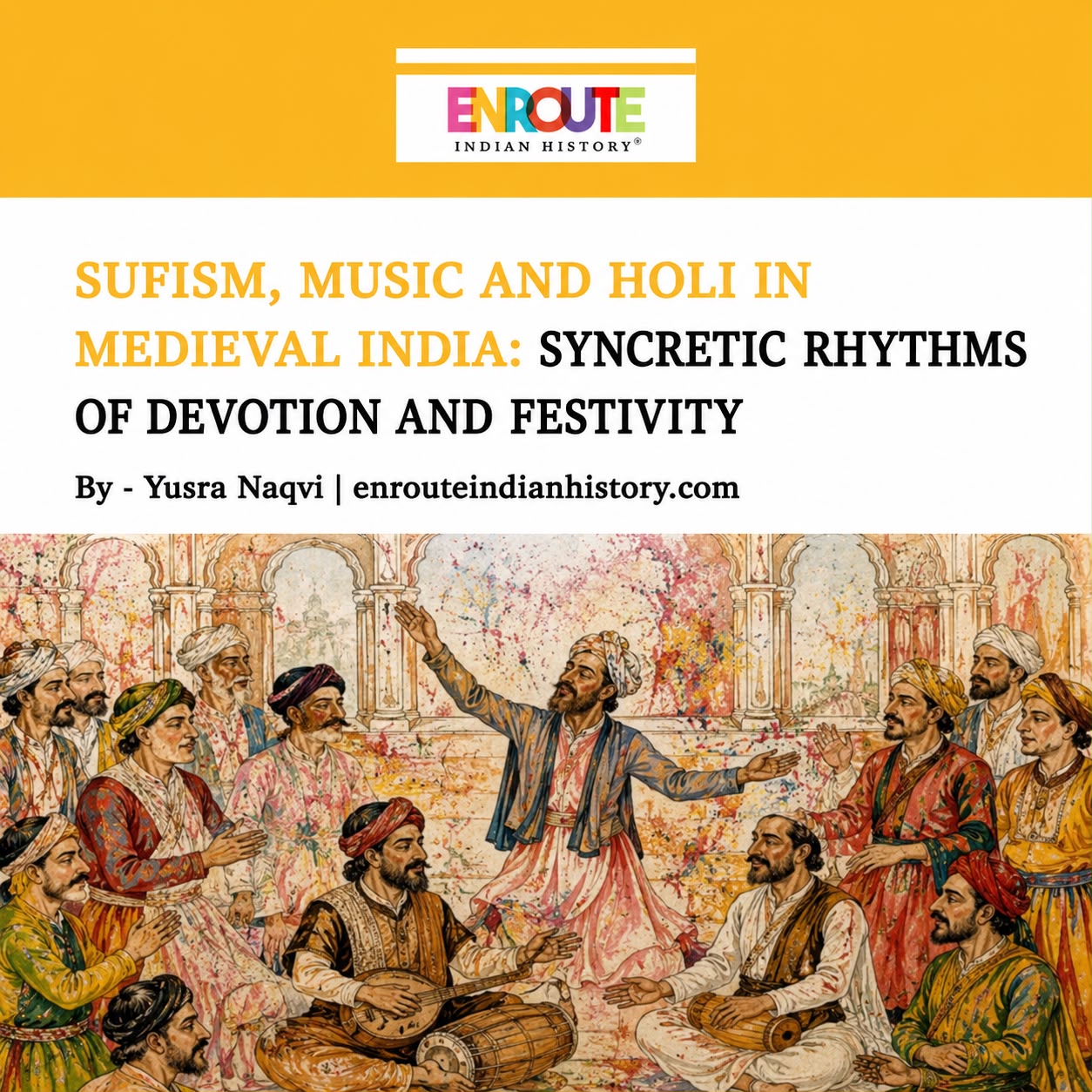
Sufism, Music and Holi in Medieval India: Syncretic Rhythms of Devotion and Festivity
- July 3, 2026
-: By Yusra Naqvi
India’s spiritual and cultural heritage has long been shaped by music, celebration, and festivity. From the twelfth to the eighteenth centuries, the Indian subcontinent experienced a rich cultural exchange, with music playing a central role in spiritual experiences, identity, and social harmony. Sufism in India developed closely alongside local Indic traditions. Among these intersections, the festival of Holi is a clear instance of how mystical Islam and local rituals intertwined. This article discusses how Sufism and Holi celebrations were connected in the broader socio-religious context of medieval India, showing how Sufi mystics, bhakti poets, and folk performers often shared devotional spaces, languages, and musical forms that transcended religious and sectarian lines.
Introduction
Sufism, the mystical aspect of Islam, began to spread across the Indian subcontinent from the twelfth century onwards. Sufi saints, popularly known as ‘pirs’ were significant in shaping the region’s social and spiritual life. Unlike formal religious institutions, Sufi orders (tariqas) focused on personal spiritual experiences, centred on humility, service, and divine love (ishq-e-haqiqi) as the path of God. Their centers, known as khanqahs, welcomed people from various backgrounds. This inclusivity encouraged interaction with local traditions, especially in music and festival practices. Sufi thought thus, did not exist separately from regional customs, but rather engaged with them actively. Music, seen as a means to reach a state of ecstatic devotion, played a key role in Sufi rituals like sama and zikr, where repetitive rhythms and melodies were designed to induce spiritual feelings. This form of spirituality, in the form of qawwalis, kalams, and folk-based devotional songs, was based on the belief that love for God could be expressed through any art that moved the soul.
By the thirteenth century, the festival of Holi, with its references to Holika legend, agrarian cycles, and mythological narratives, had become deeply embedded in popular culture throughout India. Music became a vital part of Holi celebrations. Folk songs, called horis, were lyrical and romantic, referencing the love story of Radha and Krishna. These shared aesthetics led to the composition of kalaams addressed to ‘khuda, Ali, Allah, and Khwaja,’ preserving the essence of Awadhi or Braj music. Medieval Persian sources, including travel accounts and court poetry, describe Holi celebrations in North India with a sense of familiarity, indicating a close connection between the communities. In some areas, local Sufis took part in Holi festivities, adapting their own musical expressions to the rhythms of the festival. A clear example of this syncretism is the blending of Sufi musical styles with folk elements found in Hori songs, many of which incorporated Persian and early Urdu influences. The very term ‘Hori’ appears in the repertoire of devotional performances at Sufi shrines during spring. These performances were not always religious in the sense of doctrine, but they illustrated how music and festivities moved freely between different religious traditions.
Eid-e-Gulabi
One can experience the bliss of nearly a century-old ‘Sufi Holi’ at the shrine of the 19th-century Sufi saint Haji Waris Ali Shah, popularly known as Dewa Sharif Dargah in Barabanki, Uttar Pradesh. Popularly known as Waris Piya, he was a man of inclusive thought and asked his disciples to respect every religion as a foundation of love, devotion, and spirituality. This explains why the pluralistic tradition of celebrating colours was incorporated in Sufi practice. The sight of both Hindus and Muslims coming together to celebrate Holi as ‘Eid-e-Gulabi’, or Festival of Roses or Pink Eid, is a symbol of syncreticism also known as Ganga-Jamuni tehzeeb that defines communal harmony in North India.
This Sufi celebration of colours was also popular during the Mughal period and blended local traditions with elite Persianate culture, known as Eid-ul Alwan (festival of colours) and Eid-e-Gulabi in the reign of Akbar and Shah Jahan. Tuzuk-e-Jahangiri, the autobiography of the Mughal Emperor Jahangir, mentions ‘Aab-e-Pashi’ (shower of colours). This kind of celebration is based primarily on the Sufi idea of ‘Wahdat-ul-Wujud’ or Unity of Being, a concept that still preserves India’s shared culture and multiculturalism in a diverse society.
Music in Holi and the Sufi Experience: A Textual Analysis of Sufi Holi Lyrics
Sufi khanqahs functioned as cultural centers (markaz). In towns and villages where Sufi saints were respected, Holi celebrations were often expressed through lyrical poems that blended with local melodies. Oral traditions collected from regions like Uttar Pradesh and Rajasthan include interesting lyrics that were sung mainly at gatherings known as mehfils and baithaks. Jahangir’s autobiography tells that he used to hold Mahfil-e-Holi. These gatherings reflected the broader idea of ‘folk Sufism’, where the boundaries between ‘Islamic’ and ‘Hindu’ practices were not rigid, but rather dialogic, with each tradition influencing expressions of devotion through music and poetry. This relationship is best seen in the poetic works attributed to Amir Khusro (1253-1325), a disciple of Nizamuddin Auliya and a famous saint, Sayyid Abdullah Shah Qadri, popularly known as Bulleh Shah, who wrote deep emotive poetry in Persian, Braj, Awadhi, and Hindavi. The renditions based on particular ragas have become an integral part of Basant and Holi celebrations in India.
One of the most commonly performed compositions by Khusro is:
Aaj rang hai ri ma rang hai ri
Mere mehboob ke ghar rang hai ri
( There’s colour today, O mother, there’s a glow today
In my beloved’s home there’s a new colour today)
Nizamuddin Auliya jag ujiyaro
Jag ujiyaro jagat ujiyaro
(O saint Nizamuddin Auliya, you’ve lit up the world; the universe is lit)
Main toh aisi rang aur nahi dekhiyo sakhi ri
(Never have I seen such colour, O sakhi)
Main toh aisi rang des bides mein dhund phiri hu
(I have travelled far and wide, here and abroad, searching for such colours)
Ae tora rang mann bhāyo nizamuddin
Main toh jab dekhu more sang hai ri
(It’s your person, your glow that has tinged my heart, O saint Nizamuddin
Whenever I look around, he’s here with me)
~ translated by Maaz bin Bilal
(Versions vary across oral and qawwali traditions)
The repeated use of the word rang carries multiple meanings. In the cultural context of North India, being drenched in colour is linked to the Holi ritual. However, in Sufi thought, colour symbolises spiritual absorption, the annihilation of self (fana) in divine presence. The beloved (mehboob), a common Sufi term for God or the spiritual guide, transforms the festival into a mystical narrative. The house of the beloved represents both the shrine and the spiritual realm,
Similarly, Sayyid Abdullah Shah Qadri, popularly known as Bulleh Shah, composed these lines :
Horī kheluñgi keh kar bismillah
(I will play Holi in the name of the Lord, saying bismillah)
Naam nabī ki ratan chaDhī buuñd paDi allāh allāh
(Cast like a gem in the name of the prophet, each drop falls with the best of Allah, Allah)
Rang-rangīlī ohī khilāve jo sakhī hove fanā fillāh
(Only he may play with these colourful dyes, who has learnt to lose himself in Allah)
~ translated by Maaz bin Bilal
This verse is notable for its explicit juxtaposition of Islamic invocation (Bismillah) with participation in Holi. The act of playing Holi is framed within remembrance of the Prophet. The verses reinterpret and adapt local traditions through Islamic vocabulary. This adaptation reflects the broader Chishti art of embedding Islamic spirituality into local expressions.
The significance of these lyrics lies not only in their words but in how they are sung. Like the Holi songs and bhajans in North India are sung in ragas associated with spring, such as Kaafi, Bahaar, and Basant, qawwali adaptations of Khusro and Bulleh Shah’s verses often use similar melodies. These ragas have a profound impact on the listeners, allowing them to experience divine love by immersing themselves in the music. Hence, music continues to bridge differences by drawing people into moments of shared ecstasy and remembrance.
In the 18th century, the poet of the people, Nazeer Akhbarabadi, wrote:
Juda na ham se ho ai khush-jamal holi mein
Ki yaar phirte hain yaroñ ke taal holi mein
Har ek aish se haiga bahal holi mein
Bahār aur kuchh ab ke hai saal holī mein
Mazā hai sair hai har sū kamāl holī mein
(Do not stay away from us, O beautiful one, in Holi
For friends wander freely with their companions in Holi
Everyone feels refreshed by joy and pleasure during Holi
Spring itself feels different in Holi this year
Holi is full of wonder and delight all around)
In Awadh too, folk songs have been passed on through oral traditions. Here is a composition sung by Aseemun Bai, recorded in my hometown of Mustafabad, Raebareilly:
Rangāye na de morī lālī chunarīya
Lā ilāh ke būte tāke
Illallāh ki najariyā
(Do not stain my red veil with earthly colour
Let it be embroidered with the words La ilaha
And adorned with the gaze of illā Allah)
The poet, anonymous, uses Sufi metaphors to celebrate colours. A red veil signifies divine love and union. The dyeing of the veil evokes the colouring ritual in Holi, but here the poet resists ordinary colour and says that the veil should be decorated only with divine unity (La ilaha illallah).
Conclusion
In such a cultural milieu, it becomes evident that Sufi poets were attaching different meanings to the occasion of Holi. They wrote in the language of the people and used the metaphor of colours to evoke divine love and spirituality. Music became a means to carry the message across communities by using an inclusive approach towards regional cultures. This gave way to the creation of a new shared heritage, which gives people hope to connect in times of communal tension, even in the present time.
References:
- Ernst, C.W., & Lawrence. B.B, Sufi Martyrs of Love: The Chisti Order in South Asia and Beyond. Palgrave Macmillan, 2002
- Manuel, Peter. “North Indian Sufi Popular Music in the Age of Hindu and Muslim Fundamentalism.” Ethnomusicology, 52, no3, 2008, pp 378-400 JSTOR
- Abbas, Qamar, “Bulleh Shah: The Sufi and the Poet of the Eighteenth century Punjab.” Educational Research International 5.3 (2016: 48)
- Gill, Rajdeep Singh. Indigenous Spectres, Subversive Lilas: Encounters between Nawabi Authority, Colonialism, and Popular Ritual in Lucknow. University of British Columbia, 2003
- M, “Sufism and its Lasting Influence on Music, Poetry, and Visual Arts in South Asia.” International Journal of Engineering Science and Humanities 3.4 (2013) : 08-16
- Jahangir, Emperor of Hindustan. The Jahangir Ama: Memoirs of Jahangir, Emperor of India. Translated, edited, and annotated by Wheeler M. Thackston, Oxford University Press, 1999
- Abul Fazl, The Ain-i-Akbari. Translated by H. Blochmann and H.S Jarett, edited by D.C Philott, Low Price Publications, 2011
- Akbarabadi, Nazeer, rekhta.org, Accessed March 1, 2026
- sufinama.org, Accessed February 27, 2026