

By Ananya Vishnu
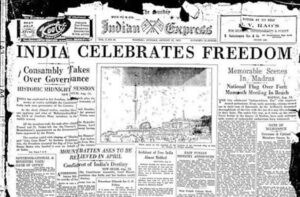
Historic front page of The Indian Express, August 15th of 1947 marking the dawn of a free India.
Introduction: 1947’s Dream, 1949’s Reality
On the midnight of August 15, 1947, as India awoke to life and freedom, the air was filled with celebration and hope for a new dawn. Yet for countless individuals especially the tenant farmers in the Konkan region of Maharashtra, this political independence felt distant and incomplete. For them freedom was not merely about the departure of a foreign power, it was about breaking the shackles of an oppressive centuries old system of servitude that governed every aspect of their lives. While the nation celebrated its newfound sovereignty, these farmers remained trapped in a state of bondage, their land, their labor, and their dignity held captive by a class of powerful intermediaries. Their struggle for true independence was far from over and their story is a poignant reminder that freedom is a battle that must be fought on many fronts, not just the political one.
The people who bore the brunt of this system were the agricultural tenants, many of whom belonged to the so-called “Depressed Classes”, including Mahars, as well as other cultivating communities like the Kunbis. For generations they had tilled the soil but they could never call it their own. They were living as quasi-serfs, their existence defined by economic exploitation and social subjugation under the thumb of landlords known as Khots. The Khots treated them as tenants-at-will, which meant they could be evicted from the land they cultivated at any moment, without reason or recourse. This perpetual insecurity was the foundation of their powerlessness. The tenants were forced to pay exorbitant rents, often amounting to more than half of their produce, and were subjected to a cruel system of forced labor known as “veth begar”. This meant they had to perform unpaid labor for the Khot, working in his house or on his personal lands, a practice that robbed them of their time, energy, and self-respect. The exploitation was relentless, extending to illegal cesses and arbitrary demands that left the farmers in a perpetual state of poverty and debt unable to escape the vicious cycle of dependency. Their lives were a testament to a system that was designed not just for economic gain, but for the assertion of social dominance and the perpetuation of a rigid caste hierarchy.(Suradkar,2013)
What was the Khoti System?
The Khoti system was a complex and deeply entrenched form of land tenure prevalent primarily in the Kolaba, Ratnagiri, and Thane districts of the Bombay Presidency. At its core, it was a system of revenue farming. The Khots were originally appointed by the British government as intermediaries responsible for collecting land revenue from the cultivators and paying a fixed amount to the state treasury. However over time their role mutated. They transformed from mere revenue collectors into powerful, hereditary landlords who exercised absolute control over the land and the people who worked it. The system stripped the actual tillers of the soil of any ownership rights reducing them to the status of serfs. While some tenants held the status of permanent tenants with some degree of security, a vast majority were tenants-at-will completely at the mercy of the Khot. The Khots wielded immense power, not just economically but also judicially and socially often settling disputes and imposing their will on the entire village. This created a parasitic class that thrived on the sweat and toil of the farmers, contributing nothing to agricultural improvement while extracting everything of value leaving the land and its people impoverished.(Bajantri & Mahalinga, 2024)
Despite the British administration’s attempts from 1864 to curb the exploitation by Khots, their oppressive practices only deepened over time. In many villages, tenant farmers or Kuls faced humiliating social restrictions like they were barred from wearing fine clothes in the presence of Khots and were forced to thatch their homes with grass bundles purchased exclusively from them. Khots also operated as moneylenders, trapping cultivators in cycles of debt while controlling vast tracts of land. In Bhendval village of Uran taluka for instance, 700 out of 960 acres belonged to Khots and in Kulaba district alone there were nearly 6,000 Khot creditors.
One notorious case was the Padave incident in Sindhudurg district, where a decades old land dispute escalated into violent conflict. In 1911, armed men supporting a powerful creditor attacked farmers, looted crops, and assaulted villagers including women while even blocking medical care for the injured. The clash left two creditors dead and in a sweeping verdict all farmers were sentenced. Tipago Herle, a Dalit farmer took sole responsibility and was condemned to death. To fight this miscarriage of justice the Padave Bachav Samiti was formed under the leadership of Rao Bahadur Bole. The Samiti successfully overturned the death sentence saving Herle’s life.(Wakode, 2015)
Into this world of despair and exploitation stepped Dr. B.R. Ambedkar, who emerged as a powerful champion for the oppressed tenants. He recognized that the Khoti system was not merely an issue of unfair land revenue, it was a form of social and economic slavery that was intrinsically linked to the caste system and was designed to keep the Depressed Classes in a state of perpetual subjugation. His fight against the system began to gain momentum in the 1930s. He believed that economic emancipation was a prerequisite for social equality and dedicated himself to dismantling this feudal structure. Dr. Ambedkar organized the peasant communities holding conferences like the one in Chiplun in 1929, to raise awareness and build a united front against the Khots. He did not just fight on the ground he took the battle to the corridors of power. Using his position as a member of the Bombay Legislative Council, he became the most vocal and articulate advocate for the abolition of the Khoti system. He meticulously studied the system, gathered data and presented a formidable case against it arguing that it was inefficient, unjust, and a barrier to both agricultural progress and human dignity.(Kumar, 2022)
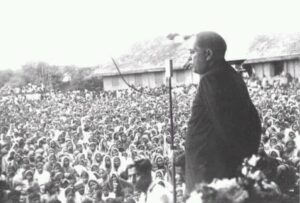
Dr. B.R. Ambedkar addressing a mass gathering.
When Freedom Reached the Fields
A crucial milestone in this long and arduous struggle was the introduction of the Khoti Abolition Bill by Dr. Ambedkar in the Bombay Legislative Assembly on September 17, 1937. This was more than just a piece of legislation it was a revolutionary document that sought to upend the entire feudal power structure of the Konkan region. The bill’s primary objective was simple yet profound: to make the actual tiller of the soil the owner of the land. It aimed to abolish the Khot’s role as a revenue intermediary and transfer all rights and privileges associated with the Khoti tenure directly to the government. The bill proposed to convert the Khot’s claims into a simple charge on the land, payable by the tenant, thereby severing the direct bond of servitude between the farmer and the landlord. The introduction of this bill was a moment of immense hope for the tenants but it was met with fierce opposition from the Khots and even from sections of the ruling Congress party who were hesitant to alienate the powerful landlord lobby. Though the bill did not pass in its original form at the time, its introduction was a landmark achievement. It forced the issue into the legislative spotlight, laid down the legal and moral framework for abolition and served as a powerful declaration that the end of this oppressive system was not just a possibility but an inevitability.(Moon & Narke, 2019)
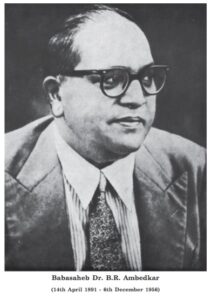
Portrait of Dr. B.R. Ambedkar (1891–1956) – Architect of the Indian Constitution and champion of the oppressed.
The seeds of change planted by Dr. Ambedkar and the relentless struggle of the tenant farmers finally bore fruit two years into India’s independence. The years of agitation, legislative battles, and social mobilization had created an undeniable pressure for reform. The new government which was built on the promise of justice and equality for all could no longer ignore the plight of the Konkan tenants. In 1949 the Bombay Legislative Assembly passed the Bombay Khoti Abolition Act, a historic piece of legislation that officially sounded the death knell for the centuries old system. The Act formally abolished the Khoti tenure, stripping the Khots of their special rights and privileges over the land and its revenue. It was the culmination of a decades long fight for dignity and justice. For the thousands of tenant farmers and their families, this was their true moment of liberation. While the nation had gained its freedom in 1947 their personal independence and freedom from forced labor, freedom from exorbitant rents, and the freedom to own the land they had cultivated for generations arrived with the passage of this Act. It was a long-overdue dawn, proving that the true measure of a nation’s freedom lies in the liberty and dignity it secures for its most vulnerable citizens.(Patel, 2025)
Concluding Thoughts
In the grand story of India’s independence, the abolition of the Khoti system reminds us that freedom is not complete until it reaches the fields, homes and lives of the most marginalised. The political midnight of August 15th of 1947, lit the flame of sovereignty and the Khoti Abolition Act of 1949 ensured that this light reached those who had long toiled in darkness.
Jai Hind!
References
1. Kumar, A., 2022. B R Ambedkar on caste and land relations in India. Review of Agrarian Studies, 10(1), January–June. Available at: AgEcon Search – Research in Agricultural and Applied Economics.
2. Bajantri, R. and Mahalinga, K., 2024. Ambedkar: As saviour of farmers’ rights. Cuestiones de Fisioterapia, 53(3), pp.5084–5089.
3. Patel, A.I., 2025. Dr. B.R. Ambedkar’s views on land reforms and agricultural sector: A critical analysis. Electronic International Interdisciplinary Research Journal, XIV(Special Issue II).
4. Suradkar, S.P., 2013. The Anti-Khoti Movement in the Konkan, c.1920–1949. NLI Research Studies Series No. 106/2013. NOIDA: V.V. Giri National Labour Institute. ISBN 978-93-82902-04-1.
5. Wakode, V.D., 2015. Dr. Ambedkar and Khoti Padhati. International Journal of Engineering and Scientific Research, 3(12).
6. Moon, V. and Narke, H. eds., 2019. Dr. Babasaheb Ambedkar: Writings and Speeches, Volume 2. New Delhi: Dr. Ambedkar Foundation, Ministry of Social Justice & Empowerment, Government of India. ISBN 978-93-5109-173-8.
Images
1. Indian National Congress, 2019. Indian Independence in Photographs. In: In Focus. All India Congress Committee (inc.in). 15 August. Available at: https://inc.in/in-focus/indian-independence-in-photographs (Accessed: 8 August 2025).
2. Navayan. Photo Gallery – Babasaheb Ambedkar. Available at: http://navayan.com/photo-gallery.php?name=babasaheb-ambedkar (Accessed: 8 August 2025).
3. People’s Archive of Rural India. Room: Dr. B.R. Ambedkar. Rural India Online. Available at: https://ruralindiaonline.org/en/library/rooms/dr-br-ambedkar/ (Accessed: 8 August 2025 ).